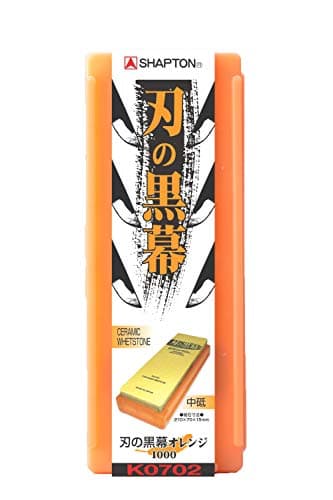
The single biggest reason people do not sharpen often enough is friction — the ten-minute soak before you can even start. The Shapton Kuromaku 1000 removes it. It is a hard, magnesia-bonded ceramic water stonethat is "splash-and-go": a splash of water on the surface and it is ready. It is the stone we recommend to sharpeners who have graduated from the King and want less maintenance without giving up the water-stone feel, and it is a pick in our best sharpening stones roundup.
What the spec sheet tells you
It is a single-grit 1000 ceramic stone, roughly 210 x 70 mm, that ships in a plastic case which doubles as a stand. Two words carry the whole review: ceramic and hard. A hard magnesia binder means the stone holds its shape — it dishes far more slowly than a soft combination stone, so you flatten it much less often — and it needs no soaking because it does not rely on absorbing water to cut. At 1000 grit it is a sharpening stone: it sets a clean, keen working edge on kitchen knives. It is not a finishing stone.
How it feels to use
Splash water on the surface, keep a consistent angle, and sharpen exactly as you would on any stone — raise a burr on the 1000 grit along the whole edge, flip and repeat, then remove the burr with light passes. The Kuromaku cuts quickly and cleanlyon both soft German and hard Japanese steel, and the hard surface gives a crisper, more precise feel than a soft King's muddy slurry. It stays flatter as you work, which means straighter edges over time and far less flattening. If you have only ever used a soft soaker, the first thing you notice is how much less fuss there is — no soak, no puddle of slurry, less mess to clean up.
The honest trade-offs
Three. First, it is a single grit — 1000 sharpens but does not polish, so you will want a finishing stone (a 5000/6000) or a strop if you want a refined, push-cutting edge. Second, it costs several times a King combination stone that also throws in a 6000 side, so on pure grits-per-dollar the King wins. Third, a harder stone gives less tactile feedbackthan a soft one — the reason we still start beginners on the King, which "talks back" as you find the angle. The Kuromaku rewards a sharpener who already knows what the burr feels like.
Who it's for — and who should skip it
Buy the Kuromaku if soaking is what stops you sharpening, if you want a stone that stays flat and clean, and if you already have the basic techniquedown. It is the "I sharpen regularly and want less ritual" stone. Skip it if this is your first stone and a tight budget (the King 1000/6000 teaches the skill for less and includes a finishing grit), or if you specifically want the maximum feedback of a soft surface. Pair it with a honing steel for maintenance between sharpenings.
Value
Good, once you value your time. You pay a premium over a soft combination stone and get a single grit — but you also get no soaking, far less flattening, a cleaner workflow and a stone that will outlast several soft ones. For a sharpener who actually sharpens on a schedule, that convenience is worth real money, because it is the difference between a stone you use and a stone you avoid. See how it stacks up against the soft and diamond options in best sharpening stones, and why splash-and-go matters in how to use a whetstone.