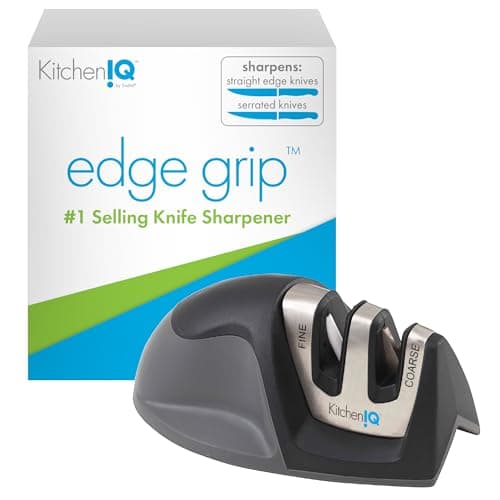
The KitchenIQ Edge Gripis the little pull-through sharpener you see near the checkout for around ten dollars. We include it because being honest about it is more useful than pretending it doesn't exist: it will make a butter-dull knife cut a tomato in ten seconds, and it is the wrong tool for any knife you care about. Both of those things are true at once, and knowing when each applies is the whole review.
What the spec sheet tells you
It's a two-stage pull-through: a carbide slot (coarse) to grind a fresh edge and a ceramicslot (fine) to refine it, both at a fixed, preset angle. The clever bit is the "edge grip" base — a lip that hooks over the edge of a counter so the whole thing stays planted and you can sharpen one-handed and safely. There's no angle adjustment and no finesse: you draw the blade through the slot and the fixed carbide or ceramic does the rest. It costs almost nothing and takes seconds to use.
What it's genuinely good at
Two things, and they're real. First, emergencies and rescue jobs: a truly dull cheap knife, a camp knife, a knife at a rental with nothing else around — a few pulls through the carbide slot and it cuts again. Second, safety and simplicity: the counter-gripping base makes it stable and idiot-proof, so anyone can use it without technique. As a glovebox, camping or just-need-it-to-cut-tonight tool on knives you don't care about, it does exactly what it promises for pocket change.
The honest trade-offs — and they're serious
Here's why it's the wrong tool for a good knife. The carbide slot tears metal— it scrapes away a lot of steel and leaves a coarse, toothy edge rather than a clean one, so it both damages the blade and produces an inferior edge. There's no angle control, so it imposes its own fixed geometry on whatever you feed it, which can ruin a thin or hard Japanese blade. And used regularly it shortens a knife's life fast, eating away far more steel than a stone ever would. This is the core reason pull-throughs turn up so often in why your knife won't get sharp and why it dulls so fast.
How it compares
Against literally anything that preserves an edge, it loses — and that's fine, because it's not trying to compete there. A beginner whetstone costs a little more and produces a vastly better, longer-lasting edge while removing far less metal. A guided system like the Work Sharp Precision Adjust gives foolproof andgood results. The KitchenIQ's only real edge is price and instant simplicity — the same trade, taken to its cheap extreme, that we cover in electric vs manual sharpeners.
Who it's for — and who should skip it
Buy the KitchenIQ as an emergency backup for cheap knives, a camp or car kit, or a spare for a household that will never learn to sharpen properly and just needs blades that cut. Do not make it your main sharpener, and never put a nice German or Japanese knife through it. If you own knives worth keeping, spend slightly more on a stone or a guided system and learn to hone— your edges and your knives will last far longer.
Value
Fair, strictly on its own terms. As a ten-dollar emergency tool for knives you don't care about, it delivers — stable, simple and instantly effective. As anything more than that, it's a false economy that quietly grinds your knives away. Buy it for the glovebox, not for the good knives — and see the tools that actually preserve an edge in best sharpening systems.