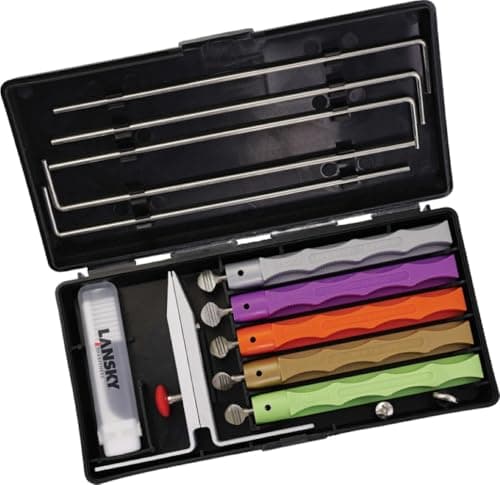
The Lansky Deluxe 5-Stone System is one of the cheapest ways to get genuinely consistent, guided sharpening angles. You clamp the knife, thread a guide rodthrough one of four preset angle holes, and stroke the mounted stone along the edge — the clamp holds the angle so you don't have to. Five grits take a blade from repair to polish. For the money it's a lot of capability, with one real limitation: it's happiest on smaller blades, not long kitchen knives.
What the spec sheet tells you
It's a clamp-and-guide-rod systemwith five stones running from extra-coarse to ultra-fine, and preset angles of roughly 17°, 20°, 25° and 30° per side via guide holes. That range covers everything from reprofiling a neglected edge to putting a fine polish on it. The whole thing packs into a small case. The key idea is that the mechanical clamp enforcesthe angle — the same principle as any guided system, at a fraction of the price of a fixed-base jig.
What it does well
The Lansky shines on small and pocket knives and on reprofilinga badly dull edge. Because the angle is fixed once you set it, results are consistent even for a beginner — you can't wander the way you can freehand. Having five grits in one kit means you can set a fresh bevel with the coarse stone and work up to a keen, refined edge without buying anything else, and the preset angles take the guesswork out of matching a knife. For folding knives, hunting knives and paring knives, it's a lot of sharpening system for very little money.
The honest trade-offs
Two real drawbacks. It's fiddly and slow— clamping the knife, threading the rod and stroking each side is far more setup than a few passes on a bench stone, so it tests your patience on a full set. And the small stones and clamp handle long chef's knives awkwardly: the clamp can struggle to grip a tall blade securely, and doing a long edge end to end with a short stone is tedious and can leave the very tip and heel uneven. It's a small-blade specialist thatcan do kitchen knives, not a kitchen-knife tool that also does small blades.
How it compares
Against the fixed-angle Work Sharp Precision Adjust, the Lansky is cheaper and more portable but slower and less comfortable on big kitchen blades — the Work Sharp is the better kitchen guided system. Against the Spyderco Sharpmaker, the Lansky sets a bevel from scratch better (five grits including coarse) while the Sharpmaker is quicker for touch-ups. And against a plain bench stone, the Lansky trades speed and edge control for guaranteed angle consistency — the classic guided vs freehand trade.
Who it's for — and who should skip it
Buy the Lansky if you mostly sharpen smaller knives— pocket, hunting, paring — want guaranteed angle consistency, and love the low price and portability. It's also a great way to reprofilea neglected edge cheaply. Skip it, or pair it with a bench stone, if your main job is long chef's knives: there the Work Sharp or a good stone is quicker and less fiddly. Whatever you sharpen with, keep the edge honest between sessions with a honing steel.
Value
Excellent for the price, with a clear caveat. As a cheap, portable, five-grit guided kit for small and medium blades, it's hard to beat and does exactly what it promises. As your only tool for long kitchen knives, it's slower and fussier than the alternatives. Match it to smaller blades and reprofiling work and you'll get a lot for your money; see the whole guided field in best sharpening systems.