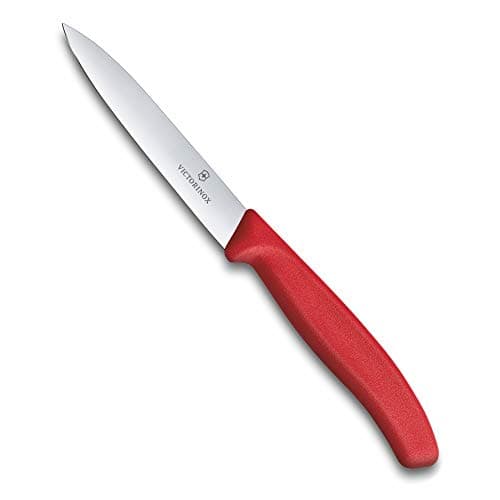
Most of this site is about where spending more money buys you a better knife. This page is about the one category where it mostly does not. Victorinox publishes a 3.9 in blade, 8.3 in overall, a weight of 1 oz, a polypropylene handle, a straight edge with a pointed tip, and a lifetime warranty, Swiss made. It also states plainly that the knife is dishwasher safe. It costs about what a decent sandwich costs.
A paring knife is a precision tool used at close range for short cuts, and the things that make an expensive chef's knife worth the money — hard steel that holds an acute edge through an hour of prep, a thin blade that does not wedge in a dense vegetable — barely matter when the blade is four inches long and the cut is a centimeter deep. What matters instead is weight, grip and sharpness, and this knife is excellent at all three for very little money.
What Victorinox publishes
The model is 6.7701in Victorinox's numbering (the red-handled Swiss Classic paring knife; the same knife sells in several handle colors under adjacent numbers). From Victorinox's own product page:
- Blade length: 3.9 in — it is sold as a 4-inch knife, and 3.9 in is the figure Victorinox prints.
- Total length: 8.3 in.
- Weight: 1 oz.
- Blade: stainless steel, straight edge, pointed tip. Not forged.
- Handle: polypropylene (PP), 0.9 in wide and 0.5 in high.
- Dishwasher safe: yes, per Victorinox.
- Origin: Switzerland — Swiss made.
- Warranty: Victorinox lifetime warranty.
What Victorinox does not publish for this model: a steel grade or a Rockwell figure. The product page says "stainless steel" and stops. Victorinox's kitchen cutlery is widely documented as X50CrMoV15 at roughly HRC 55–56 — the same recipe as the Fibrox Pro chef's knife — and the way this blade behaves on a stone is entirely consistent with that. But it is an inference from the brand's range, not a figure Victorinox states about this knife, and we are not going to present it as one.
The number that actually surprises people is 1 oz. That is not a rounding of something heavier; a paring knife this light disappears in the hand, which is the entire point of the category. For comparison, the chef's knives this site ranks run 6 to 8 oz. When you are coring a tomato or taking the eyes out of a potato, the weight of the tool is the thing most likely to make the cut clumsy.
Why cheap wins in this category specifically
Our paring knife ranking puts this knife first and a Damascus-clad Japanese paring knife last, which inverts the order of almost every other list on the site. The reasoning is worth setting out, because it is not inverse snobbery.
Edge retention barely matters at four inches. Edge retention is a function of how much cutting you do between sharpenings. A chef's knife does thousands of strokes through dense produce in a week; a paring knife peels a few apples. The soft steel that is a real compromise on an 8-inch chef's knife is close to irrelevant here — and it comes with a genuine upside, which is that it takes thirty seconds to bring back to screaming sharp on a stone.
Geometry barely matters either. Blade thickness decides whether a knife wedges as it travels through food, which is why 2.5 mm is the headline spec on a nakiri. A paring cut is short and shallow. There is no travel for the blade to wedge during. Blade geometry explains the mechanism and why it stops mattering at this size.
What does matter is grip and loss tolerance. Paring work happens in the hand rather than on a board, often with wet fingers and a wet apple, and the textured polypropylene handle grips in exactly those conditions. And paring knives get lost: they go into the drawer mixed in with the cutlery, they go out to the garden with the herbs, they end up in the dishwasher. A knife cheap enough to own three of, and cheap enough that losing one is an inconvenience rather than a loss, is a genuinely better tool than a beautiful one you are careful with.
This is also why professional kitchens are full of them. The Victorinox paring knife is standard issue in restaurant prep for the same reasons it is right at home: it is light, it is sharp, it grips wet, and nobody cries when it walks.
The dishwasher question, answered honestly
This site tells you not to put knives in the dishwasher, repeatedly and at length. Victorinox tells you this knife is dishwasher safe. Both things are true and the apparent contradiction is worth unpicking, because it is the most useful thing on this page.
The two standing reasons not to use a dishwasher are the handle and the edge. Dishwasher heat and detergent destroy glued or riveted wooden handles, which is why a Pakkawood-handled Japanese knife genuinely cannot go in. And the rack lets blades knock against other steel, which chips a hard thin edge.
This knife has neither vulnerability in the same degree: the handle is solid polypropylene with nothing to delaminate, and the edge is soft steel at a relatively obtuse angle that rolls rather than chips, and which you can restore in half a minute. Victorinox is not being careless — the specification genuinely tolerates it, and the brand backs it with a lifetime warranty.
Our honest recommendation is still to hand wash it. Not because the knife will break, but because a dishwasher dulls an edge faster than hand washing does, and because a loose paring knife in a cutlery basket is a hazard when someone reaches in. It takes four seconds to wash. But if the realistic alternative is that the knife sits dirty on the counter, put it in the dishwasher with a clear conscience — this is the one knife in the house where that is a defensible choice. Can you put knives in the dishwasher is the full version, and best dishwasher-safe kitchen knives ranks the knives that tolerate it best.
Spear point or bird's beak? And how long?
Victorinox sells this knife in several blade shapes and lengths, and picking the wrong one is the only real way to be disappointed.
The 4 in straight spear point — this knife — is the default. A straight edge with a pointed tip does the broadest range of paring work: peeling, coring, hulling, trimming, deveining, slicing a shallot in your hand. If you are buying one paring knife, buy this shape.
The 3 to 3.25 in versions are the same knife, shorter. They give a little more control for very fine work and a little less reach. If you have small hands or you mostly do detail work, they are worth considering; otherwise the extra inch is more useful than not.
A serrated paring knife is a genuinely different tool, and the one case for owning two. Small serrations bite through tomato and citrus skin without the squash that a straight edge causes when it has gone even slightly dull. Our ranking includes one for exactly this reason.
A bird's beak (a curved, hooked blade) is a specialist for turning vegetables and peeling round produce. Excellent at that, awkward at everything else, and not a first paring knife. What is a paring knife used for covers the jobs each shape suits, and do you need a paring knife is the prior question.
Living with it
Sharpening it is the easiest job in the kitchen. Soft steel, a short straight edge, no belly to track and no height to balance. A 1000-grit stone and two minutes restores it completely, and because the blade is short you can do the whole edge in a handful of strokes per side. How to sharpen a paring knife is the walkthrough. If you have been nervous about freehand sharpening, this is the knife to practice on — it costs almost nothing, so the stakes are nil.
A honing rod is mostly wasted on it. A 4-inch blade is short enough that you may as well just sharpen it, and a long rod is awkward with a short knife. Sharpening vs honing explains the difference; on this knife, skip to sharpening.
Keep the tip off hard things. The one way to actually damage this knife is to use the point as a lever — prying a pit out of an avocado, opening packaging, levering a lid. A thin 4-inch tip snaps. That is a user error, not a design flaw, but it is the failure mode.
Store it where the edge is protected. Loose in a drawer with the cutlery is how paring knives get dull and how fingers get cut. A slot in a block, a magnetic strip, an in-drawer tray or a cheap blade guard all solve it — best knife storage ranks the options and how to store knives in a drawer covers the cheapest fix.
Buy two. Not an upsell — a genuine recommendation at this price. One lives with the prep knives, one lives wherever you actually end up peeling things. Victorinox sells multi-packs of exactly this knife for this reason.
Who should not buy it
Anyone who wants a knife that feels substantial. One ounce of stamped steel and a plastic handle is the opposite of heft. If you like the reassurance of weight and a bolster, the forged Mercer Genesis paring knife gives you that for not much more, and a Wüsthof Classic gives you a lot of it for a lot more.
Anyone buying a gift. This is the right knife and the wrong present. It looks like what it is — a cheap red working tool — and unwrapping one communicates nothing. Our chef knife gift guide has things that read as gifts.
Anyone who wants a matching set. The Swiss Classic range is colored plastic. It does not match a block of forged German knives and it is not trying to. Best chef knife sets is the route if visual coherence matters to you.
Anyone who mostly cuts tomatoes and citrus. Buy the serrated version of the same knife instead, or alongside. A straight edge that is 90% sharp skates on tomato skin where small serrations bite.
Anyone who will use the tip as a lever. Buy something thicker and accept it will cut worse. This blade is thin and it will break rather than bend.
The verdict
The Victorinox Swiss Classic 4-inch paring knife is the easiest recommendation on this site, and the hardest one to make interesting. A 3.9 in blade, 8.3 in overall, one ounce, grippy polypropylene, Swiss made, dishwasher safe, lifetime warranty, and a price low enough to own several. It arrives genuinely sharp, it sharpens back in two minutes, and in the one knife category where premium steel and premium geometry stop paying for themselves, it does everything a paring knife is for.
Buy the Mercer Genesis paring knife instead if you want a forged, bolstered knife with real weight. Buy a serrated paring knife instead, or as well, if tomatoes and citrus are most of what you cut. Buy a Shun or a Wüsthof paring knife instead if it needs to match a set or look like an object — just know you are buying finish, not a better cut, which is a perfectly reasonable thing to buy with open eyes.
Honest limitations: Victorinox publishes no steel grade or Rockwell figure for this model; the steel is soft and dulls sooner than a hard Japanese blade; it is stamped, unbolstered and plain to look at; the thin tip snaps if you lever with it; and a straight edge is the wrong choice if your main job is tomato skin.
Where it sits on our lists: best paring knives, best kitchen knives and best chef knives for the money.