Skip to content
Bevel & Bone

HUB 04 · Reviews

Miyabi Kaizen II 8" Review

Zwilling's Japanese line, and about the keenest edge you can buy off the shelf — a hand-honed Honbazuke bevel on hard FC61 steel. Beautiful, and unforgiving.

By Stephen V.Updated How we choose
#ad

We earn a commission when you buy through our Amazon links, at no extra cost to you. It never changes a ranking, and we say so when the cheaper knife is the better buy. How this works.

The Miyabi Kaizen II is what happens when Zwilling — the German house behind the Pro S — builds a knife the Japanese way in its Seki, Japan factory. Where the Zwilling is heavy, soft and forgiving, the Miyabi is hard, thin and keen to a fault. It is one of the few off-the-shelf knives that arrives with a genuinely hand-finished edge, and it shows the moment it touches a tomato. The question is whether you can keep an edge this fine alive.

What the spec sheet tells you

The blade is FC61 — a fine-carbide stainless — forged and hardened to about HRC 60, then ground and hand-honed with the three-step Honbazuke process to roughly 9.5–12° per side. That last number is the story: most good Japanese knives sit around 15° per side, so a sub-12° Honbazuke edge is dramatically more acute — it falls through food with almost no resistance. The hard FC61 steel is what lets that thin edge hold; a soft German blade ground this fine would fold immediately. More on why hardness and geometry decide the cut in our steel guide.

How it feels to use

Effortless, and a little intimidating. The out-of-box edge is the keenest in our whole lineup — it scores a 10 on our out-of-box metric — and the Micarta handle and forged body feel like a knife you look forward to picking up. But the same geometry that makes it glide makes it the most chip-prone knife we cover: a very acute, very hard edge has no give. Hit a bone, twist through a squash, or drop it on a tile floor and you can take a chip out of the apex — and unlike a soft German edge that rolls back with a rod, this one has to be ground back on a stone.

Who it's for

A cook who already sharpens on a stone and wants the finest edge money can reasonably buy. It's a headline knife in our best Japanese chef knives and best chef knives in the world lists for that reason. It is emphatically nota first knife: if you can't yet maintain a hard Japanese edge, you'll chip it and be unable to fix it. Start on a Tojiro or Victorinox, learn the skill, then graduate to this.

Value

It's expensive, and the returns diminish sharply versus a Tojiro DPif you don't sharpen well — a dull Miyabi cuts worse than a sharp $75 knife. Judged as an object and an edge for someone who willmaintain it, though, it's the real thing: a hand-honed edge and hard steel with no marketing shortcuts. Buy it for the craft and the cut, not as a value play — the value knives live elsewhere on the site.
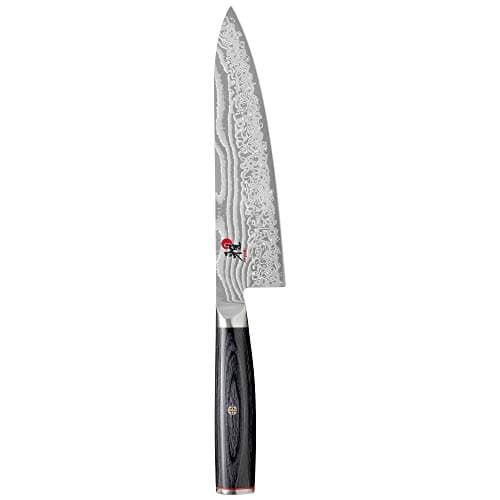
In detail

The knife, in detail

01
Miyabi Miyabi Kaizen II 8" Chef's Knife

The keenest factory edge here

Miyabi Kaizen II 8" Chef's Knife

8 in / 20 cmFC61 steel~HRC 60~9.5–12° edgeHonbazuke
8.4/10

Zwilling's Japanese line: a very hard, very acute edge with a hand-finished Honbazuke bevel.

Edge retention
9
Out-of-box edge
10
Handling
8
Build
9
Value
6

Pros

  • The hand-honed three-step Honbazuke edge is one of the most acute factory edges you can buy
  • Hard FC61 steel keeps that edge far longer than any German knife
  • Beautifully finished — this is a knife you look forward to using

Cons

  • A very acute, hard edge is the most chip-prone geometry in this roundup
  • Expensive, and the returns are diminishing versus a Tojiro if you don't sharpen well

Don't buy this if…

you can't yet sharpen a Japanese edge on a stone. A 10° edge this hard needs correct maintenance; without it you'll chip it and won't be able to fix it. Start on the Tojiro or Victorinox.

$189.95View on Amazon

Price as of Jul 28, 2026. Prices change — Amazon's is the one that counts.

#ad · we may earn a commission from this link to Miyabi Kaizen II 8" Chef's Knife

Questions

Frequently asked

Is the Miyabi Kaizen II worth the money?

For a cook who sharpens on a stone and wants the keenest factory edge available, yes — the hand-honed Honbazuke edge and hard FC61 steel are the genuine article. For anyone who won't maintain it, no: a dull Miyabi cuts worse than a sharp Tojiro a third of the price.

What is a Honbazuke edge?

Honbazuke is Miyabi's traditional three-step, hand-honed edge finishing — the reason the Kaizen II arrives ground to roughly 9.5–12° per side, far more acute than a typical 15° Japanese edge. It's what makes the out-of-box sharpness exceptional.

Does the Miyabi Kaizen II chip easily?

It's the most chip-prone knife we cover — a very acute, hard edge has no give. Keep it off bone and frozen food, never twist or pry, use a wood or plastic board, and hone/sharpen it correctly. Treated well it stays keen for a long time; treated like a German knife it will chip.

Miyabi Kaizen II vs Shun Classic — which premium Japanese knife?

The Miyabi has the more acute, hand-honed edge and a symmetric Micarta handle; the Shun adds Damascus looks but has a right-handed D-handle. Buy the Miyabi for the keenest edge, the Shun for the most beautiful blade.

Keep reading

Receipts

Sources

We do not run a test kitchen, and we do not pretend to. Specs are the manufacturer's published figures, attributed as such; where we could not verify something, we say so on the page rather than quietly leaving it out. Read our full method.