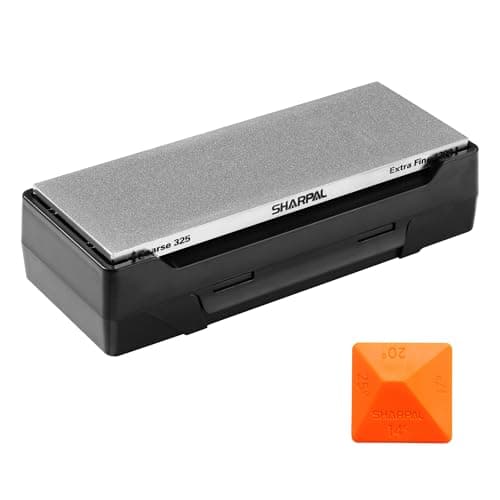
Most of what people dislike about learning to sharpen on a stone — the soaking, the slurry, the dishing, the flattening — is a property of soft water stones, not of sharpening itself. The Sharpal 162N sidesteps almost all of it. It is a dual-sided diamond plate — 325 grit on one face, 1200 on the other — bonded to a non-slip rubber frame, and it is the runner-up to the King in our best sharpening stones ranking for one reason: it is the lowest-maintenance way to put a genuinely sharp edge on a knife.
What the spec sheet tells you
Diamond is the hardest abrasive you can put on a bench stone, which drives every other trait. Because the diamonds are set in nickel and do not wear the way a bonded-abrasive stone does, the plate stays dead flat — it never dishes, so it never needs flattening, and there is nothing to soak. A splash of water (or nothing at all) and it cuts. The two grits are chosen well: 325 is a true coarse grit that repairs a chip or resets a badly dull edge fast, and 1200sets a clean working edge. The plate is 8 x 3 inches, big enough to run a chef's knife heel-to-tip in one stroke.
Where diamond genuinely wins
Two situations make a diamond plate the right tool over a water stone. The first is hard, wear-resistant steel. Very hard Japanese and modern powder steels chew through a soft water stone and dish it quickly; diamond cuts them fast and shrugs off the wear. The second is maintenance you will actually keep up with. A stone you have to soak for ten minutes and flatten every few sessions is a stone that stays in the drawer; a plate you can grab, splash and use is a stone you will actually reach for, and the best sharpening tool is the one you use. As a bonus, a coarse diamond plate is also the correct tool to flatten your soft water stones, so even committed water-stone sharpeners tend to own one.
The honest trade-offs
Diamond is not free of compromise. It leaves a toothier edge than a fine water stone — a 1200-grit diamond finish bites aggressively, which is great for tomatoes and rope and less so if you want a polished, push-cutting finish. There is no true polishing grit here, so if you want a refined, hair-splitting edge you will pair this with a 6000-grit water stone or a strop. And like every diamond plate it loses a little aggression as it breaks in— the very first sessions feel fastest, then it settles into a steady, long-lived cutting rate. The feedback is also flatter and more clinical than a soft King; you do not get the same tactile "bite" a beginner learns the angle from, which is exactly why we still send first-timers to the King.
Who it's for — and who should skip it
Buy the Sharpal if you want a no-fuss stone you will keep using, if you sharpen harder modern steels, or if you want one plate that both sharpens and flattens your other stones. It is the pragmatist's pick. Skip it if you are learning your very first freehand strokes and want the maximum feedback of a soft stone (start on the King 1000/6000), or if a mirror-polished finish is the whole point for you — diamond tops out toothy. Whichever you choose, hold a consistent angle and finish by checking the edge with a simple sharpness test.
Value
Excellent. A diamond plate costs more up front than a budget water stone, but it never wears out the way a soft stone does, never needs a separate flattening stone, and does double duty flattening any water stones you own — so over years it is arguably the cheaper tool. For a household that wants sharp knives without a ritual, it is the single most sensible sharpening purchase. Remember it only sharpens: keep the edge alive between sessions with a honing steel, and see where it ranks against the water and ceramic stones in diamond plate vs whetstone.