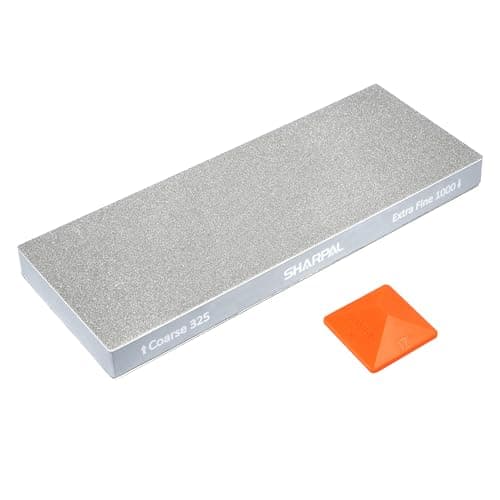
The Sharpal 168H is the diamond plate to buy if you have never sharpened a knife on a stone and you want the shortest path to a working edge. Two things earn it that recommendation and neither is glamorous: a full 8 × 3 incontinuous sharpening face, which gives you real room to steer an 8-inch chef's knife, and an Angle Pyramid guide in the box with preset references at 14°, 17°, 20° and 25°. Angle control is the single thing beginners get wrong, and this is one of very few stones at any price that ships with an answer to it.
There is also one ownership rule that is easy to miss and important: Sharpal says to use this plate dry or with honing oil, and explicitly not with water. That is the opposite of the habit most people bring from water stones, and the opposite of what DMT allows on its own diamond plates. More on why below.
What the spec sheet says
Sharpal and its US retailers publish a usefully specific set of figures for this plate — specific enough to check, which is more than most of this category manages.
- Grits: 325 coarse (45 micron) on one face, 1000 extra-fine (15 micron) on the other.
- Surface: 8 × 3 in (203 × 76 mm), continuous — no interruptions or holes — in electroplated monocrystalline diamond.
- Flatness: a precision-ground "MirrorFlat" surface with a published tolerance of ±0.002 in (0.05 mm).
- In the box: the plate, an anti-slip rubber pad, and the Angle Pyramid guide with four fixed reference angles.
- Lubricant: dry or honing oil. Sharpal says water should not be used.
- Weight: ~1.52 lb, per US retailer listings. Made in China.
The flatness figure is the one worth dwelling on, because it is a verifiable claim rather than a marketing adjective. A water stone dishes — it wears into a hollow in the middle, and a hollow stone puts a convex grind on your edge whether you want one or not, which is why flattening a whetstone is a chore every water-stone owner eventually learns. A diamond plate does not dish, because the abrasive is harder than the steel and does not yield. Sharpal putting a number on how flat theirs starts out is a small act of confidence.
The angle guide: what it does, and what it cannot do
This is the reason to buy the 168H over a plain plate, so it deserves an honest description rather than a sales one.
The Angle Pyramid is a small wedge with four faces cut at 14°, 17°, 20° and 25°. You sit it on the stone, lay the knife against the face matching your target angle to see what that angle looks like, then hold that attitude through the stroke. It does not clamp the blade and does not move with it. It is a visual and tactile reference, not a jig.
What that is worth. A great deal, actually, because almost nobody's mental picture of "about 15 degrees" is correct on their first attempt, and being 10 degrees out is the difference between sharpening a knife and rounding its edge over. Five seconds against the pyramid at the start of each session recalibrates your hand. For an absolute beginner, that is the gap between a stone that works and a stone that lives in a drawer.
What it is not. It is not a substitute for a clamped guided system. If you want the angle held mechanically for you, the Work Sharp Precision Adjust and the Lansky clamp the blade and remove the variable entirely — guided vs freehand sharpening is the honest comparison of the two approaches, and best sharpening systems ranks the clamped options. The pyramid teaches you the angle. It does not keep you there.
A note on which face to use: match the factory grind rather than the guide's roundest-looking number. Roughly 15° per side suits a hard Japanese knife and roughly 20° a softer German or Swiss one, so most kitchen work lands on the 14° or 17° faces, with 20° for German blades and 25° for tougher outdoor knives. The reasoning is in knife sharpening angle.
Why diamond, and what it costs you
Diamond plates and water stones solve the same problem differently, and the choice is a real one. Diamond vs whetstone is the full comparison; here is the short version as it applies to this plate.
What diamond buys you. It never dishes, so it never needs flattening. It needs no soaking and no setup — you take it out of the drawer and start. And it cuts fast on exactly the steels that wear a water stone down quickest, which means hard modern stainless at HRC 60 and up (see knife hardness explained) — a Shun Sora or a MAC MSK-65 is exactly the kind of blade this plate is for. For someone who sharpens four times a year, the no-maintenance argument is close to decisive: a water stone that needs flattening before you can use it is a water stone you will not use.
What it costs you. A toothier edge. Diamond at 1000 grit leaves a more aggressive, less polished apex than a 3000- or 6000-grit water stone, and if you want a mirror finish that pushes through a tomato under its own weight, this is not the tool. Sharpening stone grits explained covers what each range actually delivers. A toothy edge is arguably better for most kitchen work — it bites skin and crust — but it is a different edge, not a finer one.
Diamond plates also lose a little aggression as they break in. The first few sessions on a new plate are the fastest it will ever cut; it then settles to a stable rate and stays there for years. How long a whetstone lasts covers the arithmetic for both systems.
168H versus 162N: which Sharpal to buy
Sharpal's own lineup is the 168H's closest competition, and the 162N is our pick for most kitchens on best diamond sharpening stones.
They share the important things. Both are 8 × 3 in continuous diamond plates with a 325 coarse face and a non-slip base, and both include an angle guide.
Two things differ. The 162N finishes at 1200 grit against the 168H's 1000, and the 162N ships in a storage case that doubles as its base, where the 168H sits on a bare non-slip pad. The 162N costs meaningfully more as a result.
Which to buy. The grit difference between 1000 and 1200 is small enough that you will struggle to tell the two edges apart in a kitchen. The case is the real difference: a diamond plate stored loose in a drawer will get knocked against other metal, and the 168H gives you nothing to protect it with. If you have a shelf and a cloth, take the 168H and the savings. If the stone is going to live in a drawer with the rest of the kitchen hardware, the case on the 162N is worth paying for.
168H versus the DMT DuoSharp: continuous or interrupted
The other obvious alternative is DMT's DuoSharp, and the difference is the surface itself rather than the price or the grits.
DMT's DuoSharp uses an interrupted— "polka dot" — surface: the diamond is laid down in a dotted array with gaps between. The gaps clear swarf and stop the plate loading up, which is a genuine engineering advantage, and retailer listings put the abrasive area on an 8-inch DuoSharp at roughly 6 × 2 5/8 in rather than the full footprint — DMT publishes that figure for its DuoSharp Plus models rather than for the standard plate. The cost is feel: a narrow or pointed kitchen blade can catch on the hole edges, and most beginners find the sensation unsettling for the first few sessions.
The 168H is continuous. There is nothing to catch on, nothing to steer around, and the full 8 × 3 in is abrasive. For kitchen knives specifically, and for a learner in particular, continuous is the easier plate. The DuoSharp's compensations — it is made in the USA, and DMT permits water as well as dry use — are real; our DuoSharp review makes the case for it in full, and how to use a diamond sharpening stone works through the surface choice in more detail.
The water rule, and why it matters
Worth its own section because it is the thing people get wrong. Sharpal specifies dry or honing oil onlyfor this plate and says water should not be used. DMT, by contrast, says its plates can be used dry or with water. Same abrasive, different instruction — so follow the maker of the plate you actually own rather than the general advice you read about diamond stones.
Practically: sharpen dry if you want the least fuss, which works perfectly well and is how most people use these plates. Add a few drops of honing oil if you want to suspend and float off the swarf, which keeps the surface cutting cleanly for longer. Then wipe the plate down and dry it, because the slurry is steel dust and leaving it there achieves nothing. Water stone vs oil stone covers the lubricant question across stone types, and how to clean a whetstone covers the cleanup.
Who should not buy it
Anyone chasing a polished, hair-splitting edge. 1000 grit of diamond is a working finish, not a refined one. If a mirror-polished apex is the goal, finish on a 3000–6000 water stone or a strop; the plate alone will not get you there. Best sharpening stones for Japanese knives is the shortlist for that job.
Anyone with serious edge damage to repair. 325 is the coarsest face here, which is fine for a dull knife and slow for a chipped or badly reprofiled one. A dedicated 220 or extra-coarse plate removes metal far faster — how to fix a chipped knife edge sets out when you need one.
Anyone who already holds a steady angle freehand. The guide is most of what you are paying extra for over a plain plate. Without it, buy on grit pair, size and flatness instead, and the field is wider.
Anyone who wants the stone to do the thinking. A clamp-free pyramid still leaves the angle in your hands. If that is not acceptable, buy a clamped system and accept its own trade-offs instead.
Living with it
Use light pressure. This is the rule people break, and it matters more on diamond than on anything else: the abrasive does not yield, so excess force goes into the edge and into the nickel bond holding the diamonds down. Let the plate cut; your job is to hold the angle, not to lean on it. Technique is in how to use a whetstone — the strokes are the same — and the kitchen-knife-specific walkthrough is how to sharpen a chef knife.
Work the coarse 325 face until you have raised a burr along the whole edge, then flip to the 1000 to refine it and take the burr off. Leaving a burr on is the most common reason a freshly sharpened knife feels grabby and then goes dull within a week — how to remove a burr is the five-minute fix.
Store it where it will not be knocked against other metal. The plate itself is effectively permanent, but the diamond coating is a surface, and surfaces can be damaged. Since this one ships without a case, a cloth and a shelf will do.
The verdict
The 168H is the best first diamond plate we rank, and it wins that on two concrete things rather than on feel: a full 8 × 3 in continuous face that is forgiving of a wandering stroke, and an angle guide that addresses the one mistake beginners reliably make. The published ±0.002 in flatness tolerance is a specific, checkable claim in a category full of adjectives, and the 1000-grit finishing side goes a step finer than DMT's 600.
Buy it if you are new to sharpening, or if you sharpen rarely enough that a stone needing soaking and flattening would simply not get used. Buy the 162Ninstead if you want the storage case and the 1200-grit finish. Buy a DMT DuoSharp instead if US manufacture or water compatibility matters to you more than a smooth continuous stroke. And add a 3000–6000 water stone on top of any of them if a polished edge is what you are really after. Honest limitations: no case in the box, 325 is too fine to be a real repair grit, the guide is a reference rather than a jig, and it is a diamond edge — toothy by nature, not refined.
Where it sits on our lists: best diamond sharpening stones, best sharpening stones for beginners and best knife sharpening kits.