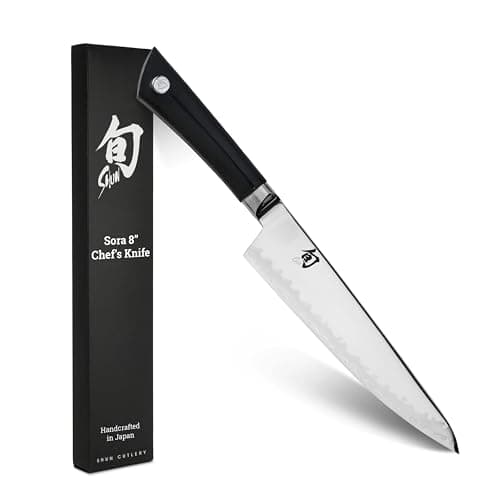
The Shun Sora is the knife you buy when you want what Shun is good at — a hard VG10 edge taken to 16° per side at ~HRC 60–61— and you are not willing to pay Classic money to get it. Shun's method for hitting the price is unusual and worth understanding before you buy: the Sora is not one piece of steel. It is two, brazed together, and the join is visible as a wavy line across the face of the blade. The premium steel sits only in the bottom third. That sounds like a compromise, and it is — but it is a compromise placed in the one spot where it costs you almost nothing.
What the spec sheet says
Shun and its US retailers publish a usefully complete set of numbers for this knife. The 8-inch (20 cm) blade stands 1.75 in tall at the heel on a 13.75 in overall length, the spine measures 2 mm at the heel, and the finished knife weighs 6.6 oz (188 g). The cutting edge is a three-layer san mai sandwich with a VG10 core, hardened to a published HRC 60–61 and hand-sharpened to a 16° double bevel. The upper portion of the blade is Japanese 420J stainless. The handle is a textured PP/TPE polymer blend. It is made in Seki, Japan, and carries a 10-year warranty.
Three of those figures decide whether this knife is worth your money, and it is worth being precise about which:
- VG10 at HRC 60–61 is the real thing. VG10 is the steel in knives at two and three times this price, including the Tojiro DP and most mid-range Japanese gyutos. At 60–61 it is meaningfully harder than the ~HRC 55–56 of a Victorinox Fibrox or the ~HRC 58 of a Wüsthof Classic, which is the whole edge-retention argument — knife hardness explained works through the Rockwell scale properly, and VG10 vs X50CrMoV15 puts this steel directly against the German standard.
- 16° per side is Shun's house angle, and it is deliberately not the sharpest option. Harder Japanese knives are often ground at 12–15°, and a Miyabi can go under 12. Shun's 16 is slightly more obtuse, which costs a sliver of initial keenness and buys back real chip tolerance — the single most useful trade a maker can make on a first Japanese knife. Knife sharpening angle explains why the number matters more than most spec sheets admit.
- 2 mm at the spine is thin, and it is the number nobody quotes. Edge angle only describes the last fraction of a millimeter of steel. What happens after that is set by how thick the blade is behind the edge, because a thick blade has to wedge food apart as the cut deepens. At 2 mm the Sora is as thin at the heel as a MAC, which is why it cuts better than its price suggests. Blade geometry is the full mechanism.
At 6.6 oz it is not a light knife by Japanese standards. A MAC HB-85 is ~4.9 oz and an MTH-80 ~6.5 oz; a Shun Classic 8 is ~7.5 oz. The Sora sits in the middle, closer to a Western knife in the hand than most gyutos.
The composite blade: what the braze line actually means
This is the part of the Sora that generates the most argument online, usually from people who have not looked at how it is built. The blade is made from two laser-cut sections — a san mai cutting edge and a 420J upper — fitted together and permanently joined by braze welding. The seam runs in a wave across the blade face, and Shun does not hide it. It is the knife's signature look.
The honest case for it. Steel above the edge does almost nothing. It is mass and stiffness; it never has to be hard. Using cheap stainless there and spending the budget on the lower part of the blade that does the cutting is a rational allocation, and it is why a knife at this price can carry a steel normally reserved for the shelf above. For the first years of ownership you will be sharpening the san mai section and nothing else.
The honest case against it. Two things. First, the 420J upper is soft, low-cost stainless, so the knife is only "premium" at the edge — it does not feel like a flagship Shun, and if fit and finish are what you are buying, this is the wrong knife. Second, there is a theoretical end point: sharpen a knife long enough and the edge migrates upward into the blade. In practice that is a decades-away concern on a kitchen knife — how many times a knife can be sharpened does the arithmetic — but it is a real structural difference from a fully clad blade, and anybody telling you otherwise is selling something.
Note what the Sora is not: it is not Damascus. The wavy line is a weld seam, not a forged pattern of layers. Damascus steel knives explained covers the difference, which matters because the Sora's face is frequently mistaken for the Classic's 68-layer cladding.
Sora versus Classic: what the extra money buys
The Classic is the Shun most people picture, and it is a pick on several of our lists, so this is the comparison that decides most Sora purchases.
Hardness and edge angle are the same. Both are published at ~HRC 60–61 and both are ground to 16° per side. On the two specs that decide how an edge behaves, these are siblings.
Four things differ. The Classic uses VG-MAXrather than VG10 — a Shun-specific formulation — clad in 68 layers of Damascus stainless across the whole blade, not just the lower third. It has a D-shaped Pakkawood handle instead of polymer. It is heavier, at ~7.5 oz against 6.6. And it costs roughly double.
Which to buy. If you want the knife to look and feel like a premium object on the magnetic strip, buy the Classic; the Sora will disappoint you and you will know it inside a week. If you want the cutting performance and would rather put the difference toward a stone, the Sora is the smarter purchase, and the gap in how they cut is much smaller than the gap in what they cost. Our Shun Classic 8 review covers that knife in full, and Shun vs Wüsthof sets the brand against the German default.
Sora versus Tojiro DP: the comparison that should worry Shun
The Tojiro DP gyuto is the knife that makes the Sora a harder sell than Shun would like, and we rank it above the Sora on best Japanese chef knives for beginners.
The Tojiro is also a VG10 core at ~HRC 60, also three-layer san mai — but the cladding runs the full blade rather than stopping a third of the way up, the blade is 210 mm rather than 200, the grind is a touch more acute at ~15°, and it typically sells for less. What the Sora gives you in exchange is a better handle for most Western hands (textured polymer that grips wet, against the Tojiro's hard riveted scales), a slightly more chip-tolerant 16° edge, and Shun's 10-year warranty with a US service network behind it. Tojiro vs Shun is the full head-to-head.
Put plainly: if you buy on steel per dollar, buy the Tojiro. If you buy on how the handle feels and want a brand that will answer the phone, the Sora earns its premium.
What it is like to use
The handle is the most conventional thing about any Shun, and that is the point. Where the Classic's D-shaped wooden handle is a Japanese shape that favors a right-handed pinch grip, the Sora's PP/TPE polymer is a symmetrical Western shape with real texture. It grips when your hands are wet or oily, which smooth Pakkawood does not, and it is indifferent to whether you are left- or right-handed. Knife handle materials explained covers the trade; the short version is that polymer is the practical choice and wood is the nice one.
In the hand, the 6.6 oz weight and the 2 mm spine pull in different directions, and the result is a knife that feels more substantial than it cuts. It is not the gliding, almost-weightless feel of a MAC. It falls through an onion with noticeably less force than a German knife at the same price, but you are aware of holding a tool rather than a scalpel. For a cook stepping off a Victorinox, that familiarity is a feature, not a flaw — how to hold a chef's knife matters more to your results than the knife does.
The 8-inch length is the default most kitchens settle on for good reason, and the 1.75-inch blade height gives enough knuckle clearance to rock-chop without scraping the board. Chef knife sizes explained works through why 8 inches wins.
Who should not buy it
Anyone buying for looks. Said once more because it is the most common Sora regret: the two-tone composite face and plain polymer handle read as a budget knife, because that is what they are. It cuts like a Shun. It does not look like one.
Anyone whose knife meets bone. At HRC 60–61 behind a 16° edge, the steel is harder than the bone it meets and surrenders a chip rather than rolling over. Jointing chicken, splitting ribs or working a frozen edge will damage this knife where a soft German blade would simply deform and hone straight again. Keep a cheap tough blade for that work — best knives for cutting meat is the split most professional kitchens run, and how to fix a chipped knife edge is what it costs you when you forget.
Anyone who will not sharpen. A traditional grooved steel rod barely bites at HRC 60 and mostly skates off. Keeping this edge needs a fine ceramic rod between sessions and a whetstone when it genuinely dulls, which is an ownership cost to budget for before you buy rather than after — ceramic vs steel honing rod explains why the rod in your knife block probably will not do.
A shared or careless kitchen. Hard steel rewards good habits and punishes bad ones. If this knife will end up in a sink, in a dishwasher, or scraping diced onion off the board with its edge, buy a Victorinox and be happier for less money.
Living with it
Hand wash and dry it immediately, every time. The polymer handle survives a dishwasher better than riveted wood would, but the edge does not survive knocking against racks and the soft 420J upper is not proof against detergent pitting — can you put knives in the dishwasher is the full answer. Use a wooden or soft plastic board, never glass, stone or a ceramic plate. Store it where the thin edge is protected rather than loose in a drawer, per how to store kitchen knives.
For sharpening, a 1000-grit stone does the work and a 3000–6000 finishes it. That pairing is the range in most kitchen kits — best knife sharpening kits ranks those on completeness — and best sharpening stones for Japanese knives is the shortlist for hard steel specifically. If you would rather not learn to flatten a stone, a diamond plate such as the Sharpal 168H does the same job with no maintenance and an angle guide in the box. Technique is in how to sharpen a chef knife. Hold 16° rather than chasing something finer; Shun chose that angle for a reason, and a learner who thins it to 12 will spend the next month repairing chips.
The verdict
The Sora is an honest piece of engineering surrounded by slightly dishonest noise. The composite blade is not a cost-cutting scandal — it is cheap steel put where steel does not matter and good steel put where it does, and the result is a VG10 edge at HRC 60–61 behind a 2 mm spine for roughly half of Classic money. What you give up is the look, the wooden handle, the full-blade cladding and about an ounce of reassuring heft.
Buy it if you want a first Japanese knife with a grippy Western handle and a brand behind it. Buy the Tojiro DP instead if you want more steel for the money and do not mind a harder handle. Buy the Shun Classicinstead if you want the object as well as the edge. And buy a Victorinox instead if your kitchen is hard on knives — nothing at HRC 60 is the right answer to a careless household.
Where it sits on our lists: best Japanese chef knives for beginners and best Japanese chef knives. For the brand in context, see the best chef knife brands, and for the honest case for and against hard thin steel, are Japanese knives worth it.