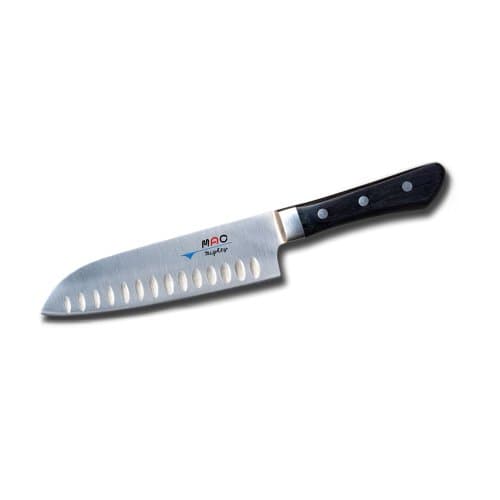
The MAC MSK-65 is the santoku to buy if you want the thing MAC is actually good at — a very thin, hard blade that needs almost no force to cut — in the shape that suits how most home cooks work. At a published 1.9–2.0 mm spine, roughly HRC 60–61, a 15° per side grind and about 6 oz in the hand, it is our top pick on best santoku knives. It is also several times the price of a Victorinox that does 80% of the same work, so the interesting question is not whether it is good. It is whether the last 20% is worth it to you.
What the spec sheet says
MAC publishes some of this and its US retailers publish the rest, and the two disagree slightly, which is worth being upfront about. MAC's own listing gives a 6.69 in blade, 1.82 in blade height, 11.69 in overall length, a 2.0 mm blade thickness and 6.0 oz. US retailers publish the blade as a round 6.5 in at 1.9 mm at the heel and 6.1 oz (176 g), with the steel at HRC 61 and the grind at 15° double bevel. Treat the differences as rounding on the same knife, not as two products.
The steel is MAC's high-carbon molybdenum-vanadium stainless, sub-zero tempered — MAC says this version "retains its edge better than our original steel." Construction is the Professional series format: thin blade, stainless bolster, triple-riveted black Pakkawood handle, made in Japan, with a 25-year warranty from US retailers. MAC does not publish a Rockwell figure on the product page itself; the HRC 60–61 range comes from retailers and from Korin, which lists HRC 60 for the brand.
Three numbers do the work here, and they compound:
- ~HRC 60–61 is genuinely hard. A Victorinox santoku sits at ~HRC 55–56, a Mercer Genesis at ~HRC 56, a Wüsthof Classic santoku at ~HRC 58. Harder steel supports a finer apex and loses it more slowly, which is the edge-retention claim and the one that holds up. Knife hardness explained covers the Rockwell scale properly.
- 15° per side is acute, where a German santoku is typically ground nearer 20° (the Wüsthof hollow-edge santoku is an exception at ~10°). Harder steel supports a thinner edge without folding it over, which is why Japanese makers grind more acutely, and a more acute edge needs less force to start a cut.
- 1.9–2.0 mm at the spine is the under-discussed number. Edge angle only describes the last fraction of a millimeter. What happens after that is set by how thick the blade is behind the edge, because a thick blade has to wedge food apart as the cut deepens. Two millimeters is thin by any standard, and on a vegetable knife it is the spec that matters most — blade geometry is the full mechanism.
Together those three are why a 6 oz knife out-cuts a 9 oz forged one on an onion. It is not doing it with mass; it is doing it by being thin and keen enough that mass is not needed.
Why a santoku, and why 6.5 inches
A santoku is the Japanese home-kitchen all-rounder: shorter than a chef's knife, flatter along the edge, taller at the heel, and finished with a blunt sheepsfoot tip instead of a point. What is a santoku knife is the full explainer, and chef knife vs santoku is the direct comparison.
What those shape changes buy, concretely:
- The flat profile suits push-cutting and chopping. A chef's knife has a curved belly designed to rock. A santoku is nearly straight, so the whole edge meets the board at once. If you chop rather than rock, the santoku wastes less of its edge.
- The height gives knuckle clearance. At ~1.8 in tall, this blade keeps your hand off the board through a long dice.
- 6.5 inches is more maneuverable than 8. On a crowded board, in a small kitchen, or in smaller hands, a 6.5-inch blade is simply easier to control — which is why the MSK-65 also appears on best chef knives for small hands.
What you lose is reach and a tip. The blunt sheepsfoot will not pierce, core, or do detail work, and 6.5 inches is not enough blade to break down a squash or a chicken in one pass. A santoku is a vegetable and everyday-prep knife that happens to be good at most other things, not a one-knife kitchen. Santoku vs nakiri covers the next step in that direction, and gyuto vs santoku covers the step back toward a full chef's knife.
The dimples: do they actually do anything?
The MSK-65 is the hollow-edge (dimpled, "granton") version, and MAC's own claim is modest and accurate: the dimples help the knife move through food with less resistance. MAC does not publish a dimple count, depth or pattern.
The mechanism is real but narrow. Dimples break the suction that makes wet, starchy slices cling to the blade face. On potato, cucumber, zucchini and anything you are cutting thin and wet, that is a genuine convenience — slices fall away instead of stacking up on the blade. On dry work, on meat, on herbs, they do nothing at all, and they do not make the knife cut better in any sense that a thinner grind would. What is a granton edge separates where they help from where they are decoration.
Our honest read: on a santoku specifically, dimples are worth having, because slicing wet produce thin is exactly what this knife shape is for. On a bread knife or a boning knife they are marketing. If the dimpled MSK-65 is unavailable and the plain MAC santoku is in stock at a better price, you are not giving up much.
MSK-65 versus the MTH-80: which MAC to buy
This is the real question for anyone already sold on the brand, because the MAC MTH-80 is the knife MAC is famous for and our top pick on best chef knives.
The steel, hardness and grind are the same family. Both are MAC's high-carbon molybdenum-vanadium stainless at roughly HRC 59–61, both dimpled, both ground near 15° per side, both Professional series with a bolster and Pakkawood. On every spec that decides how the edge behaves, these are siblings.
Shape and size are the whole difference. The MTH-80 is an 8-inch chef's knife with a curved belly, a point, and ~6.5 oz of mass. The MSK-65 is a 6.5-inch santoku with a flat edge, no point, and ~6 oz. They weigh nearly the same; they do not handle the same at all.
Which to buy. If you own one knife, buy the MTH-80 — a chef's knife does everything a santoku does plus the piercing, the tip work and the big-vegetable breakdown. If you already own a chef's knife and most of your prep is vegetables and daily dicing, the MSK-65 is the one you will reach for, and it will out-handle the 8-incher on a small board. If budget is the constraint, the MAC HB-85is the cheapest honest way into the brand's steel. For the brand against its closest rival, see MAC vs Shun.
MSK-65 versus the Victorinox: the value question
The Victorinox Fibrox Pro granton santoku is our value pick on the same roundup, and it costs a fraction of the MAC. It is worth stating plainly what the extra money buys, because it is less than the price gap implies.
The Victorinox is ~HRC 55–56 stamped X50CrMoV15 with a textured Fibrox handle. It arrives very sharp, it is light and nimble, it grips when wet, it is NSF-certified, and it is the easiest knife in the category to learn to sharpen on because the soft steel gives up a burr in minutes. What it does not do is hold that edge. You will hone it more often and sharpen it more often, and at 55–56 it will never take quite the apex the MAC takes.
So: the MAC buys you a keener edge that lasts several times longer, a thinner blade that wedges less, and a knife that feels like an object rather than a tool. The Victorinox buys you a santoku you will not grieve over. If your kitchen is shared, busy, or hard on knives, that second thing is worth more than the first.
What it is like to use
The defining characteristic is how little force it needs. A 2 mm blade at HRC 60–61 behind a 15° edge falls through an onion rather than being pushed through it, and across a long prep session that is the difference you notice — not sharpness in the abstract, but the absence of effort. It is also why the MSK-65 earns a place on best knives for cutting vegetables.
The balance sits near the bolster rather than out at the tip, which suits a pinch grip, and the 6.5-inch blade is short enough that the knife feels controlled rather than whippy. How to hold a chef's knife applies unchanged to a santoku.
The handle is the weakest part, honestly. Triple-riveted Pakkawood is well shaped, hard and smooth — fine dry, and noticeably less secure than a textured Fibrox or Santoprene handle when your hands are wet or oily. It is also the part a dishwasher destroys.
Who should not buy it
Anyone whose knife meets bone. At HRC 60–61 behind a 15° edge, this steel is harder than the bone it meets and gives up a flake rather than bending. Jointing chicken, splitting ribs or hacking at a frozen edge will chip this knife where a soft German blade would roll and hone straight again. Keep a cheap tough blade for that work — best knives for cutting meat is the split most professional kitchens run.
Anyone who wants one knife. A 6.5-inch blunt-tipped blade cannot do everything. If this is the only knife in the drawer, buy an 8-inch chef's knife instead and come back for a santoku later.
Anyone who will not maintain it. A traditional grooved steel rod barely bites at HRC 60 and mostly skates off. Keeping this knife at its best needs a whetstone or a fine ceramic rod, which is a real ownership cost to budget for before you buy — ceramic vs steel honing rod explains why the rod in your block probably will not do.
A shared or careless kitchen. Hard steel rewards good habits and punishes bad ones. If the knife will end up in a sink, in a dishwasher, or scraping diced onion off a board with its edge, buy the Victorinox and be happier.
Living with it
Hand wash and dry it, every time. The dishwasher is what kills triple-riveted wooden handles, and it is the fastest way to ruin this knife — can you put knives in the dishwasher is the full answer. Use a wooden or soft plastic board, never glass or stone. Store it where the thin edge is protected rather than loose in a drawer, per how to store kitchen knives.
For maintenance, a fine ceramic rod between sharpenings and a whetstone when it genuinely dulls. A 1000-grit stone does the work and a 3000–6000 finishes it, which is the range in most kitchen kits — best knife sharpening kits ranks those on completeness, and best sharpening stones for Japanese knives is the shortlist for hard steel specifically. The technique for this blade shape is in how to sharpen a santoku knife — a flat edge is easier to sharpen than a curved one, which is a small, real bonus of the shape. If you would rather skip stone maintenance entirely, a diamond plate like the Sharpal 168H never needs flattening and ships with a four-angle guide.
The verdict
The MSK-65 is the best santoku we rank, and it earns that on three published numbers rather than on vibes: HRC 60–61, a 15° grind, and a 1.9–2.0 mm spine. The dimples are a real feature on this blade shape rather than decoration, the 6.5-inch length is more useful to more home cooks than its 8-inch sibling, and the flat profile makes it both a better chopper and an easier knife to sharpen.
Buy it if you already own a chef's knife, your prep is mostly vegetables, and you will look after hard steel. Buy the MTH-80instead if this is your only knife. Buy the Victorinox instead if your kitchen is hard on knives or the price gap matters — it is 80% of the knife for a small fraction of the money, and there is no shame in that answer. Honest limitations: a smooth hard handle that is less secure when wet, a blunt tip that rules out detail work, no published Rockwell figure from MAC itself, and the chipping risk that comes with every blade at this hardness.
Where it sits on our lists: best santoku knives and best gifts for home cooks under $150. For the brand in context see the best chef knife brands, and for the honest case for and against hard, thin steel, are Japanese knives worth it.