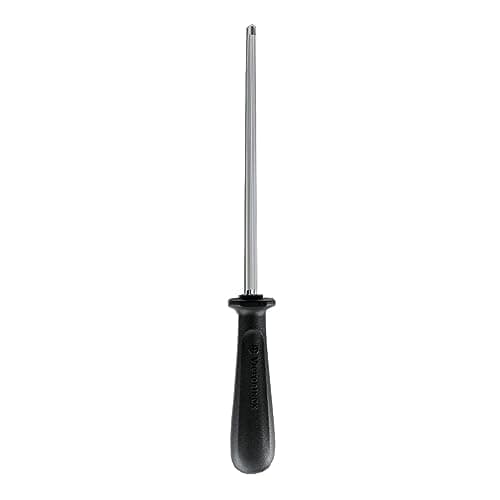
A honing steel is the most misunderstood tool in the kitchen and one of the most useful, and the Victorinox Swiss Classic 10-inch rod is the one we point most people to first. It comes from the maker of the default chef's knife, it costs very little, and it does the one job a hone is supposed to do — realign a rolled edge — without any nonsense. It is a top pick in our best honing steels roundup.
What a honing steel actually does
First, the thing everyone gets wrong: a honing steel does not sharpen a dull knife. As you cut, the thin edge rolls over microscopically to one side and stops feeling sharp; a fine steel rod realigns that rolled edge back to center, restoring the sharpness that was there — it removes almost no metal. Sharpening, on a stone, grinds a whole new edge. You hone often (every few uses, seconds) and sharpen rarely (every few months). Get that distinction straight and half of "my knife won't get sharp" disappears — the full explanation is in sharpening vs honing.
What the spec sheet tells you
It is a fine-cut steel rod, 10 inches (25 cm) of working length, with a grippy Fibrox handle and a finger guard. Two details matter. The fine cut (fine longitudinal grooves) realigns an edge gently, without stripping metal — a coarse rod eats your blade; a fine one just straightens it. And 10 inchesis long enough to hone an 8-inch chef's knife with room to spare, so the whole edge passes the rod in one clean stroke. The same Fibrox handle as the Victorinox knives grips even when your hands are wet, which — with a honing rod — is a safety feature, not just a comfort one.
How it feels to use
Honing is a fifteen-second habit: hold the rod vertical (tip on a cutting board is the safest beginner method), match the knife's edge angle, and draw the blade down and toward you, heel to tip, a few light strokes per side. The full motion is in how to hone a knife. The Victorinox rod is light, well balanced and does exactly this with no drama. Do it before or after a session and your knife keeps feeling freshly sharp for far longer between actual sharpenings — which for a soft German blade is the single highest-value habit you can build.
The one real limitation
A traditional steel rod barely bites on very hard Japanese blades (HRC 60+). The rod is only about as hard as a soft German edge, so on a hard Shun or Miyabi it mostly slides off without realigning much. If your knives are hard Japanese steel, you want a fine ceramic rod instead, which is harder than the edge and actually bites — the full comparison is in ceramic vs steel honing rod. For the soft German and stainless knives most people own, though, this rod is exactly right.
Who it's for, and value
Buy it if you own soft German or general stainless knives (a Victorinox, Mercer, Wüsthof or the like) and want the cheap, correct daily hone. Skip it only if all your knives are hard Japanese steel — then buy the ceramic rod. On value it is unbeatable: it costs a fraction of a knife, lasts a lifetime, and the honing habit it enables does more to keep your knives cutting well than almost any upgrade. It is the tool we recommend buying with your first knife, not after it. See the ranked alternatives in best honing steels.