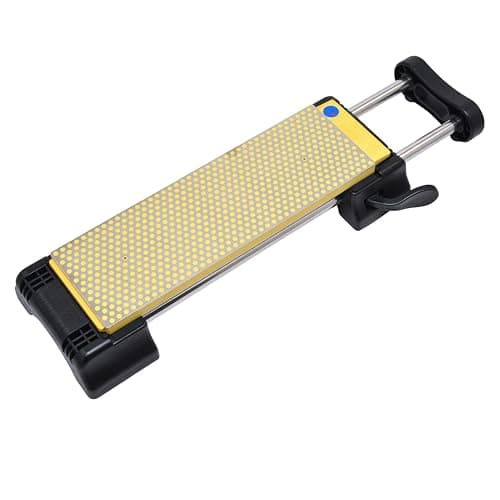
The DuoSharp is the plate to buy if you want a sharpening stone you will never replace. DMT publishes the specification plainly: a coarse face at 45 micron / 325 mesh and a fine face at 25 micron / 600 mesh, both in micronized monocrystalline diamond, on a double-sided 8-inch plate that ships with a bench stone base, made in the USA. DMT's guidance is equally plain: no oil needed, sharpen dry or with water.
There is one thing about it that nobody selling it leads with, and it is the reason this plate is our number two rather than our number one: the diamond is laid down in an interruptedpattern — a grid of raised dots with gaps between them — rather than as a continuous face. That is a genuine engineering advantage on some tools and a genuine nuisance on others. Which one it is for you depends on what you plan to sharpen on it.
What DMT publishes
DMT's own product page for this SKU (W8FC-WB, the 8-inch DuoSharp bench stone, fine/coarse, with base) is specific about the things that matter:
- Coarse side: 45 micron, 325 mesh, color-coded blue — for restoring a dull or neglected edge quickly.
- Fine side: 25 micron, 600 mesh, color-coded red — for finishing to a working sharp edge.
- Abrasive: micronized monocrystalline diamond.
- Surface: interrupted surface technology across the standard DuoSharp line.
- In the box: the plate plus a bench stone base accessory.
- Lubricant: no oil needed; sharpen dry or with water.
- Origin: made in the USA — DMT manufactures in Marlborough, Massachusetts.
- Plate size: the no-base version of the same plate (W8FCNB) is published at 8 × 2 5/8 in, 3/8 in thick.
One figure we will not state as DMT's: the exact abrasive area. Retailer listings for the 8-inch DuoSharp family put the interrupted surface at roughly 6 × 2 5/8 in per side, and DMT publishes that figure for its DuoSharp Plusmodels rather than for this standard plate. So treat it as a retailer figure: the usable abrasive is meaningfully smaller than the 8 × 2 5/8 in footprint, by an amount DMT does not state for this SKU.
The color coding is worth a sentence because it is more useful than it sounds. Every DMT grit has a fixed color — blue for coarse, red for fine — so once you own two DMT plates you can tell them apart across the room without reading anything. Small thing, but it is the kind of detail that comes from a company that has made one product for decades.
The interrupted surface: the whole argument about this plate
This is the section that should decide your purchase, so it gets the most space.
What the dots do well. Sharpening produces swarf — a slurry of removed steel and loosened abrasive. On a continuous plate, that swarf sits on the surface and progressively clogs it, so the plate cuts more slowly until you clean it. The DuoSharp's gaps give the swarf somewhere to go, which keeps the diamond biting for longer within a session and means less interruption to wipe the plate down. On wide, flat tools — a chisel back, a plane blade, a lawn tool — it is a straightforwardly better surface.
What the dots do badly. A narrow or pointed kitchen blade can catch on the edges of the holes. You feel it as a series of small ticks through the handle as the edge crosses each gap, and on the tip of a thin Japanese knife it is unsettling the first few times. It is not usually damaging — the dots are raised land rather than sharp steps — but it is the opposite of the smooth, continuous feedback that tells a beginner whether they are holding their angle. Freehand sharpening is largely a feel skill, and this plate gives noisier feel than a continuous one.
How much it matters, honestly. It depends on the blade and the user. Sharpening a wide 8-inch chef's knife across the plate's width, most people stop noticing within two or three sessions. Working the tip of a paring knife or a petty, you will notice it every time. If this is your first stone and kitchen knives are all you will ever sharpen, a continuous plate is the easier purchase — which is why best diamond sharpening stones ranks the continuous Sharpal 162N first and this one second.
Why 325/600 is the pairing most kitchens need
A two-grit plate has to answer two questions: can it bring back a truly dull knife, and can it leave an edge you are happy to cook with? The 325/600 combination answers both, and it is worth understanding why those two numbers rather than something finer.
325 does the metal removal. 45-micron diamond is aggressive. It will reset a kitchen knife that has not been sharpened in two years in a handful of minutes, and it will reprofile a bevel if you ask it to. It is too fine to be a true repair grit — a chipped edge wants something coarser, and how to fix a chipped knife edge covers that job — but for ordinary dullness it is plenty.
600 is a working finish, not a polished one. Be clear about this before you buy: 600 grit of diamond leaves a toothy edge. It bites tomato skin and bread crust well and it will shave hair off your arm, but it is not the mirror apex a 6000-grit water stone produces, and it is a step coarser than the 1000 and 1200 faces on the two Sharpal plates we rank. Sharpening stone grits explained sets out what each range actually delivers.
For most home cooks, a toothy working edge is arguably the right edge — it is better on skins and crusts than a highly polished one, and it stays usable longer because there is less refined apex to lose. If you want a push-cutting polish, finish on a 3000–6000 water stone or a strop afterwards; how to strop a knife is the cheap version of that step.
The base, and why it is more than packaging
This SKU includes DMT's bench stone base. A no-base version of the same plate exists at a lower price with a non-skid mat instead, and the difference is worth paying for.
A double-sided plate has a problem a single-sided one does not: it cannot sit flat on a towel, because the face you are not using is the face holding it up. Resting abrasive diamond directly on a counter is bad for the counter and worse for the plate. The base holds the plate off the surface and stops it sliding, which turns a two-handed balancing act into an ordinary bench setup.
It also raises the plate, which matters more than it sounds for technique. Sharpening is easier when the stone is at a height where your forearm can travel in a straight line, and a plate lying flat on a countertop is usually too low. How to use a whetstone covers the setup — the strokes are identical on diamond.
Dry or water: DMT's rule, and why it differs from Sharpal's
DMT says: no oil needed, sharpen dry or with water. That is a usefully permissive instruction and it is not the same as every diamond plate's.
Sharpal's 168H, by contrast, specifies dry use or honing oil and says water should notbe used. Same abrasive, opposite instruction — which is the whole lesson: follow the maker of the plate you actually own rather than general advice about diamond stones. On the DuoSharp, a little water floats the swarf away and keeps the surface cutting cleanly; dry works fine and is less mess. Either is correct here.
What you should do afterwards, in both cases, is wipe it. The slurry is powdered steel, and leaving it on the plate achieves nothing. How to clean a whetstone covers it, and water stone vs oil stone explains why oil on a stone is a one-way decision you do not have to make with this one.
DuoSharp versus the plates we rank around it
Versus the Sharpal 162N (our top pick). The Sharpal is a continuous 8 × 3 in plate with 325 and 1200 faces. It is wider, smoother to use, and finishes a step finer. The DuoSharp is made in the USA, permits water, includes a proper bench base, and clears swarf better. On price the two sit close. For kitchen knives specifically, the continuous face is the easier plate; for mixed tool and knife work, the DuoSharp is the more useful one.
Versus the Sharpal 168H (the beginner plate). The 168H is continuous, 8 × 3 in, finishes at 1000, and ships with a four-angle guide — which addresses the one thing beginners reliably get wrong. If you have never sharpened on a stone, that guide is worth more than anything the DuoSharp offers. The DuoSharp's answer is durability and US manufacture.
Versus the Norton IM200 oilstone system. The Norton is the traditional alternative: three graded stones in an oil reservoir. Cheaper per year, beginner-proof in its holder, and messier — and oil is permanent, because a stone that has had oil on it can never go back to water. The DuoSharp is the low-commitment choice.
Versus DMT's own single-sided Dia-Sharp plates. DMT also sells continuous-surface plates, and a single-sided coarse one is our pick for edge repair and for flattening water stones. If the interrupted surface is what is putting you off the DuoSharp, the answer within DMT's range is a continuous Dia-Sharp rather than a different brand — you lose the second grit and gain a smoother stroke.
Versus a water stone. The real question for most people. Diamond vs whetstone is the full comparison. The short version: diamond never dishes so it never needs flattening, never needs soaking, cuts hard modern steel fast — a Miyabi Koyaat 61 HRC is exactly the kind of blade that wears a water stone down quickest — and tops out toothier. A water stone finishes finer, gives better feedback, costs less, and is a chore. If you sharpen four times a year, buy diamond, because a stone that needs flattening before you can use it is a stone that stays in the cupboard.
Living with it
Light pressure. The rule that matters most on diamond. The abrasive does not yield, so excess force goes into your edge and into the bond holding the diamonds down. Let the plate cut; your job is only to hold the angle. On an interrupted surface there is a second reason: heavy pressure is what makes a thin tip catch on a hole edge rather than skate over it.
Expect it to slow down, once. A new diamond plate is the fastest it will ever be, because the tallest diamond particles sit proud and break off or settle in the first few sessions. It then reaches a stable cutting rate and stays there for years. How long does a whetstone last runs the arithmetic for both systems. A DuoSharp outlasting a decade of household use is an ordinary outcome, not an optimistic one.
Coarse until there is a burr, then fine. Work the 325 face until you can feel a burr along the entire edge, flip to the 600 to refine it, then remove the burr. Leaving one on is the most common reason a freshly sharpened knife feels grabby and goes dull within a week — how to remove a burr is the fix, and how to sharpen a chef knife is the full kitchen walkthrough. The diamond-specific technique notes are in how to use a diamond sharpening stone.
Do not press it into service as a lapping plate. DMT's own grit table says that unless a plate is designated Dia-Flat, it should not be used for lapping, and the DuoSharp is not. A dotted surface does clear slurry well, which is why interrupted plates get recommended for flattening water stones in general — but DMT's restriction is on this plate specifically, so use a plate designated for the job instead; how to flatten a whetstone covers the right tools.
One buying note. DMT's own direct store and third-party retailers price this plate very differently, and DMT's site has shown it out of stock while other sellers have it. It is worth checking more than one listing before you buy — the spread on this SKU is wider than it is on most sharpening gear.
Who should not buy it
Anyone sharpening their first kitchen knife. The interrupted surface gives noisier feedback exactly when you are trying to learn what good feedback feels like, and this plate has no angle guide. The Sharpal 168H is the better first plate, and it is not a close call.
Anyone who mostly sharpens small or pointed blades. Paring knives, petties, boning knives and fillet knives are where the dots are most intrusive. A continuous plate is simply nicer for that work.
Anyone chasing a polished edge. 600 grit is a working finish. If a mirror apex is the goal, you need a fine water stone or a strop on top of this, and at that point a 1000/6000 water stone may be the better purchase — best sharpening stones for Japanese knives is that shortlist.
Anyone with a chipped or badly damaged edge to fix. 325 is the coarsest face here and it is not a repair grit. You want something extra-coarse first.
Anyone who wants the widest plate for the money. At 2 5/8 in, the DuoSharp is narrower than the 3-inch plates we rank, and the interrupted pattern means less of that width is abrasive. There is less room to track a long blade than the numbers on the box suggest.
The verdict
The DuoSharp is the most durable sharpening purchase on this site and close to the last one you would ever need to make: both of the grits a kitchen knife realistically requires, monocrystalline diamond that will not dish or need flattening, a bench base in the box, and American manufacture from a company that has made nothing else for decades. If you want a buy-once tool and you also sharpen chisels, plane irons or garden tools, this is the plate — the interrupted surface is an advantage on everything flat and wide.
Buy the Sharpal 162N instead if kitchen knives are all you sharpen and you want a wider, smoother, finer-finishing face. Buy the Sharpal 168H instead if this is your first stone and you want the angle guide. Buy a 1000/6000 water stone instead if a polished, push-cutting edge is what you are really after, and accept the soaking and flattening that comes with it.
Honest limitations: the interrupted surface catches thin and pointed blades and gives noisier feedback than a continuous plate; 600 is the finishing limit, which is a working edge rather than a refined one; 2 5/8 in is narrow and the abrasive area is smaller still, by an amount DMT does not publish for this SKU; 325 is too fine to be a real repair grit; there is no angle guide; and it should not be used for lapping stones.
Where it sits on our lists: best diamond sharpening stones and how to use a diamond sharpening stone.