Skip to content
Bevel & Bone

HUB 01 · Chef Knives

Best Boning Knives Under $50

This is one of the few categories where $50 buys the whole useful range. Four boning knives ranked, and the flex grade that decides which one you want.

By Stephen V.Updated How we choose
#ad

We earn a commission when you buy through our Amazon links, at no extra cost to you. It never changes a ranking, and we say so when the cheaper knife is the better buy. How this works.

The verdict: buy the Victorinox Fibrox Pro 6" curved semi-stiff. It is the right boning knife for the cook who breaks down chicken and trims their own roasts — semi-stiff is the compromise flex that handles both, and the textured Fibrox handle grips when your hands are covered in fat. The budget pick is the Victorinox Swiss Classic 6" narrow flexible, the cheapest knife here that does the job, and the one to buy if what you actually cut is fish. Prices render live from the price layer with the "as of" date printed under the table.

Boning knives are the rare category where a $50 ceiling costs you almost nothing. Four knives in our registry carried a verified live price under $50 at the last price check, and they cover every flex grade the category has. Above $50 you are buying a forged bolster and a nicer handle; you are not buying a blade that follows a bone better. Both premium boning knives on best boning knives cost roughly three times the top pick here and score no higher.

Flex grade is the entire decision

Everything else — steel, hardness, handle material — is secondary. Flex is published, and it decides whether the knife helps you or fights you.

  • Stiff. For heavy trimming, large primals and working along a big bone where you want the blade to go exactly where you push it. Fights you on poultry: it cannot follow the curve of a thigh joint.
  • Semi-stiff. The compromise, and the right default for a home kitchen. Firm enough to drive along a bone, flexible enough to follow a curve. If you are buying one boning knife and you are not sure, this is it.
  • Flexible / narrow flexible. For fish and for skinning, where you want the blade to bend along a rib cage or ride flat under a skin. On a shoulder or a primal it wanders, because that is what flexibility means.

Blade length barely varies — all four of these are 6 inches, which is the standard for a reason: long enough to reach along a chicken thigh, short enough to control with the tip inside a joint. What is a boning knife used for covers the jobs, and boning knife vs fillet knife is the distinction that trips people up: a fillet knife is simply a long, fully flexible boning knife, and the Swiss Classic below is the closest thing to one in this price band.

Who each pick is for

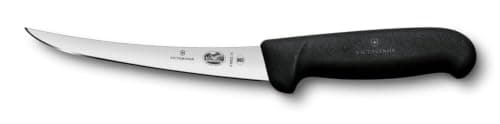
Victorinox Fibrox Pro 6" curved, semi-stiff — for the cook who breaks down chicken and trims roasts. X50CrMoV15 stainless, graded semi-stiff, stamped, with a Fibrox Pro TPE handle, Swiss made and NSF-certified. The curve is the second important spec after flex: it lets you ride the blade around a joint instead of approaching it straight on. Victorinox publishes no edge angle for this model, so that cell in the matrix is blank. It is also our overall number one on best boning knives and one of the seven knives on best kitchen knives.

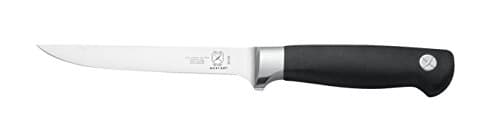
Mercer Genesis 6" stiff — for heavy trimming and large cuts. Forged, full-tang, with a bolster, graded stiff. This is the knife for someone buying primals or trimming a lot of fat, where you want the blade to go exactly where you push it and you do not need it to follow a curve. Forged construction at this price is genuinely unusual, and the extra mass behind the handle is steadying. It is the wrong knife for poultry.

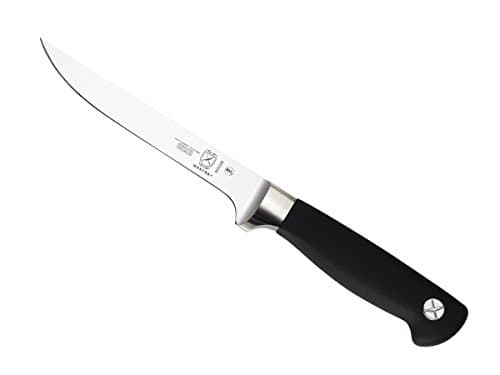
Mercer Genesis 6" flexible — for the cook who wants forged build and flex. The same forged Genesis platform, graded flexible instead of stiff. Choose it over the stiff version if most of what you cut is fish and poultry rather than roasts, and over the Swiss Classic if you want a bolster and a heavier handle.

Victorinox Swiss Classic 6" narrow flexible — for fish, and the budget pick. Narrow and fully flexible, stamped, on a polypropylene handle. It is the cheapest knife here and the most specialised: outstanding at filleting and skinning, and genuinely poor at trimming a shoulder, because a flexible blade follows whatever resistance it meets. Buy it knowing what it is for. Best knives for cutting fish is where it really belongs.

What $50 does and does not buy

Worth being specific, because this is a page defined by a price ceiling.

  • You get every flex grade. Stiff, semi-stiff and fully flexible are all represented above. Nothing about the category is gated behind a higher price.
  • You get forged construction, twice. Both Mercer Genesis picks are forged with a full tang and a bolster, which is what most buyers are actually reaching for when they spend more.
  • You get NSF certification. The Victorinox Fibrox is certified for commercial kitchens, which is as close to a durability guarantee as this category offers.
  • You do not get hard steel. Every knife here is a softer European stainless in the mid-HRC-50s. That is correct for this job: a boning knife contacts bone and cartilage constantly, and hard steel chips where soft steel rolls. Hardness is the wrong thing to want here — knife hardness explained.
  • You do not get a handle that feels expensive. Two of these are molded polymer. They work, they grip wet, and they are not beautiful.

Prices move. The live number under each row is the one that counts and it carries the date it was fetched; if a pick rises above $50 between refreshes, the figure on the page will say so rather than quietly contradicting the headline.

Keeping a boning knife sharp

A boning knife dulls faster than almost anything else in the drawer, because it spends its life scraping along bone. The upside is that soft European steel comes back on a stone in minutes, and these are cheap enough that aggressive sharpening is not a worry.

Hone before each session — how to hone a knife — and sharpen on a 1000-grit stone when honing stops helping. How to sharpen a boning knife covers the awkward part, which is that a narrow flexible blade bends away from the stone unless you support it. A guided system handles that better than freehand for most people — best sharpening systems.

The verdict

Buy the Victorinox Fibrox Pro 6" semi-stiff if you are buying one boning knife. It is the flex grade that handles both poultry and roasts, the handle works with greasy hands, and nothing above $50 does the job better. Buy the Mercer Genesis stiff if you trim primals, the Mercer Genesis flexible if you want forged build with flex, and the Victorinox Swiss Classic narrow flexible if what you actually break down is fish. All four are cheap enough that the second one is a reasonable purchase if your cooking spans both ends.
The short answer

Quick picks

#ad · Live prices from the Amazon Product API, as of November 19, 2026. Where we have no verified live price we show none — we'd rather leave a gap than print a number that has rotted.

By the numbers

The specs, side by side

Every figure below is the manufacturer's published specification. Where a maker doesn't publish a value, the cell reads "—" rather than a number we made up.

Knife / ToolBladeFlexSteelHardnessEdgeConstruction
Victorinox Fibrox Pro 6" Curved Boning Knife, Semi-Stiff6 in (15 cm), curvedSemi-stiffX50CrMoV15 stainless~HRC 55–56—Stamped, Fibrox Pro (TPE) handle, ~3.4 oz
Mercer Culinary Genesis 6" Stiff Boning Knife (M20106)6 in (15.2 cm), narrowStiffHigh-carbon German no-stain~HRC 5615° per sideForged one-piece, full tang, thick bolster, Santoprene handle
Mercer Culinary Genesis 6" Flexible Boning Knife (M20206)6 in (15.2 cm), narrowFlexibleHigh-carbon German no-stain——Forged, full tang, thick bolster, Santoprene handle, ~7.4 oz
Victorinox Swiss Classic 6" Narrow Flexible Boning Knife5.9 in (15 cm), narrowFlexibleHigh-carbon stainless~HRC 55–56Tapered, ground in two directionsStamped, TPE handle, ~2.6 oz

In detail

The picks, in full

01
Victorinox Victorinox Fibrox Pro 6" Curved Boning Knife, Semi-Stiff

The best boning knife overall

Victorinox Fibrox Pro 6" Curved Boning Knife, Semi-Stiff

6 in / 15 cmSemi-stiffCurvedSwiss madeNSF
8.0/10

The knife on the butcher's bench and in the culinary-school kit, for the price of a good lunch. Semi-stiff is the grade that handles the most jobs, and this is the cheapest honest way to own it.

Edge retention
6
Out-of-box edge
8
Handling
9
Build
7
Value
10

Pros

  • Semi-stiff is the most useful single flex grade — enough spine to drive through a chicken joint, enough give to follow a rib
  • Costs a fraction of the forged blades here and is the knife working butchers actually reach for
  • Soft-ish steel comes back to shaving sharp on a stone in a couple of minutes, which matters on a knife that meets bone
  • The textured Fibrox handle stays grippy with wet, greasy hands — the single most important safety feature on a boning knife

Cons

  • Stamped and plain; there is no heft, no bolster and nothing handsome about it
  • Softer steel dulls faster than the Japanese or German blades, so expect to sharpen more often
  • Victorinox publishes no edge angle for it, so that spec cell is blank rather than guessed

Don't buy this if…

…you mainly fillet fish or skin poultry, where a genuinely flexible blade does the job better and a semi-stiff one fights you. Buy the Swiss Classic or the Wüsthof flexible instead.

$28.91View on Amazon

$35.0017% off

Price as of November 19, 2026. Prices change — Amazon's is the one that counts.

#ad · we may earn a commission from this link to Victorinox Fibrox Pro 6" Curved Boning Knife, Semi-Stiff

02
Mercer Culinary Mercer Culinary Genesis 6" Stiff Boning Knife (M20106)

Best stiff boning knife

Mercer Culinary Genesis 6" Stiff Boning Knife (M20106)

6 in / 15.2 cmStiffForged15° edgeNSF
7.8/10

A genuinely forged, full-tang stiff boning knife at a stamped-knife price. If you break down pork shoulders or beef primals, this is the grade you want.

Edge retention
6
Out-of-box edge
8
Handling
8
Build
8
Value
9

Pros

  • A stiff blade transmits force directly — it drives through a joint instead of flexing away from it
  • Forged, full tang and bolstered at a price where nearly everything else is stamped
  • Mercer publishes a real 15° edge angle and HRC 56±1, which most makers in this bracket do not
  • NSF-certified Santoprene handle keeps its grip through fat and cold water

Cons

  • Soft at around HRC 56 — you will hone it often and sharpen it more than the Shun
  • The thick bolster adds security but also weight the Victorinox does without
  • A stiff blade is the wrong tool for fish, and it will not follow a ribcage

Don't buy this if…

…you bought a boning knife to fillet fish or skin chicken breasts. Stiff is the opposite grade for that work — take the flexible Genesis, which is the same knife with the spine ground thinner.

$34.49View on Amazon

Price as of November 19, 2026. Prices change — Amazon's is the one that counts.

#ad · we may earn a commission from this link to Mercer Culinary Genesis 6" Stiff Boning Knife (M20106)

03
Mercer Culinary Mercer Culinary Genesis 6" Flexible Boning Knife (M20206)

Best mid-price flexible

Mercer Culinary Genesis 6" Flexible Boning Knife (M20206)

6 in / 15.2 cmFlexibleForgedFull tangNSF
7.4/10

The forged flexible blade for people who will not spend three figures. Same Genesis build as the stiff version, ground thin enough to follow a fish.

Edge retention
6
Out-of-box edge
7
Handling
8
Build
8
Value
8

Pros

  • Forged and full-tang flexibility for a fraction of what Wüsthof charges for the same combination
  • The narrow flexible blade skins, trims fat and lifts fish fillets cleanly
  • Grippy NSF Santoprene handle — the practical choice for messy protein work

Cons

  • Mercer publishes no hardness or edge angle for this SKU, so both cells are blank rather than borrowed from the stiff version
  • At ~7.4 oz it is the heaviest knife here, which is odd on a blade sold for finesse
  • Soft German steel; edge retention is ordinary

Don't buy this if…

…you want the lightest possible touch on fish. The heft works against you — the 2.6 oz Victorinox Swiss Classic is far more delicate, and much cheaper.

$43.63View on Amazon

Price as of November 19, 2026. Prices change — Amazon's is the one that counts.

#ad · we may earn a commission from this link to Mercer Culinary Genesis 6" Flexible Boning Knife (M20206)

04
Victorinox Victorinox Swiss Classic 6" Narrow Flexible Boning Knife

Best budget boning knife

Victorinox Swiss Classic 6" Narrow Flexible Boning Knife

5.9 in / 15 cmFlexibleNarrow~2.6 ozSwiss made
6.8/10

The cheapest honest way to find out whether you need a boning knife at all — and at 2.6 oz, the most delicate blade here on fish and poultry skin.

Edge retention
5
Out-of-box edge
7
Handling
7
Build
5
Value
10

Pros

  • Costs less than a takeout meal and is a genuinely capable knife, not a toy
  • At ~2.6 oz it is the lightest blade here by a wide margin — you feel the skin line through it
  • Swiss made, dishwasher tolerant, and cheap enough that you will not baby it

Cons

  • Stamped, with no bolster and no finger guard — you must be deliberate about hand position
  • The thinnest, most flexible blade here is also the easiest to bend permanently if you lever with it
  • Build quality is functional; this will not be the knife you keep for twenty years

Don't buy this if…

…you work through bone regularly. A thin flexible blade near a joint is how people bend knives and cut themselves — the stiff Mercer or the semi-stiff Victorinox is the safe grade for that job.

$26.85View on Amazon

Price as of November 19, 2026. Prices change — Amazon's is the one that counts.

#ad · we may earn a commission from this link to Victorinox Swiss Classic 6" Narrow Flexible Boning Knife

How we picked

We do not run a test kitchen

We compiled each product's published specifications — steel, hardness, edge geometry, weight — normalized them into the matrix above, and scored each one against a published rubric. The scores are judgments from those specs and the value math — they are not measurements we took, because we do not have a test kitchen and we're not going to pretend we do. Units we claim to have tested: 0.

Questions

Frequently asked

What flex should a boning knife be?

Semi-stiff, if you are buying one. It is firm enough to drive along a bone and flexible enough to follow the curve of a joint. Buy stiff if you trim large primals and want the blade to go exactly where you push it, and fully flexible if what you cut is fish, where you want the blade to bend along a rib cage.

Can you get a good boning knife under $50?

Yes — this is one of the few knife categories where $50 buys the whole useful range. Every flex grade is available under the ceiling, two of the four picks are forged with a full tang and a bolster, and one is NSF-certified. The premium boning knives on our main roundup cost around three times as much and do not score higher.

What is the difference between a boning knife and a fillet knife?

Mostly flex and length. A fillet knife is a long, fully flexible boning knife optimised for riding along fish bones and under skin. A boning knife is shorter and usually firmer, built for poultry joints and meat trimming. The narrow flexible Victorinox on this page sits closest to a fillet knife.

Should a boning knife be curved or straight?

Curved, for poultry and joint work — the curve lets you ride around a joint rather than approach it head-on. Straight blades suit large, flat trimming jobs. Our top pick is curved and semi-stiff, which is the most generally useful combination in a home kitchen.

Why is hard steel wrong for a boning knife?

Because the blade contacts bone and cartilage constantly. Hard steel chips on impact where soft steel rolls, and a rolled edge comes back with a few passes on a rod. Every knife on this page is a softer European stainless in the mid-HRC-50s, and that is the right choice rather than a cost compromise.

Keep reading

Receipts

Sources

We do not run a test kitchen, and we do not pretend to. Specs are the manufacturer's published figures, attributed as such; where we could not verify something, we say so on the page rather than quietly leaving it out. Read our full method.