The verdict: the Messermeister Avanta 4-piece is the steak knife set to buy under $100. It is the only set in this band with a published edge specification — a straight 15° per side at ~HRC 57 — which means it arrives genuinely sharp and can be put back that way for as long as you own it. The budget pick is the Henckels Solution 8-piece, and it exists for one reason: it sets eight places for less than most decent four-piece sets cost. The Mercer Genesis 7-piecesits between them as the forged serrated option for six. Prices render live from the price layer with the "as of" date printed under the table.
Three sets, not six. This page ranks only sets that carried a verified live price under $100 at the last price-layer run. The Dalstrong Gladiator straight-edge four and the Wüsthof Classic four are both good and both sit above the ceiling, so they are ranked on best steak knives rather than here. The Victorinox Swiss Classic 6-piece — which would otherwise be the obvious value answer in this band — showed no buyable offer at all when the price layer last ran, so it is named here rather than silently omitted. If it comes back, it belongs on this list.
The one specification that decides this band
Under $100 you are not choosing between good steel and better steel. Every set here is ordinary stainless at a hardness the maker mostly will not publish, and none of them is a metallurgical achievement. The decision is edge type: straight or serrated, and it is permanent.
A straight edgeslices. It parts the fibers of a steak instead of tearing them, so the cut face looks like one a chef's knife made, and it can be sharpened on the same stone you already own for as long as the knife exists. The price is that it goes blunt like any other edge, and it tells you honestly when it has. If a stone is never going to happen in your kitchen, a straight edge becomes a worse knife every year.
A serrated edgesaws. The points sit proud of the cutting surface, so they stay sharp while the recessed scallops do the cutting, and a serrated steak knife will stay usable for a decade with zero maintenance. The price is that it tears rather than slices — look closely at the cut face of a steak and you can see it — and that no practical home sharpening exists for it. When it finally dulls, you replace the set.
Neither is a quality judgement. It is a judgement about you. How to sharpen a serrated knife is the realistic version of what maintaining the serrated option involves, and knife edge types explained covers the geometry.
The criteria, in the order they mattered
- Is the edge specification published? Most makers will not tell you the hardness or the grind angle of a steak knife, because at this price there is usually nothing flattering to say. The one set here that does publish both went straight to the top, and that is not an accident of our rubric — it is the single most reliable signal of whether a maker took the blade seriously.
- Cost per place setting, not cost per set. A four-piece set at $72 and an eight-piece set at $45 are not in the same conversation. If your table seats six or eight, the arithmetic of a four-piece set is that you buy two of them and blow straight through the $100 ceiling.
- Handle material, because this is a greasy-fingers knife. A steak knife is handled mid-meal with butter, fat and wine on your hands. POM and Santoprene both stay grippy wet and both tolerate a dishwasher; smooth plastic does neither as well.
- Full tang and rivet count. Steak knives get levered against plates and bone, and the failure mode at this price is a handle that loosens. A full tang with three rivets is the cheapest insurance against that, and all three picks have one.
- A verified live offer under the ceiling. Every pick carried a live price below $100 at the last price-layer run. That is also how availability was checked: a live API price means a buyable offer, not a listing we hope still exists.
The three picks
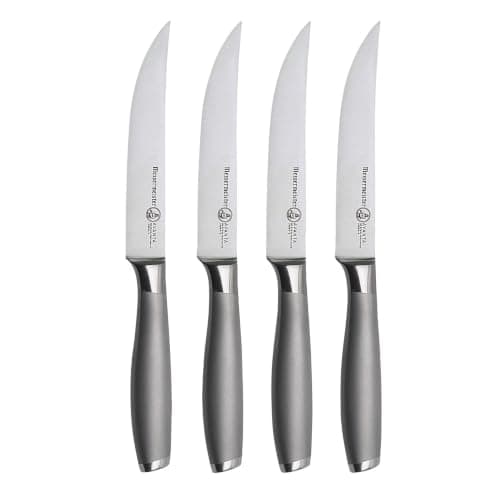
1. Messermeister Avanta 5" fine edge, 4-piece — the top pick, and the only published edge in the band. A straight 15° per side on German X50 high-carbon stainless at ~HRC 57, full tang, triple-riveted, flat-ground, on POM handles. That specification is the whole argument: 15° is keener than most chef's knives ship at, ~HRC 57 is a real hardness figure rather than "stainless," and the combination means this set arrives sharp enough that you notice at the table. It is also the only set here you can put on a stone in five years and have back as new — the same stone, at the same angle, you already use for everything else.
Honest cons:four knives. A six- or eight-place table needs two sets and the price doubles straight past this page's ceiling. A straight edge does go blunt, and unlike serrations it will not hide it — these are knives you have to actually maintain. The plain black POM handles are functional rather than handsome; nothing here is heirloom tableware. And Messermeister publishes no blade weight for the set, so that figure is absent rather than estimated.
Don't buy if you will never sharpen anything. The entire case for a straight edge is that you maintain it.
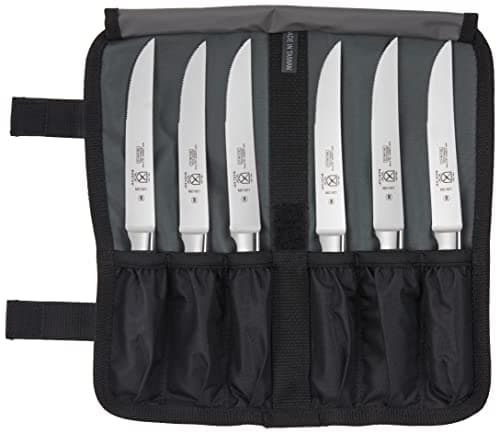
2. Mercer Culinary Genesis 7-piece — forged serrated, six places, in a roll. Six 5" serrated blades plus a storage roll, forged with a full tang from high-carbon German stainless, on Santoprene-over- polypropylene handles, NSF certified. Forging is unusual in a serrated steak set at this price — nearly everything else in the band is stamped — and the Santoprene handles are the grippiest thing on this page when wet, which is why this set is a catering standard. Six places under the ceiling is the other reason to look at it.
Honest cons:serrated, with the permanent trade-off above: it saws rather than slices, and there is no realistic way to sharpen it at home. It costs roughly twice what a plain six-piece serrated set costs for one extra inch of blade and the forging. A cloth knife roll is storage for a working cook, not for a dining room — most home buyers wanted a block or a drawer tray and will not use it. And Mercer publishes no Rockwell figure for this set, so that cell in the matrix is deliberately thin rather than borrowed from the Genesis chef's knife.
Don't buy if this is for a dinner table rather than a service kitchen. You are paying for forging and a roll you will not use.
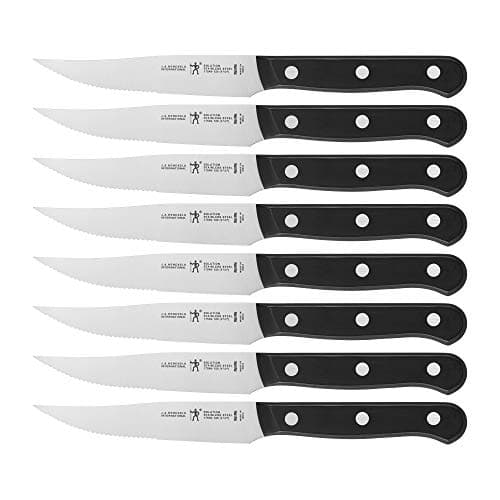
3. Henckels Solution 8-piece — the budget pick, and the only way to set eight places in this band. Eight 4½" micro-serrated blades, stamped from one piece with a full tang and triple-riveted synthetic handles, dishwasher safe. Buy this because you need eight places, not because it is the best knife here — and that is a perfectly good reason. Nothing else under $100 covers a table that size, the micro-serrations keep sawing long after a straight edge would need a stone, and a triple-riveted full tang is a better build than the price implies.
Honest cons:the weakest steel and the least keen edge on this page — it works rather than impresses. Micro-serrations tear the cut surface more visibly than larger scallops do. Henckels publishes neither a hardness nor an edge angle for this set, so several spec cells are deliberately blank rather than filled with a number from a sibling product. And at eight knives you will eventually lose one, and they are not individually replaceable.
Don't buy ifyou are setting four places. At that count the Messermeister's straight 15° edge is a large step up for a small amount more money.
Four good knives or eight adequate ones
This is the actual decision under $100, and it is worth making deliberately rather than by accident.
A hundred dollars buys either four knives with a real published edge, or eight knives with none. There is no set in this band that gives you both, and any listing claiming otherwise is either not eight knives or not publishing its specification. So the question is how often you seat more than four people.
If the honest answer is "twice a year, at Christmas," buy the four-piece Messermeister and let the extra guests use whatever else is in the drawer. The knives you use weekly should be the good ones. If the honest answer is "every Sunday," the eight-piece Henckels is the right call and the compromise is real but small — a micro-serrated blade cuts a steak perfectly well, it just does not do it beautifully.
There is a third route worth naming: buy the four-piece Messermeister now and a second one later. Two sets costs roughly double, which is outside this page's ceiling, but it gets you eight knives that are all genuinely good and all sharpenable, spread over two purchases.
What $100 does not buy, and why that is fine
Above this ceiling, steak knives get forged bolsters, G10 or hardwood handles, and in the Wüsthof Classic's case a published 14° grind in Solingen steel. Those are real upgrades in feel and in longevity, and they cost three to four times per knife what the sets here do.
They do not cut a steak three or four times better. Steak is soft, cooked, and already cut into a portion — it is the least demanding thing any knife in your kitchen touches. The honest ranking of where a knife budget does the most work puts a chef's knife first, a sharpening stone second, and steak knives a distant third. That is why a page with a $100 ceiling is a reasonable page and a page with a $400 ceiling mostly is not.
If you have not yet sorted the knife you cook with, do that first — best chef knives under $100 is the same budget spent where it changes more, and best whetstones under $50 is the cheapest upgrade available to every blade you already own.
Care: the short version
All three sets are nominally dishwasher tolerant and all three last longer if you do not. Detergent is alkaline and abrasive, the racks knock edges against other items, and heat works on riveted handles over time. Hand wash, dry immediately, and store them somewhere the edges do not touch other steel — can you put knives in the dishwasher has the detail, and best knife storage covers the drawer problem.
For the Messermeister, treat the edge like any other straight edge: hone it occasionally, sharpen it on a 1000-grit stone once or twice a year at the 15° it was ground to. Knife sharpening angle explains why matching that number matters more than the stone you use. For the two serrated sets, there is nothing to do and nothing you can do — which is the trade you made.
The verdict
Buy the Messermeister Avanta 4-pieceif your table seats four and you own a stone. It is the only set under $100 with a published 15° edge at ~HRC 57, it arrives genuinely sharp, and it is the only one here that will still be sharp in ten years because you made it so.
Buy the Henckels Solution 8-piece if your table seats eight. Nothing else in this band does, the build is better than the price suggests, and micro-serrations are the right answer when nobody is going to maintain anything. Buy the Mercer Genesis 7-piece if you need six places, want forged blades, and the roll is genuinely useful to you rather than packaging.
Two related pages worth a look. Best steak knives is the unrestricted version of this list, including the forged Dalstrong and Wüsthof sets that sit above the ceiling here. And best Wüsthof knives is where the Classic steak set comes from, if the question behind this one was really whether to spend more.