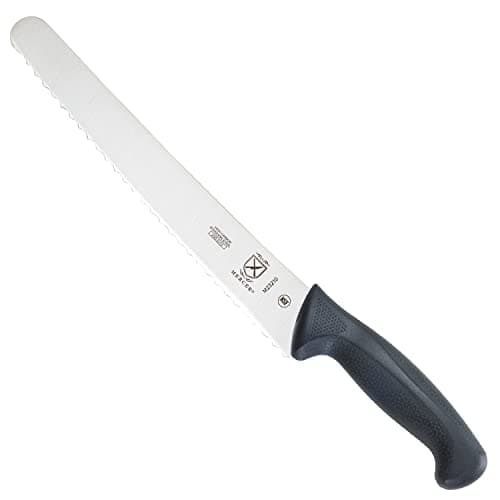
The verdict: buy the Mercer Culinary Millennia 10" wide wavy edge. It is the serrated knife for anyone who cuts bread, and it is also the cheapest knife here that does that job properly — so it is both the top pick and the budget pick, which is unusual enough to state outright. If you only ever cut tomatoes and citrus, the Victorinox Swiss Classic 4" serrated paring knife is the pick instead, and it costs less again. Prices below render live from the price layer with the "as of" date printed under the table.
Nearly every "best serrated knife" page is really a bread knife page. This one is not. A serrated edge is a mechanism, not a category, and it turns up in four distinct knives that do four different jobs: a long bread knife, an offset bread knife, a short serrated utility knife and a serrated paring knife. Buying the wrong one of those four is the actual mistake people make, so this page ranks all four.
Why a serrated edge works, and where it fails
A straight edge cuts by pressing down and parting the food. That works until the outside of the food is harder than the inside, at which point pressing down crushes the soft part before the hard part gives way. A crusty loaf is the obvious case; a ripe tomato is the same problem in miniature.
A serrated edge solves it by concentrating force on the points of the scallops, which pierce the crust, while the curved valleys between them do the slicing on the draw stroke. The knife saws instead of pressing, so the soft interior never gets compressed.
The cost is that a serrated edge is effectively not sharpenable at home. Each scallop needs individual attention with a tapered rod; a whetstone or a pull-through will only flatten the points and make things worse. How to sharpen a serrated knife is the honest account of what is and is not possible. Treat every knife on this page as a long-timescale consumable, which is also the reason to buy an excellent inexpensive one rather than a premium one.
The serration spec that actually matters
Scallop shape decides more than steel does on a serrated knife, and it is published.
- Wide wavy. Broad, shallow scallops. These saw through a hard crust without tearing the crumb underneath, and they are what the two Mercer Millennia picks and the Victorinox use. Best general-purpose serration for bread.
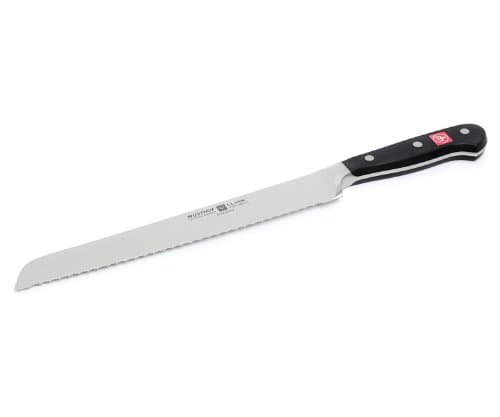
- Double-serrated / pointed. Narrow, deeper teeth, as on the Wüsthof Classic. They bite harder into a very hard crust — a well-baked sourdough or a baguette — and are more aggressive on soft crumb.
- Fine serration. Small scallops on a short blade, as on the serrated paring knife. For tomato skin, citrus peel and soft fruit, where a long blade is useless.
Blade length is the second spec. You want to cross the food in one stroke, because sawing back and forth is what tears bread. Ten inches crosses a round sourdough; eight or nine inches does not.
Who each pick is for
Mercer Millennia 10" wide wavy — for almost everyone, and the budget pick. A 10-inch blade in high-carbon Japanese stainless with wide wavy serration, stamped one-piece, on a Santoprene handle. The combination of the wide wave and the length is exactly right for bread, and nothing else on this page is better at the job regardless of price. It also tops best bread knives and is one of the three knives we say a kitchen genuinely needs on best kitchen knives.
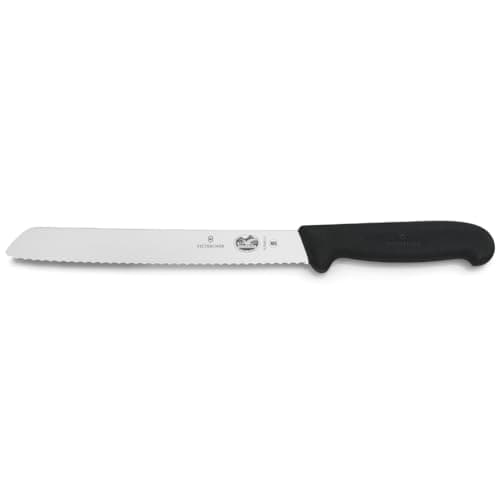
Victorinox Fibrox Pro 10.25" — for the cook who wants a buy-it-for-life version. Same idea, Swiss-made, with the textured Fibrox handle that grips with wet hands and NSF certification for commercial kitchens. You are paying for the handle and the build, not a better cut.
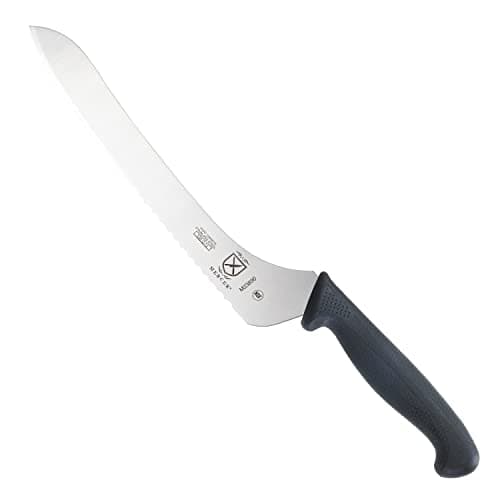
Mercer Millennia 9" offset — for sandwich work and knuckle clearance. The handle sits above the blade line rather than behind it, so your knuckles clear the board on the last slice and the blade stays flat through a sandwich. If you make a lot of sandwiches or slice bagels, this is a better knife than a straight bread knife; for a round loaf, it is not.
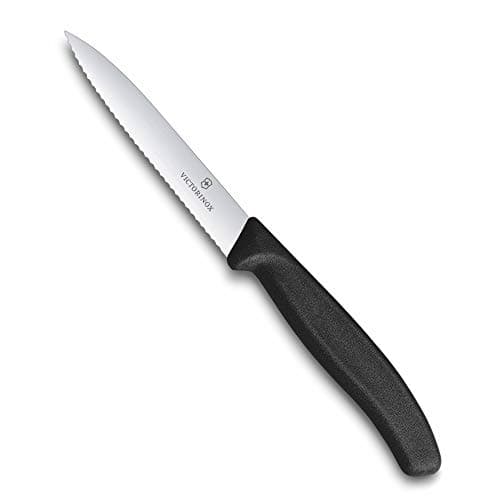
Victorinox Swiss Classic 4" serrated paring knife — for tomatoes, citrus and soft fruit. Fine serration on a 4-inch blade. This is the single most-reached-for serrated knife in a lot of kitchens and almost nobody buys it deliberately. It is cheap enough to own two, which is useful, because paring knives vanish. It also ranks on best paring knives.
Wüsthof Classic 9" double-serrated — for very hard crusts and for buying once. Forged, full-tang, with aggressive double serration that bites into a baguette crust better than a wavy edge does. Nine inches is short for a round sourdough, and it costs several times the Mercer; the trade is a knife that feels like an heirloom.
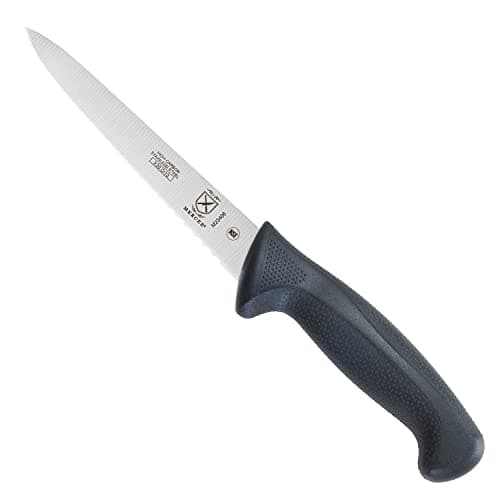
Mercer Millennia 6" wavy utility — the cheapest serrated knife here, for small jobs. Six inches of wavy edge: rolls, sub loaves, bagels, a single tomato. It is genuinely redundant if you own the 10-inch bread knife and the serrated paring knife, which is why it sits last. See best utility knives for where it fits in the drawer.
How many serrated knives do you need?
Two, for most kitchens: a 10-inch wide wavy bread knife and a serrated paring knife. Those two cover crusty bread and soft-skinned produce, which is the whole serrated remit. Add the offset if you make sandwiches as a routine, and skip the 6-inch utility unless you specifically want a bagel knife. How many kitchen knives do you need runs the same arithmetic across the rest of the drawer, and do you need a bread knife answers the sceptics.
Caring for an edge you cannot sharpen
Since resharpening is largely off the table, the lifespan of a serrated knife is decided by how you store and use it. Keep it off hard boards — glass and stone wreck serration points faster than anything else — see wood vs plastic cutting board. Store it so the teeth touch nothing: a magnetic strip, a block slot or an edge guard, per best knife storage. And keep it out of the dishwasher, where it will knock against everything else in the basket — can you put knives in the dishwasher.
The verdict
Buy the Mercer Millennia 10" wide wavy and the Victorinox Swiss Classic 4" serrated paring knife. Together they cost less than one premium bread knife and they cover every serrated job a home kitchen has. Add the Mercer 9" offset if sandwiches are a daily event, take the Victorinox Fibrox 10.25" if you want the better handle, and take the Wüsthof Classic only if you want a forged knife and accept that nine inches is short for a round loaf.