Skip to content
Bevel & Bone

HUB 01 · Chef Knives

Best Chinese Cleavers

A Chinese cleaver is not a bone chopper. It is a tall, thin, light slicing knife with a face wide enough to carry the board to the pan - and three of them are worth owning.

By Stephen V.Updated How we choose
#ad

We earn a commission when you buy through our Amazon links, at no extra cost to you. It never changes a ranking, and we say so when the cheaper knife is the better buy. How this works.

The verdict: buy the Mercer Culinary Asian Collection 8" Chinese chef's knife. It is the right first cleaver for almost anyone — a 3.25-inch tall, thin, stamped blade in high-carbon German steel on a textured Santoprene handle, NSF-certified, at a price that makes trying the grip essentially free. The budget pick is the Mercer 8" wood handle, the cheapest full-size cleaver here and the same blade dimensions on a traditional round hardwood grip. Prices render live from the price layer, with the "as of" date printed under the table.

The single most expensive misunderstanding in this category is that a Chinese cleaver chops bone. It does not. The tall rectangular blade that English speakers call a "cleaver" is, in a Chinese kitchen, a caidao— a vegetable knife. It is thin, light, and ground to slice. The bone-splitting tool is a different and much heavier object (a gudao), and if you chop joints with a caidao you will chip or bend it. Every pick on this page is a thin vegetable cleaver, and every one of them says so in its own don't-buy-if line.

What a caidao is actually good at

Four things, and the tall blade is the reason for all of them.

  • Carrying prep. A 3.25-inch-tall face will hold a whole board of diced onion, so you scoop and transfer in one motion instead of five. This is the thing cleaver owners actually miss when they go back to a chef's knife.
  • Flat push-cutting. A caidao has almost no belly, so the whole edge meets the board at once. That suits push-cutting and chopping rather than the rocking motion a Western chef's knife is built around.
  • Thin slices of soft vegetables. Cabbage, scallions, leeks, herbs. The thin stock means less wedging, and the tall blade keeps your knuckles well above the board.
  • Smashing and scraping. The flat of the blade crushes garlic and ginger, and the spine works as a tenderiser. Not spec-sheet material, but it is how the knife is used.

What it is bad at: anything needing a point. There is no tip to speak of, so coring, piercing and detail work go to a paring knife — best paring knives. And it does not break down poultry. If you want to go through joints, that is a forged Western meat cleaver, and both of ours are on best cleavers.

The specs that separate these three

All three share the key dimensions — an 8-inch blade, 3.25 inches tall — which tells you something useful: the category is standardised, and what you are choosing between is steel, handle and how the edge was finished.

Be aware of what is not published. Neither Mercer nor Dexter-Russell publishes a Rockwell hardness figure or a weight for these knives, so two cells in the matrix below read "—" rather than carrying a number we invented. On a site built around spec literacy that is worth stating plainly: this is a category where the makers publish less than we would like, and we are not going to fill the gaps with guesses.

Who each pick is for

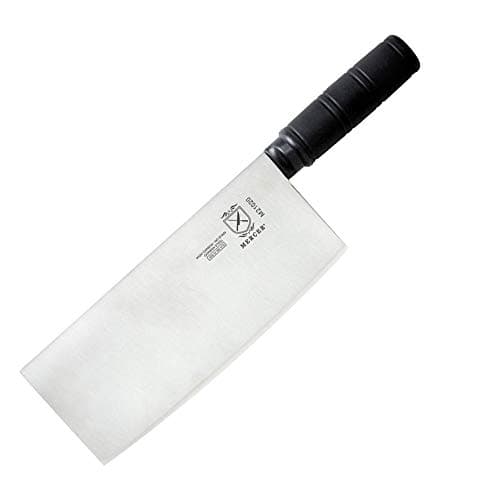
Mercer Asian Collection 8" — for your first cleaver, and for anyone who cooks with wet hands. High-carbon German steel, stamped thin, with the textured Santoprene handle Mercer uses across its commercial lines, and NSF certification. The handle is the reason it beats the wood-handled version of essentially the same blade: a smooth round grip is traditional, and it is also slippery when wet. Soft-ish stamped steel needs honing often and will not hold an edge like hardened Japanese steel — the trade is that it sharpens back in minutes on any stone.

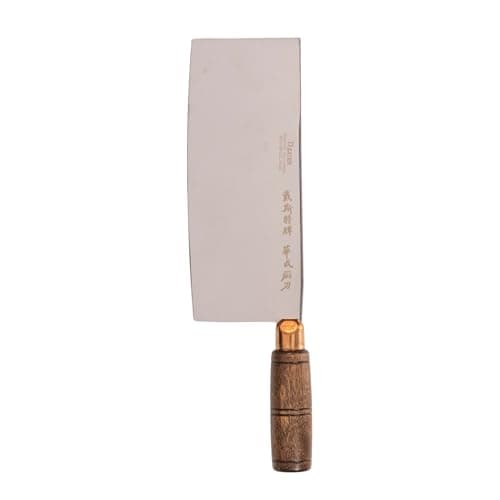
Dexter-Russell Traditional 8" — for the cook who wants a hand-ground edge and a traditional build. Made in Southbridge, Massachusetts, in high-carbon steel, with the edge individually ground and honed at the factory, a rosewood handle and a brass ferrule. It arrives sharper than anything else at this price, and it is light for its size — this is a slicing and scooping cleaver, and the balance shows it. The wood handle needs hand washing and drying, and it costs noticeably more than the Mercer for a knife that does the same job.

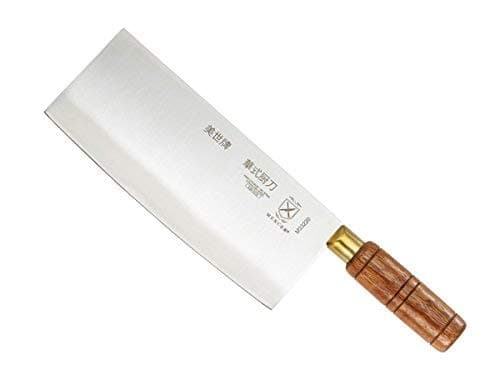
Mercer 8" wood handle — the cheapest honest way in, and the budget pick. The same tall thin blade geometry on a round hardwood handle, and Mercer lists this one as high-carbon Japanese steel rather than the German steel in the Santoprene version, so it should take a slightly finer edge. If you want the traditional round grip, or you simply want the lowest price on a full-size caidao, this is the knife. Bare wood must be hand washed and dried or it will dry out and loosen.

Learning the cleaver grip

A caidao is held differently from a chef's knife, and the first hour is awkward for everyone. The index finger goes along the spine or pinches the blade just ahead of the handle; the blade stays substantially vertical; and the motion is a push-cut or a straight chop, not a rock. Because the blade is tall, your knuckles sit far above the board, which makes it feel safer than it looks.

If you already push-cut rather than rock, you will adapt in an evening — how to hold a chef knife and knife skills for beginners cover the underlying motions. The nearest Western comparison is a nakiri, which is also tall, flat and tipless but much shorter and lighter — best nakiri knives and chef knife vs Chinese cleaver put the three side by side.

Sharpening and storing a tall thin blade

A caidao is one of the easiest knives to sharpen freehand, because the tall flat blade gives you a big, obvious reference surface to hold against the stone. Soft stamped steel also means you reach a burr quickly. Use a 1000-grit stone and finish at 3000 or above — how to use a whetstone and best sharpening stones for beginners.

Storage is the harder problem: a 3.25-inch-tall blade will not fit most knife-block slots and will not sit flat in many drawer trays. A magnetic strip is the usual answer, and an edge guard is the cheap one — best knife storage.

The verdict

Buy the Mercer Asian Collection 8". It is cheap, it is NSF-certified, the textured handle works wet, and it is the lowest-risk way to find out whether the cleaver grip suits you. Take the Dexter-Russell if you want a hand-ground edge and a rosewood handle and will hand wash it, and the Mercer wood handleif you want the traditional round grip at the lowest price here. And keep it off bone — all three of these are vegetable knives, and treating one as a chopper is how people conclude that cleavers are badly made.
The short answer

Quick picks

#ad · Live prices from the Amazon Product API, as of November 19, 2026. Where we have no verified live price we show none — we'd rather leave a gap than print a number that has rotted.

By the numbers

The specs, side by side

Every figure below is the manufacturer's published specification. Where a maker doesn't publish a value, the cell reads "—" rather than a number we made up.

Knife / ToolBladeBlade heightSteelHardnessConstructionWeight
Mercer Culinary Asian Collection 8" Chinese Chef's Knife8 in (20.3 cm)3.25 in (8.3 cm)High-carbon German steel—Stamped; Santoprene handle—
Dexter-Russell Traditional 8" Chinese Chef's Knife8 in (20.3 cm)3.25 in (8.3 cm)High-carbon steel—Stamped; individually ground edge, hardwood handle, brass ferrule; made in USA—
Mercer Culinary 8" Chinese Chef's Knife, Wood Handle8 in (20.3 cm)3.25 in (8.3 cm)High-carbon Japanese steel—Stamped; hardwood handle—

In detail

The picks, in full

01
Mercer Culinary Mercer Culinary Asian Collection 8" Chinese Chef's Knife

Your first Chinese vegetable cleaver

Mercer Culinary Asian Collection 8" Chinese Chef's Knife

8 in / 20.3 cm3.25 in tallHigh-carbon German steelStampedNSF
8.0/10

The best first cleaver for almost anyone: a tall, thin, NSF-certified Chinese vegetable cleaver with a grippy handle, at a price that makes experimenting free.

Versatility
9
Edge quality
7
Handling
8
Build
6
Value
10

Pros

  • Tall 3.25-inch blade gives you the thing a cleaver is actually for — a face wide enough to scoop and scrape a whole board of prep into the pan
  • Thin stamped stock slices cabbage, scallions and herbs far better than any heavy bone cleaver
  • Textured Santoprene handle keeps its grip wet, and the knife is NSF-certified for commercial use
  • Cheap enough that trying the cleaver grip costs almost nothing if it turns out not to suit you

Cons

  • Mercer publishes no HRC and no weight for this knife, so two of our spec columns sit empty
  • Soft-ish stamped steel needs honing often and will not hold an edge like a hard Japanese blade
  • Not a bone cleaver — the thin blade will chip or bend if you chop through joints with it

Don't buy this if…

…you want to split bones or chicken carcasses. This is a thin vegetable cleaver, and using it as a chopper will damage it. For bone work buy the Henckels or the Wüsthof.

$33.99View on Amazon

Price as of November 19, 2026. Prices change — Amazon's is the one that counts.

#ad · we may earn a commission from this link to Mercer Culinary Asian Collection 8" Chinese Chef's Knife

02
Dexter-Russell Dexter-Russell Traditional 8" Chinese Chef's Knife

A hand-ground blade made in the USA

Dexter-Russell Traditional 8" Chinese Chef's Knife

8 in / 20.3 cm3.25 in tallHigh-carbon steelRosewood handleMade in USA
7.8/10

The one made in Massachusetts: a hand-ground high-carbon blade with a rosewood handle and a brass ferrule. The nicest-cutting cleaver here that is not a luxury object.

Versatility
9
Edge quality
8
Handling
8
Build
7
Value
7

Pros

  • Individually ground and honed at the factory, which is why it arrives sharper than anything else at this price
  • Light for its size — this is a slicing-and-scooping cleaver, not a chopper, and the balance shows it
  • Rosewood handle and brass ferrule are a genuinely traditional pairing, and they feel better than molded plastic
  • Made in Southbridge, Massachusetts by a company that has been doing it since 1818

Cons

  • Dexter publishes no HRC and no bevel angle, and retailer weight figures for this model disagree with each other, so two spec columns sit empty
  • A wood handle with a ferrule needs hand washing and drying — it is not a dishwasher knife, whatever a listing claims
  • Costs noticeably more than the Mercer for a knife that does the same job

Don't buy this if…

…you want a low-maintenance knife you can abuse. The wood handle wants care, and the thin blade is no better at bone than the Mercer. Buy it for the hand-ground edge and the traditional build.

$59.33View on Amazon

Price as of November 19, 2026. Prices change — Amazon's is the one that counts.

#ad · we may earn a commission from this link to Dexter-Russell Traditional 8" Chinese Chef's Knife

03
Mercer Culinary Mercer Culinary 8" Chinese Chef's Knife, Wood Handle

The cheapest way to try a cleaver

Mercer Culinary 8" Chinese Chef's Knife, Wood Handle

8 in / 20.3 cm3.25 in tallHigh-carbon Japanese steelStampedHardwood
7.6/10

The cheapest honest way into the cleaver grip: the same tall thin blade as our top pick, on a traditional hardwood handle, for less money.

Versatility
9
Edge quality
7
Handling
7
Build
6
Value
9

Pros

  • Lowest price on this page for a full-size 8-inch tall-bladed cleaver
  • Mercer lists this one as high-carbon Japanese steel rather than the German steel in the Santoprene version, so it should take a slightly finer edge
  • A round wooden handle is the traditional Chinese cleaver grip, and some cooks strongly prefer it to a molded one

Cons

  • Mercer publishes no HRC and no weight for this model either, so two spec columns sit empty
  • A bare wood handle must be hand washed and dried, and will dry out and loosen if neglected
  • A smooth round handle is slipperier than the textured Santoprene version when your hands are wet
  • Not a bone cleaver, same as our top pick

Don't buy this if…

…you cook with wet hands and want grip above all. Pay the small difference for the Santoprene version of the same knife and get a textured handle and NSF certification with it.

$23.99View on Amazon

Price as of November 19, 2026. Prices change — Amazon's is the one that counts.

#ad · we may earn a commission from this link to Mercer Culinary 8" Chinese Chef's Knife, Wood Handle

How we picked

We do not run a test kitchen

We compiled each product's published specifications — steel, hardness, edge geometry, weight — normalized them into the matrix above, and scored each one against a published rubric. The scores are judgments from those specs and the value math — they are not measurements we took, because we do not have a test kitchen and we're not going to pretend we do. Units we claim to have tested: 0.

Questions

Frequently asked

Can you chop bones with a Chinese cleaver?

Not with any of these. The tall rectangular blade people call a "cleaver" is, in a Chinese kitchen, a caidao — a thin, light vegetable knife. Chopping joints with one will chip or bend it. Bone work needs a heavy forged Western meat cleaver, which is a different tool that happens to share the silhouette.

What is a Chinese cleaver used for?

Slicing and chopping vegetables, carrying prep from board to pan on the wide blade face, smashing garlic and ginger with the flat, and push-cutting anything that does not need a point. It replaces a chef's knife for most prep in many Chinese kitchens, but it cannot core, pierce or do detail work — that is a paring knife's job.

Is a Chinese cleaver better than a chef's knife?

For high-volume vegetable prep, many cooks think so: the tall blade carries prep, the flat profile suits push-cutting, and your knuckles sit well clear of the board. For anything needing a point — coring, piercing, breaking down poultry — a chef's knife wins outright. They are complements more than competitors.

Why do these cleavers have no hardness figure listed?

Because the makers do not publish one. Neither Mercer nor Dexter-Russell states a Rockwell figure or a weight for these models, so those cells in our spec matrix read "—". We would rather leave them blank than print a number we guessed, which is the same rule we apply everywhere on this site.

How do you store a Chinese cleaver?

Usually on a magnetic strip, or in an edge guard in a drawer. A 3.25-inch-tall blade does not fit most knife-block slots and will not lie flat in many in-drawer trays, so the storage you already own often will not take it. Plan for that before you buy.

Keep reading

Receipts

Sources

We do not run a test kitchen, and we do not pretend to. Specs are the manufacturer's published figures, attributed as such; where we could not verify something, we say so on the page rather than quietly leaving it out. Read our full method.