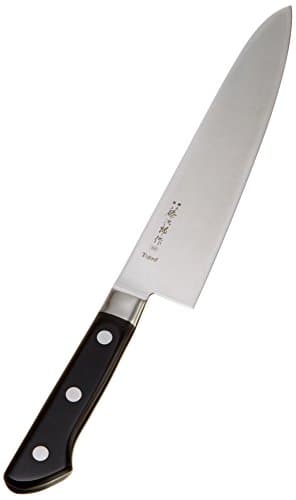
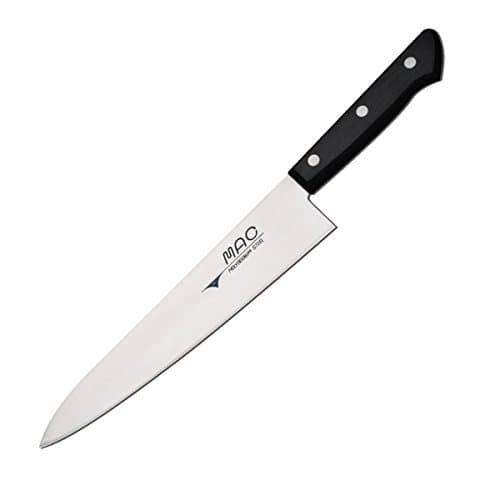
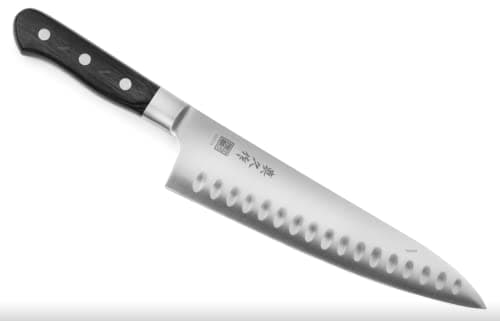
The verdict: buy the MAC MTH-80. It is the gyuto for the cook who wants one knife to do everything and wants it to feel thin — published at ~HRC 59–61 with a ~15° grind and a thin blade behind the edge, which is the whole point of the pattern. The budget pick is the Tojiro DP 210 mm, and it is the cheapest knife here that genuinely does the job: a VG10 core at a published ~HRC 60, clad in soft stainless, for roughly half what the Shun Classic costs. Every price below renders live from the price layer, with its "as of" date printed under the table.
Gyuto (牛刀, literally "beef knife") is simply the Japanese name for a Western-pattern chef's knife. It is a double-bevel, pointed, general-purpose blade — the same silhouette as a German chef's knife and a completely different object in the hand. Japanese makers grind it thinner, harden the steel further, and sharpen it to a more acute angle. That combination is why a gyuto feels like it falls through an onion while a forged German knife feels like it pushes through one.
What separates a gyuto from a chef's knife
Three published specs do nearly all the work, and you can read all three off the matrix below.
- Hardness. Every knife on this page is published at roughly HRC 59 or above. A Wüsthof Classic is published at ~HRC 58 and a Victorinox Fibrox at ~HRC 55–56. Harder steel holds a keen edge far longer, and chips instead of rolling when you abuse it — knife hardness explained is the full picture.
- Edge angle. These sit near 15° per side, or 16° in the Shun Classic's case. A more acute included angle cuts with less force, and only hard steel can hold one — which is why the two specs always travel together. Knife sharpening angle explains what that means when you come to maintain it.
- Blade geometry. A gyuto is thinner behind the edge and usually flatter through the middle of the belly than a German knife, which favours push-cutting over rocking. Blade geometry is the mechanism, and what is a gyuto covers the naming.
What a gyuto is not is a tougher knife. Everything on this page asks to be kept off bone, off frozen food and off glass boards. If that sounds like a chore, the German knives are the honest answer instead.
Who each pick is for
MAC MTH-80 — for the cook who wants the best cut and will look after it. Published at ~HRC 59–61, ground near 15°, with a dimpled hollow edge and a Pakkawood handle. It is our number one on best chef knives as well, for the same reason: it is thin where thinness matters and nothing about the handling fights you.
Tojiro DP 210 mm — for a first Japanese knife, and the budget pick. A VG10 core at a published ~HRC 60, clad in softer stainless, with a plain riveted handle and no decoration anywhere. The cladding is the trick: hard core for the edge, soft jacket for toughness. It is the cheapest honest route into real Japanese steel on this site, which is why the Tojiro DP review exists.
MAC HB-85 — for the cook who wants a MAC and a longer blade. 8.5 inches of light, thin Japanese steel, and the lightest way into the brand. It is the knife we put top of best kitchen knives for arthritis precisely because of that weight.
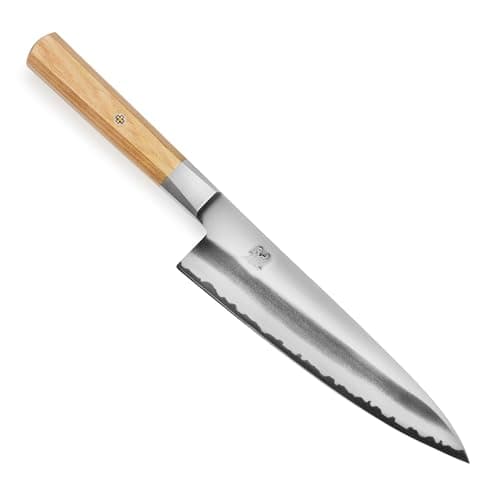
MIYABI Koya — for a first wa-handled knife. A Japanese octagonal handle rather than a Western riveted one, which changes the grip more than people expect: lighter in the hand, balanced further forward, and symmetrical, so it suits left-handed cooks as readily as right-handed ones. The Koya review has the detail.
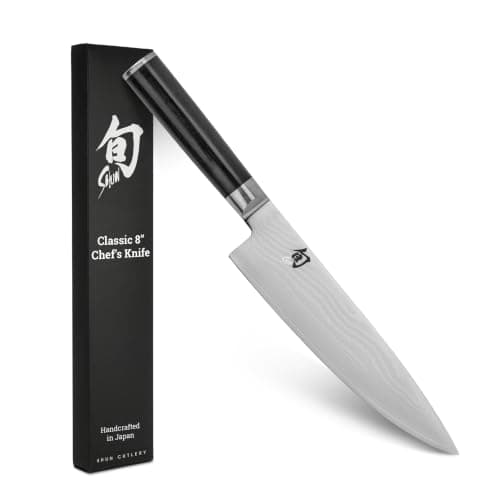
Shun Classic — for the cook who wants it to be beautiful. A VG-MAX core in 68-layer Damascus cladding at a published ~HRC 60–61, with a 16° edge on a D-shaped Pakkawood handle. The Damascus is functional cladding rather than decoration, but you pay a real premium for the finish — and the D-shaped handle is built for right-handers, so left-handed cooks should look at the Koya instead.
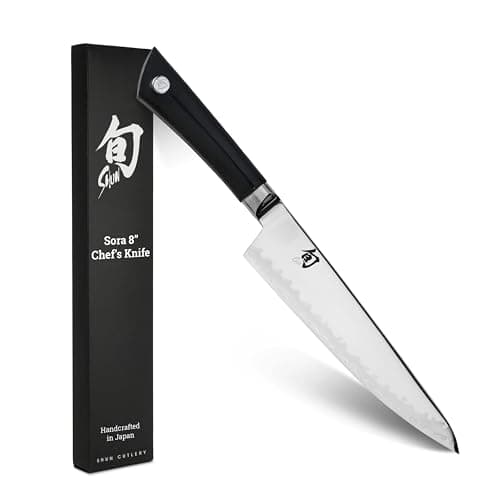
Shun Sora — for a VG10 edge with a forgiving handle. A composite blade: a VG10 cutting edge joined to a stainless upper, with a textured polymer handle rather than wood. Cheaper than the Classic and far less precious about wet hands.
What size gyuto to buy
Japanese makers size in millimetres, and the two common sizes are 180 mm (~7 in) and 210 mm (~8.25 in). For a single do-everything knife, 210 mm is the right default: long enough to cross a cabbage or a melon, short enough to control on a crowded board. 240 mm is a professional length that most home boards cannot really accommodate. Chef knife sizes explained runs the same argument for Western sizing, and gyuto vs santokuis the other fork in the road — a santoku is shorter, flatter and blunt-tipped, which suits vegetable prep and nothing that needs a point.
Sharpening a gyuto, which is not optional
A hard, acute edge is a trade: it stays sharp much longer, and when it finally goes it needs a stone rather than a steel rod. A grooved steel honing rod barely bites hardened Japanese steel and can chip it; a fine ceramic rod is the right maintenance tool and a 1000/6000 grit whetstone is the right sharpening tool.
Read ceramic vs steel honing rod first, then the stones for Japanese knives and how to use a whetstone. If you would rather not learn the stone yet, keep the knife to soft food and send it out once a year. What you must not do is run a hard, thin Japanese edge through a pull-through sharpener ground for 20°.
The verdict
Buy the MAC MTH-80 if the budget is there; it is the best-cutting general-purpose knife on this site and it is pleasant to maintain. Buy the Tojiro DP 210 mm if it is not, and understand that you are giving up finish and handle comfort rather than cutting performance. Buy the MIYABI Koya if you are left-handed or you want to try a Japanese handle, and the Shun Classicif you want the knife to be an object as well as a tool. Whichever you choose, budget for a stone in the same purchase — a dull gyuto is just an expensive knife.