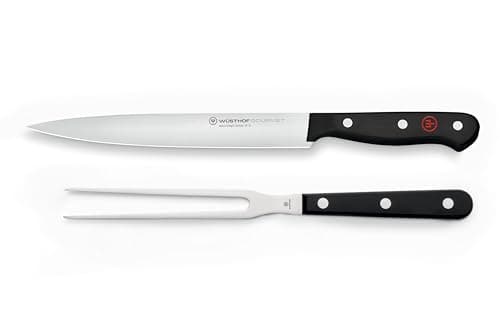
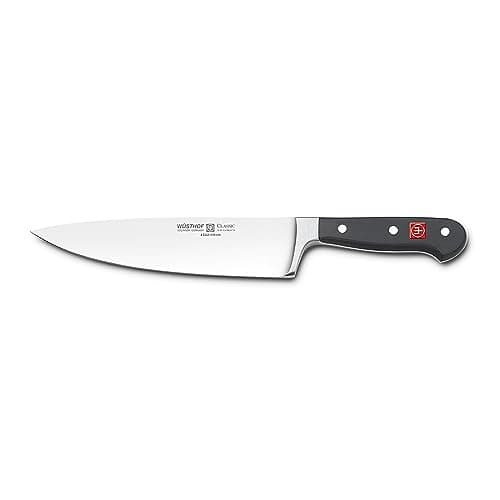
The verdict: if you own no Wüsthof, buy the Classic 8" chef's knife. It is the archetype the rest of the German category is measured against, and the one knife here that earns its price on versatility rather than on a single job. The highest-scoring Wüsthof blade on our rubric is the Classic 6" flexible boning knife — it is the most thoroughly specified knife in its whole category and it wins that category outright, which the chef's knife does not. The budget pick is the Gourmet 2-piece carving set, the cheapest genuinely Solingen-made thing on this page and the only non-Classic item we rank. Prices render live from the price layer with the "as of" date printed under the table.
One scoping note before the list: every number below is published, not estimated. Wüsthof is unusually forthcoming — it prints hardness, edge angle per side, blade length and often weight for individual SKUs, which most of this category refuses to do. That is the whole reason a brand roundup is writable here at all: there are real figures to rank on rather than adjectives.
The two lines, and which one you want
Most Wüsthof confusion is line confusion. The company sells several ranges side by side at prices that overlap, and the difference that actually matters is how the blade was made.
- Classic— the forged line, and the one almost everyone means when they say "a Wüsthof." Each blade is precision-forged from a single billet of X50CrMoV15 with a full tang, a bolster and a triple-riveted POM handle, tempered to a published ~HRC 58 and ground to 14° per side on Wüsthof's laser-guided Precision Edge Technology process. Heavy, planted, documented, expensive.
- Gourmet— the stamped line. Same X50CrMoV15 stainless, same Solingen factory, same triple-riveted handle construction, but the blade is laser-cut and stamped from sheet rather than forged, with no bolster. Lighter, thinner behind the edge, and a fraction of the price.
The practical rule: forging buys you heft, a bolster and a thicker spine, not a better steel. Both lines run the same alloy. If what you want from a German knife is mass behind the heel, buy Classic. If you want the steel and the Solingen build without the weight or the price, the Gourmet line is a legitimate answer and not a lesser one — forged vs stamped knives is the full trade-off.
The criteria, in the order they mattered
Ranking inside one brand removes the axis that usually does the work. Every Classic blade here is X50CrMoV15 at a published ~HRC 58, so steel and hardness separate nothing. The ranking turns on the rest.
- Does it win its own category? The top of this list is made of knives that beat every rival in their own roundup, not just every other Wüsthof. That is a harder bar than "good for a Wüsthof."
- Is the geometry doing the work, or the steel? In categories decided by shape — flexible boning blades, serrated bread knives, hollow-edge santoku — a forged German blade with a well-chosen profile competes directly with Japanese steel. In categories decided by edge retention, it does not.
- What does the bolster cost you over a decade? A full bolster eventually blocks the last inch of edge from a stone. We marked that against the knives that carry one, because it is a real long-term cost that nothing on a spec sheet shows.
- Price per job. A chef's knife that does ninety percent of your cutting is defensible arithmetic at almost any price in this band. A bread knife that comes out twice a week is a harder argument, and we said so where it applies.
- Is there a verified live offer? Every pick here carried a live price at the last price-layer run. Registry items with no buyable offer were left off rather than ranked on a dead listing.
The seven picks
1. Classic 8" chef's knife — the one to buy first. X50CrMoV15 at a published ~HRC 58, forged with a full tang and a full bolster, ground to 14° per side, around 9.0 oz (255 g). This is the German workhorse the whole category is benchmarked against: tough enough that nothing in a home kitchen will chip it, heavy enough that the blade does the work on a hard squash, and forgiving in a way thin Japanese steel is not. Hone it and it will outlive you. Our best chef knives roundup places it against every rival, and best German chef knives runs it against its own countrymen.
Honest cons:at ~9 oz it is heavy, and people with smaller hands or long prep sessions genuinely tire with it. The full bolster means that after many years of sharpening you will be fighting a steel shoulder at the heel. And ~HRC 58 is soft next to a Japanese blade, so it wants honing weekly rather than monthly.
2. Classic 7" hollow edge santoku — the lightweight Wüsthof. Same steel, same ~HRC 58, but ground to roughly 10° per side — keener than the chef's knife — with hollow-edge kullens and a weight near 6.4 oz (182 g). If the Classic 8" felt like a crowbar in your hand, this is the same brand, build and warranty at two-thirds the mass and a more acute grind. The flatter profile also suits push-cutting rather than rocking. Best santoku knives is the category, and chef knife vs santoku is the shape decision.
Honest cons:7" is short for breaking down anything large, and the blunt tip rules out piercing and coring. A 10° grind on soft steel rolls faster than the 14° one does, so it wants the rod more often. The kullens reduce sticking; they do not eliminate it.
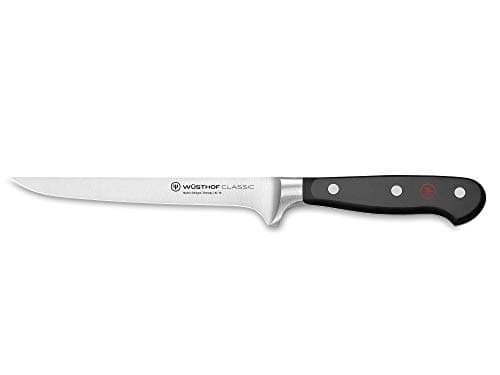
3. Classic 6" flexible boning knife — the highest-scoring blade here. A narrow S-shaped 6" blade, flexible, at a published ~HRC 58 with a 14° PEtec grind and about 5.3 oz on a triple-riveted POM handle. Boning is the one job where published flex grade matters more than anything else, and Wüsthof is one of very few makers that states it. It wins best boning knives outright, and the reason is documentation as much as steel.
Honest cons:it costs several times a Victorinox Fibrox boning knife that does the same job competently, and in the wet, greasy reality of butchery the textured Fibrox handle grips better than POM. A flexible blade is also wrong for heavy jointing — it is for following bone, not going through it.
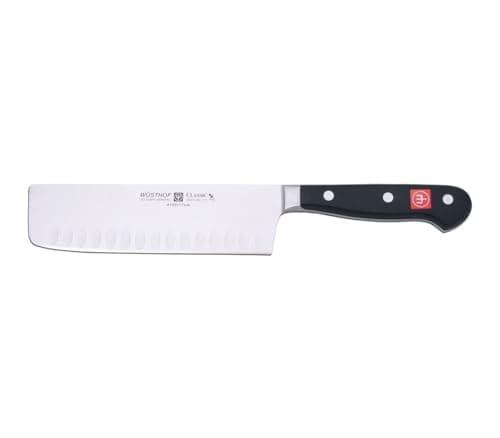
4. Classic 7" hollow edge nakiri — the German take on a Japanese pattern. A tall, flat 7" vegetable blade, precision-forged, ~HRC 58, ground to ~10° per side with kullens, around 6.4 oz. It is the best-documented nakiri we rank, and it brings German toughness to a pattern that normally arrives as thin, hard, chip-prone steel. For anyone who wants the vegetable knife without the care regime, this is the answer. Best nakiri knives ranks the field.
Honest cons:a nakiri's whole argument is a thin blade, and a forged German one is thicker behind the edge than a Japanese nakiri at half the price — it wedges more in dense root vegetables. It is also heavy for a repetition tool, and at ~HRC 58 it will not hold that 10° edge the way a VG10 blade does. It costs well above everything on best nakiri knives under $100.
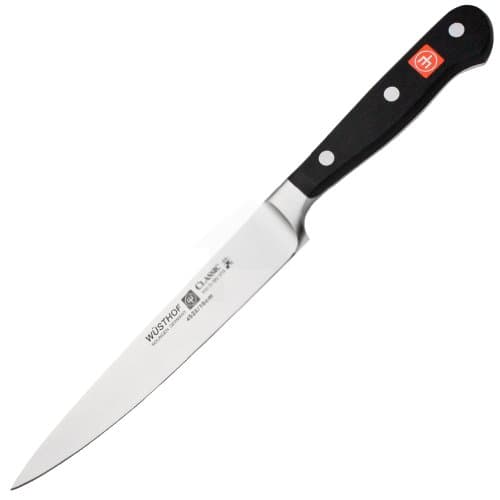
5. Classic 6" utility knife — the gap-filler, done properly. Forged, bolstered, ~HRC 58, a straight ~14° PEtec edge on a blade with roughly a 2 mm spine. A utility knife handles everything too big for a paring knife and too fiddly for a chef's knife — sandwiches, citrus, shallots, trimming — and this is the best-made example of one we rank. Best utility knives is the category.
Honest cons: the utility knife is the most skippable slot in any kitchen, and this is an expensive way to fill a skippable slot. A Mercer Millennia does the same work for a fraction of the money. Buying this one is a decision about owning a matching Classic roll, not about capability.
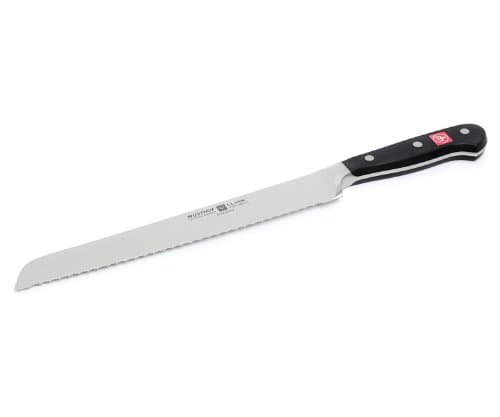
6. Classic 9" double-serrated bread knife — the buy-forever serrated blade. Forged with a full tang and a bolster, X50CrMoV15 at ~HRC 58, with Wüsthof's double-serrated edge — small scallops inside larger ones. Serrated edges are decided by scallop geometry rather than hardness, and this profile bites a hard sourdough crust without crushing the crumb. It will stay usable for years with no maintenance at all. Best bread knives has the field.
Honest cons:this is by a wide margin the most expensive way to cut bread, and a stamped serrated blade at a quarter of the price cuts a loaf almost as well. Serrations cannot be sharpened on a normal stone, so when it finally goes it goes. And 9" is short for a large round loaf — a 10" blade clears more in one stroke.
7. Gourmet 2-piece carving set — the budget pick, and the cheapest honest way into the brand. An 8" plain-edge carving knife and a 6" fork, laser-cut and stamped from X50CrMoV15, full tang, triple-riveted, made in Solingen. It is the only non-Classic item we rank, and the point of it is that you get the same steel and the same factory for far less money than any forged blade on this page — plus the fork, which no Classic carving knife includes. Best carving knives runs the category.
Honest cons:stamped, so there is no bolster and no heft behind the handle, and next to a forged Classic carver it feels like what it is. Wüsthof publishes no Rockwell figure for this set, so that cell in the matrix reads "—" rather than carrying a number borrowed from the Classic line. The edge is plain rather than hollow-ground, so slices of roast stick to it more.
What a 14° PEtec edge actually buys you
This is the Wüsthof spec worth understanding, because it is the one the brand genuinely leads on and the one most often misunderstood.
Most German-stainless knives ship ground at roughly 20° per side. Wüsthof grinds the Classic line to 14° per side using a laser-guided process it calls Precision Edge Technology, and the hollow-edge santoku and nakiri to roughly 10°. A narrower included angle means less steel to push through food, so the knife arrives cutting with noticeably less force than a 20° German blade.
What it does notbuy is edge retention. How long an edge survives is set by hardness and heat treatment, and at ~HRC 58 Wüsthof sits where German stainless sits — good for the class, several points below a Japanese blade at ~HRC 60–61. A keener grind on the same steel gives you a better first month, not a longer interval between sharpenings. Knife hardness explained is the trade-off in full, and VG10 vs X50CrMoV15 puts the two steels side by side.
There is a second consequence worth knowing: a 14° edge on soft steel is more fragile than a 20° one. You cannot treat a Classic like a cheap stamped knife and expect the factory edge to survive bone or a glass board. It is tougher than a Japanese blade, not indestructible.
Where Wüsthof genuinely wins, and where it loses
It wins where documentation and toughness matter. Flexible boning is the clearest case: the flex grade, the hardness and the grind are all published for that specific SKU, which almost no competitor does, and the blade is tough enough to twist against bone without complaint. The same applies to the nakiri and the santoku — Japanese patterns built in steel that tolerates a mistake.
It loses on edge retention and on price per job. At ~HRC 58 the Classic line will not hold an edge like a Japanese clad blade, and in categories where a cheap stamped blade does the same work — utility knives, bread knives, paring knives — the extra money buys build quality and a matching handle, not a better cut. If the brand is the point, that is a fair purchase. If the cut is the point, Wüsthof alternatives is the honest comparison and best chef knives for the money is the value lens.
Sharpening a Classic, and the bolster problem
Soft German stainless is the easiest steel on this site to maintain. Hone weekly with a rod, sharpen two or three times a year on a stone, and a Classic stays in the state it left Solingen in. It rolls rather than chips, so a honing rod actually works on it — which is not true of a hard Japanese edge. Sharpening vs honing is the distinction, and the right stones for German knives is the kit.
The one thing to plan around is the bolster. A fullbolster — which every Classic knife above carries — runs the full depth of the blade at the heel, and over years of sharpening the edge recedes while the bolster does not. Eventually the last inch of edge sits behind a steel shoulder and stops meeting the stone. This takes a long time and a professional can grind the bolster back, but it is a genuine difference between a Wüsthof Classic and a knife with no bolster at all. Knife bolster explained covers it, and best honing steels ranks the rods — including Wüsthof's own 10" fine-cut steel, which is not a knife and therefore not on this list, but is the cheapest thing you can buy to make every blade above perform better.
What we deliberately left off
- The Classic 9-piece block set. It is the right answer if you are furnishing a kitchen from zero and want everything forged, but it is a set rather than a knife and its spec shape does not line up with the matrix above. It is ranked on best chef knife sets.
- The Classic 4-piece steak knife set and the 6" cleaver. Both are excellent and both are ranked in their own categories — best steak knives and best cleavers — but each is the most expensive pick on its page by a wide margin, and putting them high on a brand list would say more about the brand than about the buy.
- The 10" honing steel and the 18" Magnabar. Neither is a knife. The steel is ranked on best honing steels and the Magnabar on best knife storage.
The verdict
Buy the Classic 8" chef's knifeif you own no Wüsthof and want the one that does the most work. It is heavy and it will need honing, and in exchange it is close to indestructible, fully documented, and the knife every German rival is compared against.
Buy the Classic 7" hollow edge santokuinstead if weight is the thing that puts you off a German knife — same steel, same warranty, two-thirds the mass and a keener grind. Buy the Classic 6" flexible boning knifeif you break down poultry or fish at home, because it is the best-specified blade in that category and the highest-scoring Wüsthof we rank. And buy the Gourmet 2-piece carving setif you want Solingen steel at the lowest honest price — stamped, lighter, with the fork included.
If the price of the Classic line is what sent you here, Wüsthof alternatives matches it spec for spec at lower money, and best Victorinox knives is the other end of the same market — the brand professional kitchens buy by the dozen. If a table rather than a prep board is what you are shopping for, best steak knives under $100 ranks the sets that clear that ceiling.