The verdict: buy the Mercer Culinary BPX 11" granton edge slicer. Eleven inches of thin, nearly straight blade with a granton edge, and it is also the cheapest knife on this page — so it is both the top pick and the budget pick, which is worth saying plainly rather than burying. If you cook full packer briskets rather than trimmed flats, take the Victorinox Fibrox Pro 12"instead for the extra inch of reach. Prices render live from the price layer with the "as of" date under the table.
A brisket is the hardest thing in barbecue to slice well and the easiest to ruin at the last step. It is a long, wide, very tender piece of meat with a pronounced grain that changes direction between the flat and the point, and it is usually resting at a temperature that makes it want to fall apart. The knife has one job: part the grain in a single clean pass without dragging, tearing or compressing the slice.
The three specs that decide a brisket knife
- Length, and it is the big one. You want to cross the whole width of the meat in one stroke, because every time you saw back and forth you tear the muscle fibres you just separated. A trimmed flat is comfortable with 10–11 inches. A full packer is wider, and 12 inches stops being a luxury.
- A granton (hollow-ground, dimpled) edge. The scallops ground into the blade face break the suction between the steel and the cut surface. On a wet, fatty, warm slice that is the difference between the meat releasing and the meat clinging and tearing as you lift the knife away. Three of the four picks here are granton; see what is a granton edge.
- Almost no belly. A slicing knife is nearly straight from heel to tip. A chef's knife has a curved belly designed for rocking, which means only a short section of the edge is ever in contact with a flat cut face — so you end up sawing. This is exactly why a chef's knife shreds brisket: carving knife vs slicing knife has the geometry.
What does not decide a brisket knife is hardness. Nothing about slicing cooked meat is abrasive, and a softer blade you can touch up with a rod between racks is more useful on a cook day than a hard one you have to take to a stone.
Who each pick is for
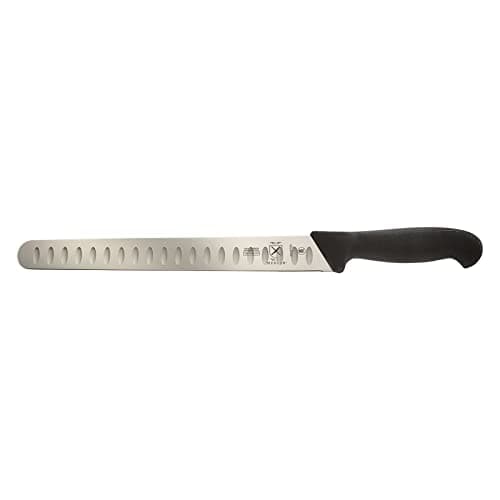
Mercer Culinary BPX 11" granton slicer — for almost everyone, and the budget pick. Eleven inches, granton edge, high-carbon stainless, stamped, with a textured handle built for a wet grip. The BPX line is Mercer's barbecue and butchery range, and this is the knife that does the job other slicers are adapted to. It is also our top pick on best carving knives and one of the seven knives on best kitchen knives.
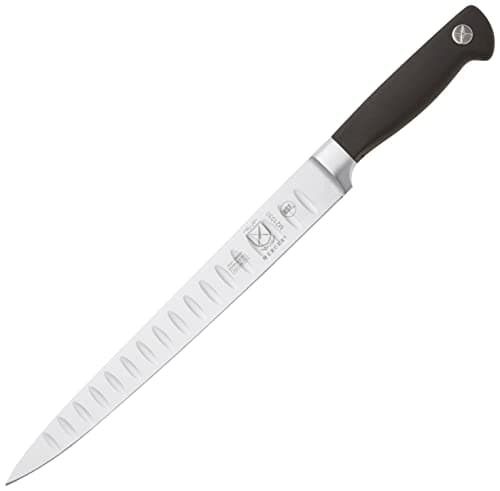
Mercer Genesis 10" granton carving knife — for the cook who wants a forged handle feel. Forged, full-tang, with a bolster and a granton edge. Ten inches is enough for a trimmed flat and plenty for a prime rib or a turkey breast, and the extra mass behind the handle makes it steadier for someone who does not slice often. It is short for a packer.
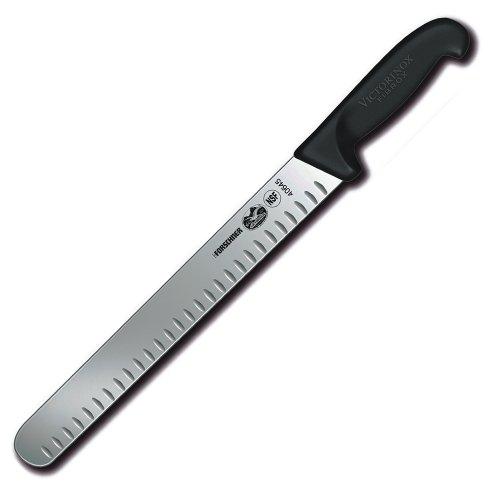
Victorinox Fibrox Pro 12" granton slicer — for full packer briskets and whole birds. Twelve inches of Swiss-made X50CrMoV15 with a granton edge and the textured Fibrox handle, NSF-certified. This is the brisket knife for anyone running a competition-sized cook, where reach decides whether the slice is one stroke or three. The length is unwieldy for anything else in a home kitchen, which is the honest cost.
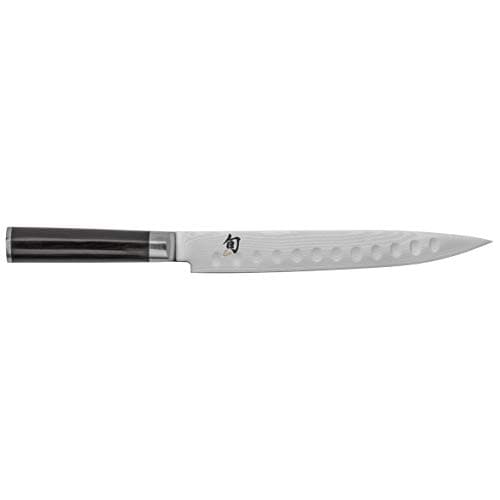
Shun Classic 9" hollow ground slicer — for the finest cut face, if the budget is there. A hollow-ground Japanese blade on a Pakkawood handle. It leaves the cleanest surface of anything here, and at nine inches it is the shortest — so it is a prime rib and tenderloin knife that happens to slice a trimmed flat well, rather than a brisket knife first. It also costs several times the Mercer.
Slicing brisket: the part the knife cannot do for you
Four things matter more than which of these you buy.
- Rest it. A brisket pulled off the smoker and cut immediately will shed its juice onto the board no matter how good the knife is.
- Find the grain, twice. The flat and the point run in different directions. Separate them, then slice each across its own grain. The flat gets pencil-thick slices; the point gets cubed or cut thicker.
- One stroke, no sawing. Let the length of the blade do the work. Draw the knife through on a single pass using as little downward pressure as you can manage.
- Hone before you slice, not after. A couple of passes on a rod right before you start costs nothing and is the single biggest improvement available — how to hone a knife and best honing steels.
Keeping a slicer sharp
A long thin blade is easy to sharpen and easy to sharpen badly, because keeping a consistent angle over 11 or 12 inches of edge takes more passes than an 8-inch knife. A guided system is a reasonable answer here even if you freehand everything else — best sharpening systems and guided vs freehand sharpening. Granton scallops do not change how you sharpen: they are ground into the face above the edge, not into the edge itself, so you work the bevel exactly as you would on a plain blade. Store it where the long edge touches nothing — most blocks will not take a 12-inch blade, so a magnetic strip or an edge guard is usually the answer, per best knife storage.
The verdict
Buy the Mercer BPX 11". It is the best brisket knife here and the cheapest, it was built for exactly this job, and nothing above it in price slices a flat noticeably better. Go to the Victorinox Fibrox 12" if you cook full packers and want the reach, take the Mercer Genesis 10" if you want a forged knife that also carves a roast, and take the Shun Classic 9" only if a flawless cut face matters more to you than length.