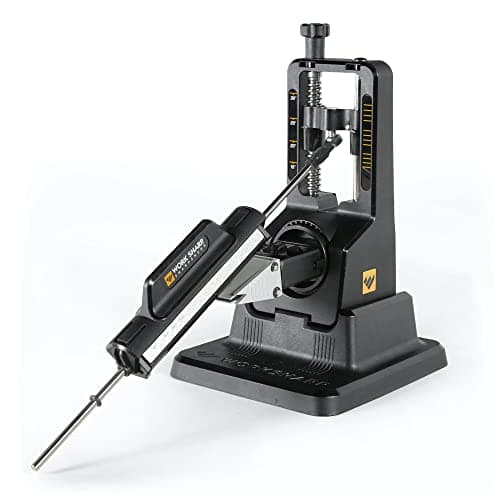
The verdict: buy the Work Sharp Precision Adjust. It is the sharpener for the cook who wants repeatable, genuinely sharp results without learning a stone — a clamp-and-rod guided system with a settable angle, which means it can be dialled to 15° for a Japanese knife or 20° for a German one instead of forcing every blade onto the same bevel. The budget pick is the Presto 08800 EverSharp, the cheapest sharpener here that genuinely works. Every price below renders live from the price layer with its "as of" date printed under the table, and the under-$100 band was set against those same live numbers.
This page deliberately mixes two kinds of tool that usually get separate lists, because under $100 the real question is not "which guided system" or "which electric" — it is which type should I buy at all. So guided systems and electrics are ranked together here, and the honest answer for a lot of readers is a third thing that is not on the page: a whetstone.
The three types, and the one real trade-off
Every sharpener trades skill required against steel removed and control over the angle. That is the whole category in one sentence.
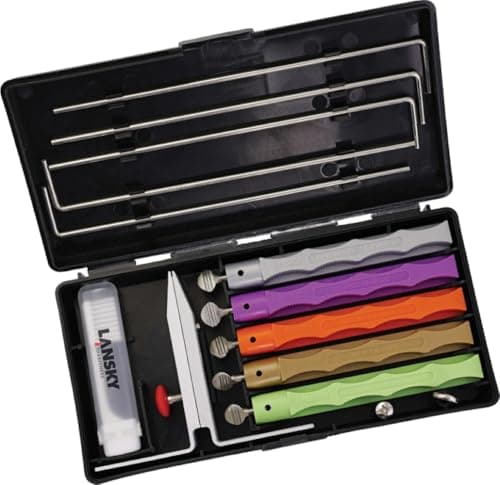
- Guided systems (clamp-and-rod, or fixed-angle stones). You still do the strokes, but a jig holds the angle for you. Best results per dollar, minimal skill, and they remove only as much steel as you choose to. Slower than an electric. The Work Sharp Precision Adjust, the Spyderco Sharpmaker and the Lansky Deluxe are all this type.
- Electrics (motorised abrasive wheels or belts). Fastest, least skill, and the most metal removed per session — which is fine on a thick German knife and expensive on a thin Japanese one. Most cheap electrics also grind one fixed angle, usually around 20°, so they re-profile anything ground finer.
- Pull-through sharpeners. Deliberately not on this list. They are the cheapest things in the category and they work by scraping a V-shaped carbide edge onto the blade, which is a quick-fix rather than sharpening. We rank one on best sharpening systems as an emergency tool and say so there; pull-through vs whetstone is the full argument.
The missing fourth option is a whetstone, and it is genuinely cheaper than most things on this page — a good combination stone sits well under $50. It removes the least metal, gives the most control and produces the best edge, and it is the only one of these that takes real practice. Whetstones under $50 is the shortlist, and whetstone vs electric sharpener is the comparison. If you are willing to learn, learn — this page is for people who have decided they are not.
Who each pick is for
Work Sharp Precision Adjust — for almost everyone here. A clamp holds the knife; you run abrasive rods down the edge at an angle you set. The settable angle is the whole reason it tops the page: a drawer with a German chef's knife at ~20° and a Japanese gyuto at ~15° does not have to be forced onto one bevel. It is our number one on best sharpening systems as well, and it is slower than an electric by a wide margin.
Spyderco Tri-Angle Sharpmaker — for foolproof touch-ups and serrated blades. Ceramic rods in a plastic base at two fixed angles. You hold the knife vertical and stroke down, which is about as hard to get wrong as sharpening gets. The triangular rod profile also lets you work inside the scallops of a serrated knife, which almost nothing else here can do — how to sharpen a serrated knife. Fixed angles are the limitation.
Lansky Deluxe 5-Stone system — for the cook who wants guided angles and a graded stone progression. A clamp with five hones from coarse to fine, which means it can actually re-profile a damaged edge rather than just refresh one. It is fiddlier to set up than the Work Sharp and it is the most hobbyist-feeling thing on this page.
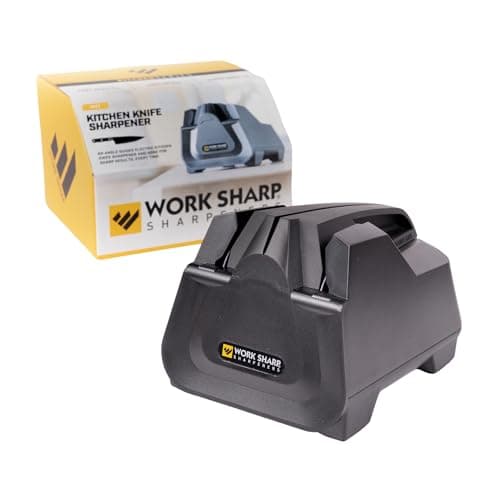
Work Sharp Culinary E2 — for an electric that removes the least metal. A flexible abrasive belt rather than a rigid wheel, which conforms to the edge instead of grinding a new bevel into it. If you want an electric and you are nervous about what electrics do to knives, this is the one that answers that worry. It is our pick for exactly that on best electric knife sharpeners.
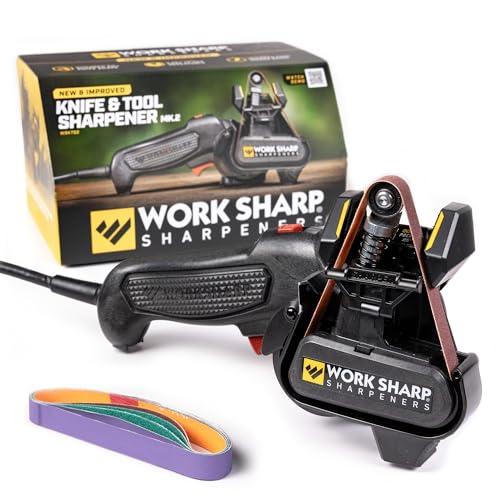
Work Sharp Mk.2 — for the household that sharpens more than kitchen knives. A belt sharpener with guides for kitchen knives, pocket knives, scissors and garden tools. If half the reason you want a sharpener is the shed rather than the kitchen, this is the one that covers both. It is more aggressive than the E2.
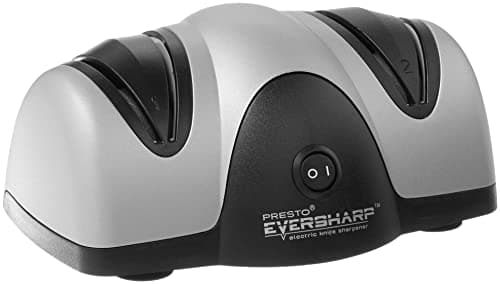
Presto 08800 EverSharp — the cheapest sharpener here that works, and the budget pick. A two-stage motorised electric with sapphirite wheels and a fixed guide. It will put a working edge on a dull German or Swiss kitchen knife in under a minute, which is more than can be said for anything cheaper. Be clear about the trade: it grinds one fixed angle, it removes meaningfully more steel than everything above it, and it is the wrong tool for a thin hard Japanese blade. Are electric knife sharpeners bad is the honest discussion.
Match the sharpener to the knives you own
- German and Swiss knives (~HRC 55–58, ~20°). Any of these six. Thick, soft, tough steel forgives a fixed-angle electric, and these knives dull faster so speed is worth something.
- Japanese knives (~HRC 60, 15–16°). The Work Sharp Precision Adjust, because it is the only sharpener here whose angle you can actually set. A 20°-only electric will re-profile a 15° edge, which throws away both the geometry you paid for and a lot of steel — knife sharpening angle.
- Serrated knives. The Spyderco Sharpmaker, and only the Sharpmaker. Nothing else here reaches inside a scallop.
- A mixed drawer. The Precision Adjust, and accept that it is slower than an electric.
- Pocket knives, shears and garden tools too. The Work Sharp Mk.2.
What $100 buys, and what it does not
It buys a settable angle, which is the single most valuable feature in the category and the thing cheap sharpeners do not have. It buys a graded abrasive progression, so a genuinely damaged edge can be rebuilt rather than just refreshed. And it buys speed, if you go electric.
It does not buy a professional-grade motorised system — the wet-wheel and powered-guided machines that shops use start several times higher, and we do not stock any in the registry because they sit outside this site's price band. It does not buy the quality of edge a competent hand gets off a 6000-grit stone. And it does not buy a device that cannot be used badly: every sharpener on this page will take metal off your knives faster than necessary if you keep going after the burr has formed — how to remove a burr and how many times can a knife be sharpened.
Two of the picks sit close enough to the $100 ceiling that a sale or a price rise can cross it. The live figure under each row is the one that counts, and it carries the date it was fetched; where we have no verified price, the button reads "Check price" and we print no number at all.
Hone first, sharpen later
Most knives that feel dull do not need sharpening. They need honing — the edge has rolled over rather than worn away, and a few passes on a rod straightens it with almost no metal loss. Sharpening vs honing is the distinction most people have backwards, and best honing steels costs less than anything on this page. Hone weekly and most kitchens only need the sharpener two or three times a year — how often should you sharpen a knife.
The verdict
Buy the Work Sharp Precision Adjust. A settable angle is what separates a sharpener that serves your knives from one your knives have to accommodate, and no other pick here under $100 has one. Take the Spyderco Sharpmaker if you want the simplest possible routine or you own serrated knives, the Work Sharp Culinary E2 if you want an electric that is gentle with steel, and the Presto EverSharp if the budget is the binding constraint and your knives are German. And if you are at all tempted to learn: a combination whetstone costs less than every one of these and makes a better edge.