Skip to content
Bevel & Bone

HUB 01 · Chef Knives

Best Japanese Chef Knives Under $100

Under $100 you cannot buy Damascus cladding or a hand-finished edge. You can buy genuinely hard Japanese steel ground near 15 degrees, which is the part that cuts.

By Stephen V.Updated How we choose
#ad

We earn a commission when you buy through our Amazon links, at no extra cost to you. It never changes a ranking, and we say so when the cheaper knife is the better buy. How this works.

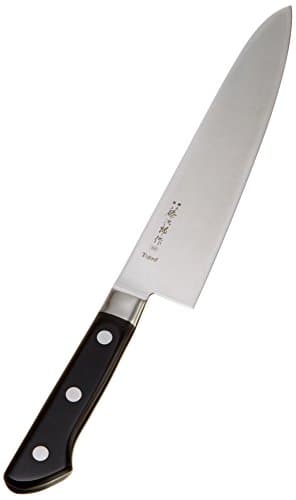
The verdict: buy the Tojiro DP 210 mm. It is the best knife on this page and also the cheapest, which almost never happens and is worth saying plainly — so it is both the top pick and the budget pick. A VG10 core at a published ~HRC 60, clad in softer stainless, ground near 15° per side, with a handle that has no pretensions at all. If you want a longer, lighter blade instead, the MAC HB-85is the pick for you. Every price here renders live from the price layer; the "as of" date sits directly under the table, and the band below was checked against those same live numbers.

This page exists because "Japanese chef's knife" and "expensive" have become the same idea, and they are not. The specs that make a Japanese knife cut — hardness around HRC 60, a grind near 15° per side, a thin blade behind the edge — are all available under $100. What is not available under $100 is finish: hand-polished Damascus cladding, a wa handle in figured wood, a hand-finished edge. You are buying the geometry and giving up the jewellery.

How the under-$100 band was set

There are exactly three knives in our product registry that are Japanese-made general-purpose chef's knives andcarried a verified live price under $100 at the last price check. All three are on this page. We did not pad the list with Western knives that happen to be shaped like a gyuto, and we did not include anything whose price we could not verify — if the price layer has no number for a product, its button reads "Check price" and we print no figure at all.

Prices move, and two of the three sit close enough to the ceiling that a sale or a price rise can cross it. The live number under each row is the one that counts, and it carries the date it was fetched. If you need more headroom, best chef knives under $200 is where the MAC MTH-80, the Shun Classic and the Miyabi Kaizen II live.

Who each pick is for

Tojiro DP 210 mm — for anyone who wants the most cutting performance per dollar on this site. Tojiro publishes a VG10 cutting core at ~HRC 60 clad in soft stainless, a 210 mm (8.25 in) blade and a ~15° grind. The clad construction is why it survives at this price: the hard core does the cutting and the soft jacket absorbs the knocks that would chip a mono-steel blade of the same hardness. The handle is a plain riveted composite and the finish is utilitarian. Nothing about it is decorative, and nothing about it needs to be. Full Tojiro DP review.

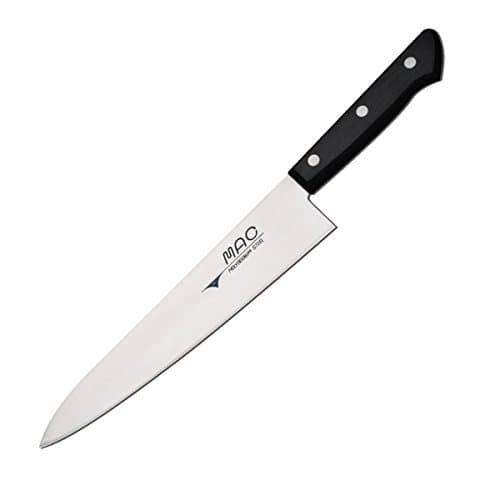
MAC HB-85 — for the cook who wants a longer, lighter blade. 8.5 inches of thin Japanese steel from MAC's Chef Series, with a hollow dimpled edge and a Pakkawood handle. It is the lightest blade of the three and the longest, which is a genuinely different feel from the Tojiro rather than a better or worse one. It is also the cheapest way into MAC, whose MTH-80 is our overall number one on best chef knives. That light blade is also why it tops best kitchen knives for arthritis. See the HB-85 review for how it differs from the Professional series.

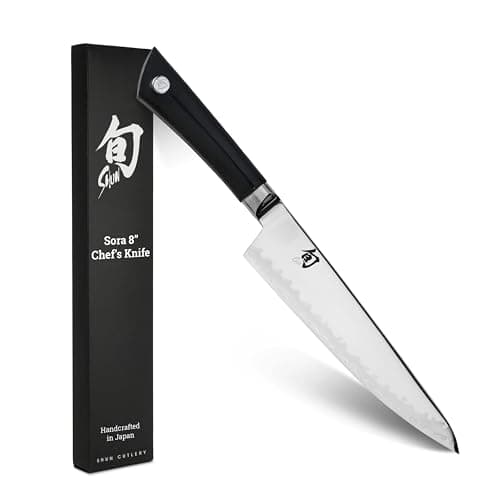
Shun Sora — for the cook who wants a VG10 edge and a handle that forgives wet hands. A composite blade: a VG10 cutting edge joined to a stainless upper section, finished with a textured polymer handle rather than Pakkawood. That construction is how Shun gets its VG10 edge down to this price. It is the most forgiving of the three to own — no wood to oil, no delicate cladding to scratch — and the visible weld line is the honest cost of the trick. Full Shun Sora review.

What you give up under $100

Worth knowing before you buy, because the gap between these and a $150 knife is real but narrower than the price suggests.

  • Finish and fit. Hand-polished cladding, a rounded spine and choil, a figured-wood handle. All cosmetic, all pleasant, none of it cuts.
  • Out-of-box edge. Premium Japanese knives arrive with a hand-finished edge. These arrive sharp, but a $160 Miyabi arrives sharper. Twenty minutes on a 1000/6000 stone closes that gap permanently — how to use a whetstone.
  • Handle comfort over long sessions. The Tojiro handle in particular is functional rather than comfortable. If you prep for two hours at a stretch, that is where the money goes.
  • What you do not give up: hardness, edge angle or thinness. All three of these knives are published at roughly HRC 60 and ground near 15°. That is the same specification as knives costing twice as much.

Budget for the stone, not just the knife

A hard Japanese edge cannot be maintained with a grooved steel rod, and a pull-through sharpener ground for 20° will destroy the 15° grind you just paid for. If you are spending under $100 on the knife, spend something on the maintenance: whetstones under $50 is the cheap route, stones for Japanese knives is the considered one, and sharpening vs honing is the distinction most owners have backwards.

The verdict

Buy the Tojiro DP 210 mm. It is the cheapest knife on this page and the best one, and that is not a compromise verdict — clad VG10 at ~HRC 60 is the specification that matters, and Tojiro sells it without charging for the finish. Take the MAC HB-85 if you want 8.5 inches and the lightest blade here, and the Shun Soraif you want a VG10 edge on a handle you can grab with wet hands. Then put $30–$50 into a combination whetstone, because at this price the knife you sharpen beats the knife you upgrade to.
The short answer

Quick picks

#ad · Live prices from the Amazon Product API, as of November 19, 2026. Where we have no verified live price we show none — we'd rather leave a gap than print a number that has rotted.

By the numbers

The specs, side by side

Every figure below is the manufacturer's published specification. Where a maker doesn't publish a value, the cell reads "—" rather than a number we made up.

Knife / ToolBladeSteelHardnessEdgeConstructionWeight
Tojiro DP Gyuto 210 mm Chef's Knife8.3 in (210 mm)VG-10 core, stainless clad (3-layer)~HRC 60~15° per sideStamped, bolsterless, riveted handle~7.4 oz (210 g)
MAC Chef Series 8.5" Chef's Knife (HB-85)8.5 in (21.5 cm)High-carbon chrome-molybdenum-vanadium~HRC 60~15° per sideThin (2.0 mm) stamped blade, riveted Pakkawood handle, steel bolster~4.9 oz (139 g)
Shun Sora 8" Chef's Knife8 in (20 cm)VG10 san mai cutting edge, 420J stainless upper (composite)~HRC 60–6116° per sideComposite blade (brazed edge/upper), PP/TPE polymer handle~6.6 oz (188 g)

In detail

The picks, in full

01
Tojiro Tojiro DP Gyuto 210 mm Chef's Knife

The best value in a Japanese knife

Tojiro DP Gyuto 210 mm Chef's Knife

8.3 in / 210 mmVG-10 core~HRC 60~15° edge3-layer clad
8.2/10

The cheapest honest way into a real VG-10 Japanese knife. It punches absurdly far above its price.

Edge retention
8
Out-of-box edge
8
Handling
8
Build
7
Value
10

Pros

  • A genuine VG-10 cutting core at a price the German knives can't touch — this is the value story of the category
  • Harder than any German blade here, so it holds a keen edge far longer
  • Thin, flat-ish profile suits push-cutting and precise work

Cons

  • The Western handle is basic and a little blocky — you're paying for the steel, not the fit and finish
  • Harder steel chips if you twist it through bone or freeze; treat it with respect
  • Reactive-ish edge on the very hard core wants drying after acidic food

Don't buy this if…

…this is the only knife in a household that abuses knives. VG-10 rewards good habits and punishes bad ones — a Victorinox is the more forgiving choice for a shared kitchen.

$74.82View on Amazon

Price as of November 19, 2026. Prices change — Amazon's is the one that counts.

#ad · we may earn a commission from this link to Tojiro DP Gyuto 210 mm Chef's Knife

02
Mac MAC Chef Series 8.5" Chef's Knife (HB-85)

The lightest, cheapest way into a MAC

MAC Chef Series 8.5" Chef's Knife (HB-85)

8.5 in / 21.5 cmMolybdenum-vanadium~HRC 60~15° edge4.9 oz
8.0/10

MAC's entry-level gyuto: the same hard, thin Japanese steel as the famous MTH-80 in a lighter, plainer, cheaper package.

Edge retention
8
Out-of-box edge
8
Handling
9
Build
7
Value
8

Pros

  • MAC calls it the lightest chef's knife it makes — at under 5 oz it is nimble in a way no German knife is
  • A 2.0 mm spine with the gyuto's gradual taper: it slides through produce rather than wedging
  • The same molybdenum-vanadium steel family and ~HRC 60 as MAC's pricier lines, at the lowest MAC price on Amazon
  • Western riveted handle with a small steel bolster — nothing about the grip needs learning

Cons

  • No dimples (granton edge), so starchy slices stick to the blade more than on the MTH-80
  • The half-bolster and thinner handle feel spare next to a forged German knife of the same price
  • Hard, thin steel is less forgiving of twisting and bone contact than a soft stamped blade

Don't buy this if…

…you want heft. This is a feather; if a heavy, forward-balanced knife is what feels 'right' in your hand, the Tojiro DP or a German blade will suit you better.

$89.94View on Amazon

Price as of November 19, 2026. Prices change — Amazon's is the one that counts.

#ad · we may earn a commission from this link to MAC Chef Series 8.5" Chef's Knife (HB-85)

03
Shun Shun Sora 8" Chef's Knife

A VG10 edge with a forgiving handle

Shun Sora 8" Chef's Knife

8 in / 20 cmVG10 edge, 420J upper~HRC 60–6116° per sideComposite
7.6/10

Shun's entry line puts a real VG10 cutting edge under a cheaper stainless upper — the Shun sharpness without the Shun price.

Edge retention
8
Out-of-box edge
8
Handling
7
Build
7
Value
8

Pros

  • The part that cuts is VG10 — the same steel class as knives costing twice as much
  • Shun's 16° edge is a touch more obtuse than the 12–15° of harder Japanese blades, which makes it more chip-tolerant for a learner
  • Textured polymer handle grips wet and is the most conventional-feeling grip of any Shun
  • Made in Seki, Japan; 10-year warranty; a visible braze line tells you exactly where the hard steel is

Cons

  • The 420J upper is soft, low-cost stainless — the knife is only 'premium' at the edge
  • The two-tone composite look is not to everyone's taste, and the polymer handle reads as plain
  • Heavier and blunter-feeling in the hand than the Tojiro or either MAC

Don't buy this if…

…you want the knife to look and feel like a $150 Shun. It cuts like one; it does not feel like one. If fit and finish matter to you, save for the Classic.

$87.95View on Amazon

$109.9520% off

Price as of November 19, 2026. Prices change — Amazon's is the one that counts.

#ad · we may earn a commission from this link to Shun Sora 8" Chef's Knife

How we picked

We do not run a test kitchen

We compiled each product's published specifications — steel, hardness, edge geometry, weight — normalized them into the matrix above, and scored each one against a published rubric. The scores are judgments from those specs and the value math — they are not measurements we took, because we do not have a test kitchen and we're not going to pretend we do. Units we claim to have tested: 0.

Questions

Frequently asked

Can you get a real Japanese chef's knife under $100?

Yes. The specs that make a Japanese knife cut — hardness around HRC 60, a grind near 15° per side, a thin blade behind the edge — are all available under $100, and all three knives on this page publish them. What you cannot buy under $100 is finish: hand-polished Damascus, a figured-wood wa handle, a hand-finished edge.

Is the Tojiro DP better than the Shun Sora?

On published specification, yes, and it usually costs less. Both use a VG10 edge, but the Tojiro is fully clad with a 210 mm blade, while the Sora joins a VG10 edge to a stainless upper. The Sora wins on handle: its textured polymer grip is more secure with wet hands than the Tojiro's plain riveted composite, and there is no wood to look after.

Why are there only three knives on this list?

Because only three Japanese-made general-purpose chef's knives in our registry carried a verified live price under $100 at the last price check. We would rather publish three real picks than pad the list with Western knives shaped like a gyuto, or with products whose price we cannot verify.

Do cheap Japanese knives chip?

Any knife at HRC 60 will chip if you use it on bone, frozen food or a glass board — hardness buys edge retention and pays for it in toughness. Clad construction, which the Tojiro uses, helps: the soft stainless jacket absorbs impacts that would crack a mono-steel blade of the same hardness. Treat all three as vegetable, fish and boneless-meat knives.

Should I spend more than $100 on a Japanese knife?

Only once you know you will maintain it. Above $100 the money buys finish, handle comfort and a keener factory edge — all real, none of them the reason a Japanese knife cuts well. A sharpened $75 Tojiro out-cuts an unsharpened $180 Miyabi every single time, so buy the stone before you buy the upgrade.

Keep reading

Receipts

Sources

We do not run a test kitchen, and we do not pretend to. Specs are the manufacturer's published figures, attributed as such; where we could not verify something, we say so on the page rather than quietly leaving it out. Read our full method.