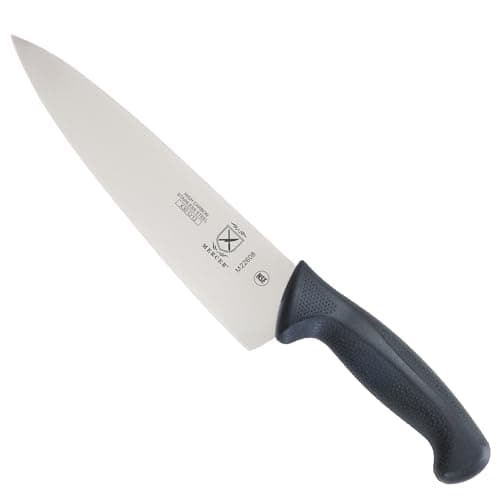
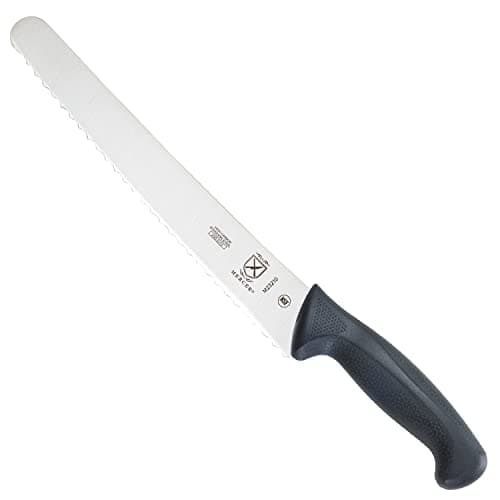
The verdict: the best Mercer knife is the Millennia 10" wide wavy edge bread knife. That is not a hedge or a consolation prize — it is the highest-scoring knife in the entire Mercer range on this site and the best bread knife we rank at any price, which is a genuinely unusual thing for a budget brand to own outright. It is for anyone who cuts bread. The budget pick is the Millennia 8" chef's knife, the cheapest knife in this whole catalogue that is worth owning. Prices render live from the price layer with the "as of" date under the table.
Mercer Culinary is the brand you meet in a culinary school knife kit, and that is the clearest thing anyone can tell you about it: the knives are specified to be handed to a nineteen-year-old who will abuse them, wash them wrong and still need them sharp in the morning. Nothing in the range is an heirloom. Several things in it are the best available answer to a specific job, and this page is about which.
The three Mercer lines, and who each is for
- Millennia— stamped, one-piece, molded Santoprene-and-polypropylene handles, high-carbon Japanese stainless in the HRC low-50s. The cheap line, and the one that wins outright in serrated blades and slicers where blade geometry decides everything and heft decides nothing.
- Genesis— forged, full tang, with a bolster and a textured Santoprene handle, in German steel. This is the line to buy when you want the feel of a forged knife: heavier behind the handle, steadier, and far closer to a Wüsthof in the hand than the price suggests.
- BPX— Mercer's barbecue and butchery range. Long blades, granton edges, grippy handles built for wet hands. Narrow, and excellent inside that scope.
The rule of thumb: Millennia for geometry jobs, Genesis for feel jobs. A bread knife, a slicer and a utility knife do not benefit from forging — nothing about them is improved by mass behind the handle. A chef's knife, a santoku and a boning knife do. Forged vs stamped knives is the underlying mechanism, and best stamped chef knives makes the case for the cheap construction properly.
Who each pick is for
Millennia 10" wide wavy bread knife — for anyone who cuts bread. Ten inches of high-carbon Japanese stainless with wide wavy serration, stamped one-piece, Santoprene handle. The broad shallow scallops saw through crust without compressing the crumb, and ten inches crosses a round sourdough in one stroke so you never saw. It tops best bread knives and best serrated knives, and it is one of the three knives we say a kitchen genuinely needs on best kitchen knives.
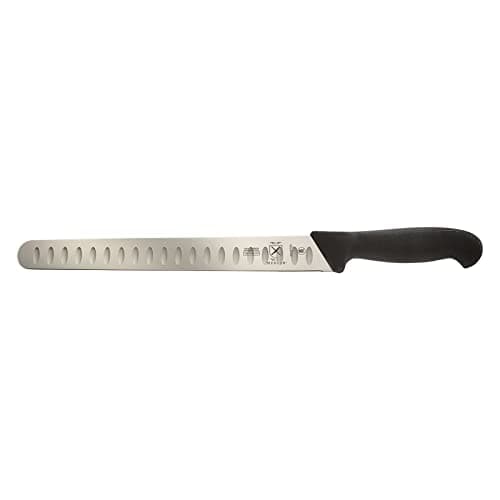
BPX 11" granton slicer — for carving roasts and slicing brisket. Eleven inches, granton edge, nearly straight profile, grippy handle. It is our top pick on best carving knives and on best brisket knives, and it costs less than a third of the premium Japanese slicer it beats on both.
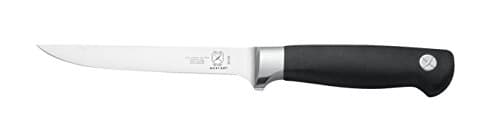
Genesis 6" stiff boning knife — for trimming roasts and breaking down large cuts. Forged, full tang, bolstered, graded stiff. Forged construction at this price is genuinely unusual, and stiff flex is right for heavy trimming where you want the blade to go exactly where you push it. It is the wrong flex for poultry — see best boning knives under $50 for the flex-grade decision in full.
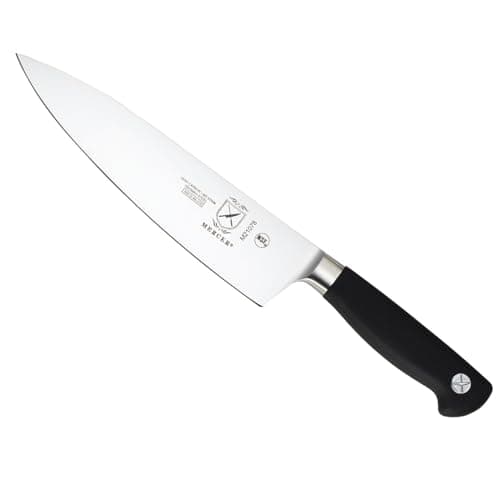
Genesis 8" chef's knife — for a forged chef's knife on a small budget. Forged German steel, full tang, bolster, textured Santoprene handle. This is the knife to buy if you want the Wüsthof idiom and not the Wüsthof price — it is our budget pick on Wüsthof alternatives for exactly that reason, and it ranks on best chef knives and best chef knives under $50.
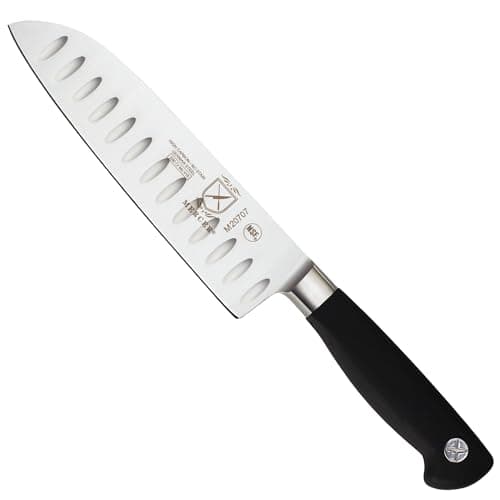
Genesis 7" santoku — for vegetable prep with a forged feel. A flatter profile and a blunt sheepsfoot tip, which suits push-cutting and chopping rather than rocking. It is the cheapest forged santoku we rank, and it will not pierce or core — that is the pattern, not a defect. Best santoku knives puts it against the Japanese-made competition.
Millennia 8" chef's knife — the cheapest knife here worth owning, and the budget pick. Stamped, one-piece, high-carbon Japanese stainless at the softest hardness in this lineup. It needs honing often and it is a plain working tool in every respect. It is also genuinely sharp, genuinely light, and cheap enough to be the right knife for a first apartment, a holiday rental or a second set — which is why it also tops best kitchen knives for arthritis on weight grounds.
What Mercer gets right, and what it does not
Right: textured handles that grip when wet, NSF certification across most of the range, a genuinely forged line at a price nobody else matches, and blade geometry in the Millennia serrated and slicing knives that beats far more expensive knives because geometry is the whole game in those categories.
Not right: steel hardness. Mercer publishes figures in the HRC low-to-mid 50s where available, which is softer than German forged knives at ~HRC 58 and much softer than Japanese knives at ~HRC 60. Soft steel means you hone more often. It also means these knives sharpen back faster than anything else in the drawer, and they are cheap enough that aggressive sharpening is no loss — so for a cook who owns a stone this is close to a non-issue, and for a cook who owns nothing it is the main limitation. Knife hardness explained has the trade-off in full.
Also not right: Mercer does not publish a Rockwell figure or a weight for several models, including the Chinese cleavers and some Millennia blades. Where that is the case, the matrix cell reads "—" rather than carrying a number we guessed.
The set question
The Genesis 6-piece forged block set is the best-value forged set we rank, and it is a reasonable purchase if you specifically want a matching block. It is still a block, with the usual block arithmetic against it: you pay for the stand and the slots, and you get knives you will not use. Knife set vs open stock runs the numbers. Buying the Millennia bread knife, the Genesis chef's knife and a paring knife separately costs less and is a better kitchen.
Keeping Mercer knives sharp
Soft European and Japanese-stainless blades in the HRC 50s are the easiest steels in this whole catalogue to maintain. A grooved steel rod works on all of them — best honing steels — and a single 1000/6000 combination stone will keep the entire set in shape: best combination whetstones and how to use a whetstone. The exception is the serrated Millennia blades, which are not practically home-sharpenable — how to sharpen a serrated knife. Treat those as long-term consumables, which at this price is a perfectly reasonable thing to do.
The verdict
Buy the Millennia 10" bread kniferegardless of what else is in your drawer — it is the best knife Mercer makes and the best bread knife we rank at any price. Buy the BPX 11" slicer if you carve roasts, the Genesis 8"if you want a forged chef's knife for very little, and the Millennia 8"if you want the cheapest knife on this site that is still worth owning. Then put $30–$40 into a combination stone, because soft steel plus a stone is a better kitchen than hard steel plus nothing.