The verdict: buy the Mac Japanese Series JU-65 6.5" vegetable cleaver. It is the nakiri for the cook who does a lot of vegetable prep and wants the thinnest blade the band will buy — Japanese-made, a published 2.5 mm spine, and the lightest knife here at a published 5.6 oz. The budget pick is the Mercer Culinary Asian Collection 7" nakiri, the cheapest knife here that genuinely does the job, and the right buy if you are not yet sure the pattern suits you. Prices render live from the price layer with the "as of" date printed under the table, and the band below was set against those same live numbers.
This page exists because the nakiri category has an unusually wide price spread for an unusually narrow set of functional differences. The most expensive nakiri we rank costs roughly five times the cheapest, and what that money buys is mostly steel hardness and finish. The things that actually make a nakiri work — a tall blade, a flat edge, no tip, a thin grind — are geometry, and geometry does not get more expensive. Under $100 you get the geometry in full.
What a nakiri is, in one paragraph
A nakiri (菜切り, roughly "vegetable cutter") is a double-bevel Japanese knife with a rectangular blade, a flat edge from heel to tip, and a blunt squared-off end instead of a point. It is built for one motion: straight down. You push-cut or chop, the whole edge meets the board at once, and the tall blade face gives you somewhere to pile the prep before you scoop it into the pan. It is not a general-purpose knife and it is not pretending to be — there is no tip, so it cannot core, pierce, trim or break down a chicken. What is a nakiri knife is the longer version, and is a nakiri worth it is the honest answer to whether you need one at all.
How the under-$100 band was set
Three nakiri in our product registry carried a verified live price under $100 at the last price check, and all three are on this page. The other three we rank — the Shun Classic, the Wüsthof Classic and the Zwilling Pro — sit well above the ceiling and are on best nakiri knives instead.
Two things worth saying plainly about that. First, the top pick sits close to the ceiling, close enough that a price rise can cross it; the live figure under each row is the one that counts and it carries the date it was fetched, so the page will never quietly contradict its own headline. Second, we did not pad the list. Three picks is the minimum we will publish a roundup on, and we would rather run three real ones than reach for a santoku or a Chinese cleaver to make it six — those are different patterns with different jobs, covered on best santoku knives and best Chinese cleavers.
The criteria, in the order they mattered
A nakiri is judged on different axes from a chef's knife, because the motion is different and the tip is missing. Here is what we weighted, and why.
- Blade thinness, first and by a distance. A nakiri spends its life going straight down through dense vegetables — carrot, squash, cabbage stem, sweet potato. The enemy is wedging: a thick blade has to force the two halves apart, which takes force and splits a carrot rather than slicing it. A thin blade behind the edge is the single biggest determinant of how a nakiri feels, and it is the reason the Mac wins. Blade geometry is the mechanism.
- Edge angle. Nakiri are ground acutely — near 15° per side on Japanese-made blades. Less force per cut, cleaner separation, and a visibly better cut face on something like a tomato or a cucumber. Knife sharpening angle covers what that means when you maintain it.
- Blade height. The whole ergonomic case for the pattern. Enough height keeps your knuckles clear of the board on a straight-down chop and gives you a face wide enough to carry prep. Every pick here is tall enough; this was a pass/fail rather than a ranking axis.
- Weight, and specifically lightness. A nakiri is a repetition tool. You make hundreds of identical strokes dicing an onion or shredding a cabbage, and mass you have to lift every time is a cost, not a feature. This is the opposite of how we weight a German chef's knife.
- Handle security when wet. Vegetable prep is wet work. A textured polymer handle genuinely outperforms smooth wood here, which is why the cheapest knife on this page beats the mid-priced one on one axis.
- What we deliberately did not weight: edge retention. Vegetables are not abrasive. A nakiri used on vegetables, on a wood board, holds an edge far longer than the same steel used on a chef's knife doing everything. Hardness is worth less here than in any other category on the site, which is precisely why a $100 ceiling costs you so little.
Who each pick is for
1. Mac Japanese Series JU-65 6.5" — for the cook whose prep is mostly vegetables, and the top pick. Mac publishes a 2.5 mm blade thickness and a 5.6 oz weight for this knife, made in Japan, ground acutely. Those two numbers are the whole argument: it is the thinnest and the lightest blade on this page, so it wedges less and costs you less effort per stroke than anything else here. It is also our overall number one on best nakiri knives — the premium Shun and Wüsthof nakiri do not beat it, they just cost more.
Honest cons:it is the most expensive knife on this page by a wide margin and sits near the band ceiling. The thin hard edge is the least forgiving here — it will chip on a squash seed cavity, a frozen edge or a glass board where a softer blade would roll. The riveted handle is smooth rather than textured, which is a real downgrade on wet hands. And it is a specialist: with no tip, it cannot do a single thing a paring knife does. Full JU-65 review.
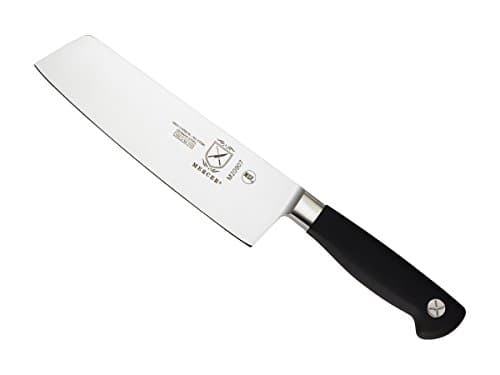
2. Mercer Culinary Genesis 7" nakiri (M20907) — for the cook who wants a forged knife and a bolster. Forged from a single billet with a full tang and a bolster, in German steel, with a textured Santoprene handle. Forged construction in a nakiri at this price is genuinely unusual, and what it buys is feel: more mass behind the handle, a steadier knife for someone who does not chop often, and a bolster to brace a pinch grip against. Seven inches is also the longest blade here, which helps on a wide cabbage.
Honest cons: softer German steel means you hone it noticeably more often than the Mac, and it is ground less acutely, so each cut takes a little more force. It is heavier, which on a repetition tool is a genuine negative rather than a sign of quality. And the forged bolster is the one thing that will eventually complicate sharpening the heel. See forged vs stamped knives for why forging matters less on this pattern than on a chef's knife.
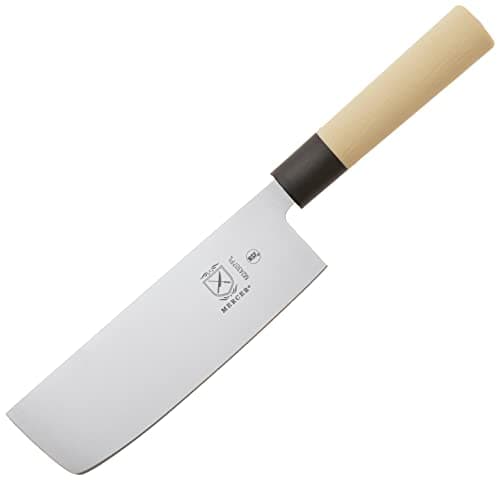
3. Mercer Culinary Asian Collection 7" nakiri — for finding out whether you want a nakiri at all, and the budget pick. Stamped thin, in high-carbon steel, on the textured NSF-certified Santoprene handle Mercer uses across its commercial lines. Two real advantages over the knife above it: the stamped blade is thinner than the forged Genesis, and the handle is the most secure on this page when your hands are wet. It is also cheap enough that buying it to try the pattern is close to free, which matters because a meaningful number of cooks try a nakiri and go back to a chef's knife.
Honest cons:the softest steel here, so it needs honing most often and will not hold an edge like the Mac. Mercer publishes no Rockwell figure for the Asian Collection, so that cell in the matrix reads "—" rather than carrying a number we invented. The finish is purely functional, and nothing about the knife is pleasant to look at. It also tops best Mercer knives' value argument: the cheap line wins where geometry decides the outcome.
What $100 does and does not buy in a nakiri
Worth being precise, since this is a page defined by a ceiling.
You get the full geometry. Tall blade, flat edge, no tip, thin grind. There is no nakiri at any price with better geometry than the Mac on this page — the premium knives are not thinner, they are harder and better finished.
You get a genuine Japanese-made blade. The top pick is made in Japan and ground acutely. That is the thing most buyers think they have to spend $150 for.
You get forged construction, if you want it. The Genesis is forged, full-tang and bolstered.
You do not get HRC 60-plus hardness with a finished edge. The Shun Classic nakiri is published harder and arrives with a keener factory edge than anything here. In this category that buys less than it sounds like, because vegetables are not abrasive — but it does mean longer between sharpenings.
You do not get Damascus cladding or a wa handle. Cosmetic, pleasant, and irrelevant to the cut. Damascus steel knives explained is blunt about which parts are functional.
Nakiri or santoku, if you are choosing one
This is the real decision for most people, and it is not close once you know what you cook. A nakiri is taller, perfectly flat and tipless: it is the better vegetable knife and nothing else. A santoku is shorter in height, has a slight belly and a usable (if blunt) sheepsfoot tip, so it can do a bit of everything — it is a small general-purpose knife that happens to be good with vegetables.
If you already own a chef's knife and want something that is genuinely better at the vegetable half of your prep, buy the nakiri. If you want one knife to replace the chef's knife on a small board, buy the santoku. Santoku vs nakiri runs it properly, and chef knife vs nakiri is the comparison if a nakiri would be your only knife, which we do not recommend.
Sharpening a nakiri, which is easier than it looks
A flat edge is the easiest profile on this site to sharpen freehand. There is no belly to roll through and no tip to taper, so you hold one angle and work heel to tip in straight passes. The tall blade also gives you a large, obvious reference surface against the stone, which is exactly what beginners lack on a curved chef's knife.
The one thing not to do is rock the knife while sharpening, which is the reflex a chef's knife teaches and the thing that rounds a flat nakiri edge into a useless curve. How to sharpen a nakiri knife is written for exactly this, and how to use a whetstone is the general method.
On tools: the Mac wants a 1000/6000 combination stone and a fine ceramic rod for maintenance, not a grooved steel rod, which can chip hardened Japanese steel. Both Mercers are soft enough to tolerate a steel rod happily. Best combination whetstones and whetstones under $50 are the two shortlists, and ceramic vs steel honing rod is the rod question.
Storage is worth a thought before you buy. A tall nakiri does not fit every knife-block slot and will not lie flat in some in-drawer trays. A magnetic strip or an edge guard is the usual answer — best knife storage.
The verdict
Buy the Mac JU-65if vegetables are most of your prep and you will keep it off bone, frozen food and glass. A published 2.5 mm spine at 5.6 oz is the lowest-effort vegetable cut available on this site at any price, and the premium nakiri above the band do not improve on it — they just last longer between sharpenings.
Buy the Mercer Genesis 7" if you want a forged knife with a bolster and more mass in the hand, and accept more honing and a little more force per cut. Buy the Mercer Asian Collection 7"if you are testing whether the pattern suits you, if you cook with wet hands, or if the budget is the binding constraint — it is thin, it is secure, and it is cheap enough that the decision is reversible. Then put $30–$50 into a combination stone, because a flat edge is the easiest thing in the kitchen to keep sharp and the most obvious when it is not.
Two neighbouring pages finish the vegetable-knife picture. If a flatter general-purpose blade would suit you better than a tipless one, the best value in that shape is a Victorinox granton santoku — best Victorinox knives ranks it top of the brand. And if you are shopping this price band for a main chef's knife rather than a vegetable specialist, Dalstrong alternatives covers what roughly the same money buys there.