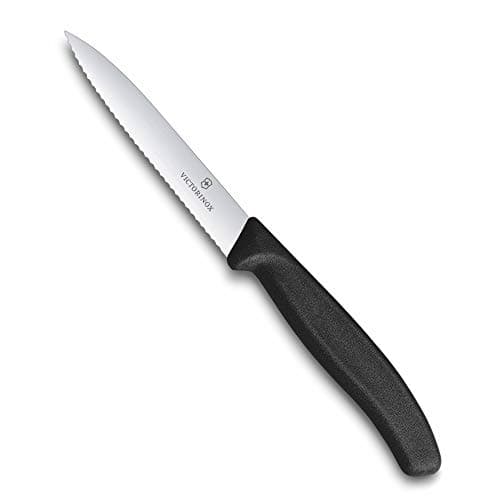
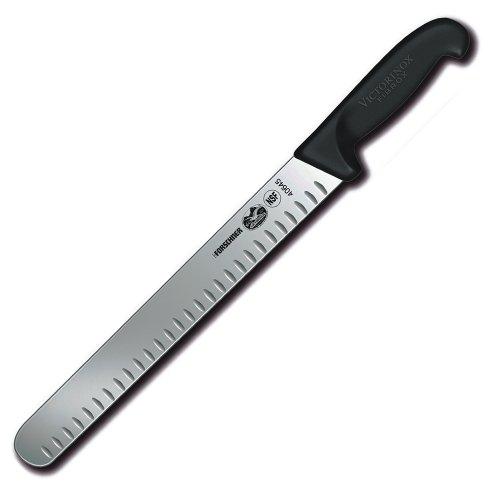
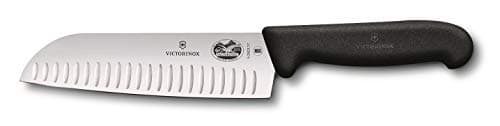
The verdict: if you own no Victorinox, buy the Fibrox Pro 8" chef's knife. It is the default answer to "what is a good first chef's knife" and the knife this whole site keeps arriving back at. The highest-scoring Victorinox knife on our rubric is the Fibrox Pro 7" Granton santoku — it wins its own category outright, which the chef's knife does not. The budget pick is the Swiss Classic 4" serrated paring knife, the cheapest knife here and the most-reached-for blade in a lot of kitchens. Prices render live from the price layer with the "as of" date printed under the table.
One clarification first, because the brand name pulls in two different audiences: this page is about kitchen cutlery only. Victorinox also makes the Swiss Army knife, and pocket knives, EDC and camping tools are a different category that this site does not cover. Everything below is a kitchen knife.
The two lines, and which one you want
Nearly all Victorinox kitchen confusion comes from not knowing that there are two ranges sold side by side at similar prices.
- Fibrox Pro— the commercial line. Stamped blades with a textured TPE handle (that is what "Fibrox" is), NSF-certified for professional kitchens, built around grip security when your hands are wet or greasy. Ugly, light, and the reason restaurant kitchens buy them by the dozen. This is the line for anything you will use hard: the chef's knife, the boning knife, the bread knife, the slicer, the santoku.
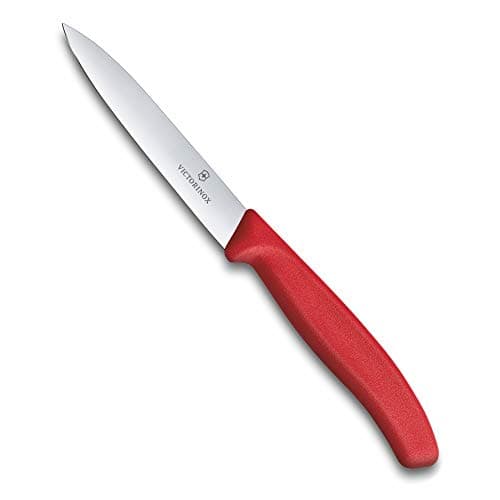
- Swiss Classic— the domestic line. Smaller blades on moulded polypropylene handles, in colours, sold at supermarket prices. This is the line for the small knives: paring, serrated paring. It is not a worse line, it is a line aimed at shorter, lighter cuts where handle bulk is a nuisance.
The practical rule: Fibrox Pro for anything with a handle you need to hold firmly, Swiss Classic for anything you hold in your fingers. Both lines run the same soft-ish Swiss stainless, so the choice is ergonomics rather than metallurgy.
The criteria, in the order they mattered
Judging a single brand means the usual steel-and-hardness axis barely separates anything — almost every blade here is X50CrMoV15 or a high-carbon Swiss stainless published around HRC 55–56. So the ranking turns on the other axes.
- Does it win its own category? The top of this list is made of knives that beat every competitor in their own roundup, not just every other Victorinox. That is a higher bar than "good for the money."
- Blade geometry for the job. Where a category is decided by shape rather than steel — serrated bread knives, granton slicers, paring knives — a cheap stamped blade with the right geometry beats an expensive one with the wrong geometry. That is most of why this brand punches above its price. Blade geometry is the mechanism.
- Grip security when wet. The Fibrox handle is the brand's actual competitive advantage and it is worth more in a real kitchen than a Rockwell point.
- Sharpenability. Soft steel at ~HRC 55–56 comes back on any stone in minutes and tolerates a grooved steel honing rod. Over ten years that is worth more than the edge retention it gives up — the easiest knives to sharpen makes the case.
- Verified live availability. Only products with a verified live price from the price layer are ranked. Several Victorinox kitchen items we hold in the registry had no buyable offer at the last price check, so they are not on this list.
- What we did not weight: edge retention and looks. Soft Swiss steel loses on edge retention to any Japanese blade and nothing Victorinox makes is beautiful. Both are true, both are the price of admission, and neither moved a rank.
Who each pick is for
1. Fibrox Pro 7" Granton santoku — for vegetable prep on a budget, and the highest-scoring knife here. Published as X50CrMoV15 at ~HRC 55–56, 7 in, stamped with a full tang and a Fibrox handle, with a granton (fluted) double-bevel edge. The dimples genuinely reduce the suction that makes wet potato and cucumber slices cling to the blade, and the flatter santoku profile suits push-cutting. It is the value winner on best santoku knives, where it sits against Japanese blades costing three times as much.
Honest cons:Victorinox publishes no weight for this model, so that cell reads "—". The blunt sheepsfoot tip will not pierce or core. Soft steel means frequent honing. And a stamped santoku has none of the heft some cooks want.
2. Swiss Classic 4" paring knife — for close work in the hand. Victorinox publishes a 3.9 in blade, 8.3 in overall and a weight of 1 oz, with a polypropylene handle, a straight edge and a pointed tip, Swiss made, dishwasher safe, under a lifetime warranty. This is the category where expensive steel stops paying for itself: paring cuts are short and shallow, so edge retention and blade thinness barely signify while weight and wet grip decide everything. It is the top pick on best paring knives and one of the three knives we say a kitchen genuinely needs on best kitchen knives.
Honest cons: a plain stamped blade and a plastic handle, nothing substantial about it. Victorinox publishes no steel grade or Rockwell figure for this model. The thin tip snaps if you lever with it. Full review.
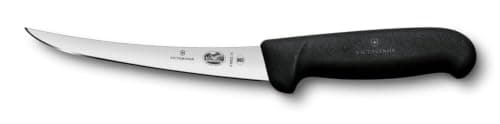
3. Fibrox Pro 6" curved boning knife, semi-stiff — for breaking down chicken and trimming roasts. X50CrMoV15, graded semi-stiff, stamped with a Fibrox Pro TPE handle, Swiss made and NSF-certified. Flex grade is the whole boning category, and semi-stiff is the right compromise: firm enough to drive along a bone, flexible enough to follow a curve. It is our overall number one on best boning knives and on best boning knives under $50.
Honest cons: Victorinox publishes no edge angle for it, so that cell is blank. It is a specialist you will not touch if you buy meat already butchered, and the narrow blade goes through a finger as readily as a joint.
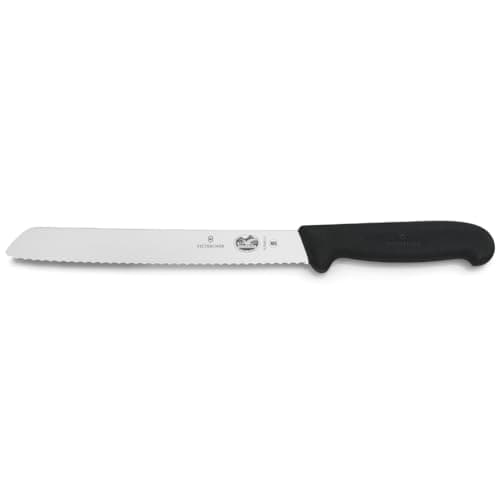
4. Fibrox Pro 10.25" bread knife — for buying a serrated knife once. A 10.25 in pointed-serrated blade in high-carbon stainless, stamped and conical ground, on a textured NSF Fibrox handle. Ten inches crosses a round sourdough in one stroke, which is what stops you sawing, and the pointed serration bites hard into a well-baked crust. It ranks second on best bread knives and on best serrated knives, behind a knife that costs a fraction of it.
Honest cons:you are paying for the handle and the build rather than a better cut — the cheap Mercer wide-wavy blade is gentler on soft crumb. A serrated edge is effectively not home-sharpenable, so this is a long-timescale consumable rather than a lifetime knife — how to sharpen a serrated knife.
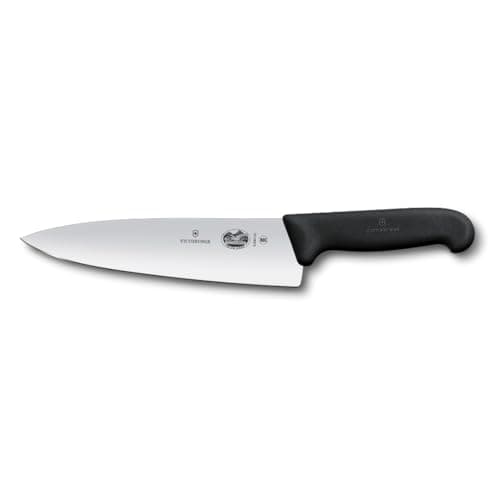
5. Fibrox Pro 8" chef's knife — the one to buy first. X50CrMoV15 at ~HRC 55–56, a ~20° edge, stamped with a full-length tang, ~6.6 oz, Swiss made and NSF-certified. It arrives genuinely sharp, the textured handle grips with wet hands, and the soft-ish steel is the easiest blade on this page to learn to sharpen on. If you are buying one Victorinox knife and you do not already own a chef's knife, buy this one regardless of where it sits in the ranking. It is on best chef knives, best chef knives for beginners and best chef knives under $50.
Honest cons:you will hone it often and sharpen it more frequently than a hard Japanese blade. The stamped blade lacks the heft and bolster some cooks want for control. And it is a tool, not an heirloom — nothing about it is beautiful. Full review.
6. Swiss Classic 4" serrated paring knife — for tomatoes and citrus, and the budget pick. A 4 in serrated spear point in high-carbon stainless at ~HRC 55–56, stamped, on a textured polypropylene handle. A straight paring edge slides off tomato skin and crushes the flesh behind it; micro-serrations pierce the skin instead, and they stay grippy for years without sharpening. It is the cheapest knife on this page and the one a lot of kitchens reach for most.
Honest cons: serrations cannot practically be resharpened, so treat it as a consumable. It is useless for anything needing a clean straight cut, and the spear point is not as precise as the straight paring knife above it. It also ranks on best serrated knives.
7. Fibrox Pro 12" Granton edge slicer — for big roasts, whole birds and brisket. Published as an 11.8 in rounded-tip blade with a granton (fluted) edge at ~6.2 oz, stamped, NSF, Swiss made. The length crosses a full-width cut in one draw and the granton scallops break the suction that makes a warm slice cling and tear. It is the full-packer pick on best brisket knives and ranks on best carving knives.
Honest cons: Victorinox publishes neither the edge angle nor the steel grade for this model, so two matrix cells are partial. Twelve inches is unwieldy for anything else in a home kitchen, and it will not fit most knife blocks. The rounded tip means it cannot do any detail work at all.
What is deliberately not on this list
The 10" Fine Cut honing steel. It is the highest-scoring Victorinox product on this entire site — and it is not a knife, so it is not on a knives list. It is also the single cheapest thing you can buy to make every blade above perform better. See best honing steels and the full honing steel review.
The Fibrox Pro 3-piece set. A genuinely sensible bundle — chef's, paring, serrated — but a set rather than a knife, and its spec shape does not line up with the matrix above. It is ranked on best chef knife sets, and knife set vs open stock runs the arithmetic on whether to buy it that way.
Anything without a verified live offer at the last price check. Victorinox's kitchen range is wider than this page — a 10" Fibrox chef's knife, a Swiss Classic utility knife and a Swiss Classic steak set are all in our registry — but the price layer showed no buyable offer for them when it last ran. We do not rank what we cannot confirm you can buy, and we show no number rather than a number that has rotted. They appear on their own category roundups, where their availability is stated honestly.
Where Victorinox genuinely beats expensive knives
Not everywhere, and it is worth being precise about which.
Categories decided by geometry. Serrated bread knives, granton slicers and paring knives are decided by scallop shape, blade length, blade face and weight — not by steel. A stamped Swiss blade with the right shape beats a forged German one with the wrong shape, every time.
Categories decided by grip. Boning and butchery are wet, greasy, awkward work. The Fibrox handle is the best thing about the brand and it wins the boning category outright against knives at four times the price.
Categories decided by sharpenability. If you own a stone, soft Swiss steel is a feature. It comes back to screaming sharp in minutes and it tolerates a steel rod. The practical sharpness of a knife over a decade is a function of how willing you are to maintain it, and these are the least intimidating blades in the kitchen to work on.
Where it loses: edge retention and the cut itself. At ~HRC 55–56 ground near 20°, a Victorinox will not hold an edge like a Japanese knife at ~HRC 60 ground near 15°, and it does not cut as cleanly when both are sharp. If you want the best cut rather than the best value, that is a different page — best gyuto knives and Japanese vs German knives.
Keeping them sharp
Every knife on this page except the two serrated blades is soft enough that a grooved steel honing rod works properly — realign weekly and most kitchens only need a stone two or three times a year. Sharpening vs honing is the distinction most owners have backwards, and how to hone a knife is the two-minute routine.
For actual sharpening, a single 1000/6000 combination stone will keep the whole lineup in shape: best combination whetstones and the stones for softer European steels. None of these knives has a full bolster, so you can work the entire edge heel to tip without fighting anything — one more quiet advantage of a stamped blade.
The verdict
Buy the Fibrox Pro 8" chef's knifefirst if you do not already own a good chef's knife. Buy the Fibrox Pro 7" Granton santoku if most of your prep is vegetables and you want the highest-scoring knife the brand makes. Buy the Swiss Classic 4" paring knife and the Swiss Classic 4" serrated paring knifetogether — between them they cost less than a restaurant main and they cover every small job in the kitchen.
Add the Fibrox Pro 6" boning knife if you break down your own meat, the Fibrox Pro 10.25" bread knife if you want a serrated blade that will outlast the kitchen, and the Fibrox Pro 12" slicer only if you carve big cuts. Then buy the honing steel, which is not on this list and is still the best thing the brand sells.
Two related pages, if you arrived here comparing brands rather than blades. Dalstrong alternatives ranks the Fibrox Pro 8" against a Gladiator and three other forged knives on published specs. And if the granton santoku above appeals because most of your prep is vegetables, best nakiri knives under $100 covers the taller, flatter, tipless alternative in the same price band.