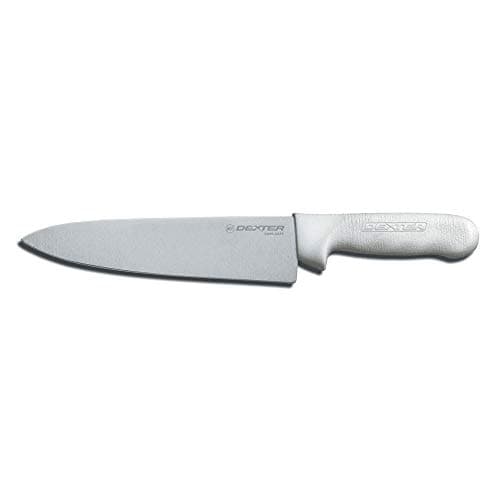
The verdict: the Dexter-Russell Sani-Safe 8" is the Cutco alternative to buy. It is the pick for the buyer whose main reason for owning Cutco is that it is made in the United States and built to be used hard — the Sani-Safe is made in Massachusetts, NSF-certified, sealed at the blade-to-handle joint, and priced to be replaced without a second thought. The budget pick is the Mercer Culinary Genesis 8", the cheapest forged, full-tang, bolstered knife here. Prices render live from the price layer with the "as of" date printed under the table.
What Cutco actually is
Worth stating accurately before comparing anything to it, because this is a brand people have strong feelings about in both directions and the published facts are more useful than either camp.
Cutco has manufactured cutlery in Olean, New York since 1949and markets itself as "American-Made Knives. Guaranteed Forever." Its blades are published as 440A high-carbon stainless with a highly engineered thermo-resin handle. Its 9¼" French Chef knife (item 1725C) is listed with a 9½" blade, 15¼" overall length, a straight edge and a weight of 8.1 oz. The Forever Guaranteestates that performance is guaranteed, that this includes free sharpening, and that if you are not satisfied Cutco will correct the problem or replace the product; a nominal return shipping and handling fee applies. The company's signature Double-D edgeis a series of three distinct small recessed cutting edges running the length of the blade, so the sharp sections sit below the points and avoid contact with surfaces that dull them — and Cutco re-sharpens that edge for you under the same guarantee.
Several of those are genuinely strong propositions. Domestic manufacture in one plant for over seventy-five years is rare in this category. A guarantee that includes sharpening solves the single biggest reason home knives stop cutting, which is that nobody sharpens them. And the Double-D edge is a real engineering answer to a real problem — an edge that survives being used on the wrong surfaces. This page is not an argument that any of that is untrue.
The two reasons people shop around come off the same spec sheet:
- The specifications a spec-literate buyer wants are not published. Cutco states the alloy (440A) and the handle material, but its product listings do not publish a Rockwell hardness figure or an edge angle per side. Those two numbers are what this site ranks knives on, because together they tell you how long an edge lasts and how much force a cut takes. Their absence is not a defect in the knife; it just means you cannot compare it on the axes that matter most to a buyer who thinks in specs — knife hardness explained is why those numbers carry so much weight here.
- The Double-D edge ties maintenance to the manufacturer. A recessed serrated edge cannot be practically sharpened on a stone at home — which is exactly why the free-sharpening guarantee exists, and the two features are designed as a pair. If you would rather own an edge you can restore yourself in ten minutes at the sink, a straight edge on ordinary stainless is a different relationship with your own knives. Neither is wrong; they are opposite philosophies. How to sharpen a serrated knife explains why scalloped edges are a different job entirely.
The five alternatives, and what each one matches
1. Dexter-Russell Sani-Safe 8" — matches the American manufacture, at foodservice prices. The top pick. Made in Massachusetts, DEXSTEEL high-carbon stainless, stamped, with a sealed blade-to-handle joint and a textured polypropylene handle, NSF certified. If the reason you own Cutco is that it is made here and built to be used rather than displayed, this is the same proposition from the other end of the market: it is the knife American delis, butcher counters and school kitchens actually buy, and it is cheap enough to replace without thinking about it.
Honest cons:Dexter publishes no Rockwell figure, no bevel angle and no weight for this knife, so three cells in the matrix above read "—" rather than carrying an invented number — which means it shares exactly the documentation gap we noted about Cutco. It is stamped, not forged, with no bolster and no heft. The handle is sealed and sanitary rather than comfortable over a long prep session. And there is no lifetime sharpening service of any kind — the assumption is that you sharpen it or replace it. Our Dexter vs Victorinox comparison runs it against the next pick.
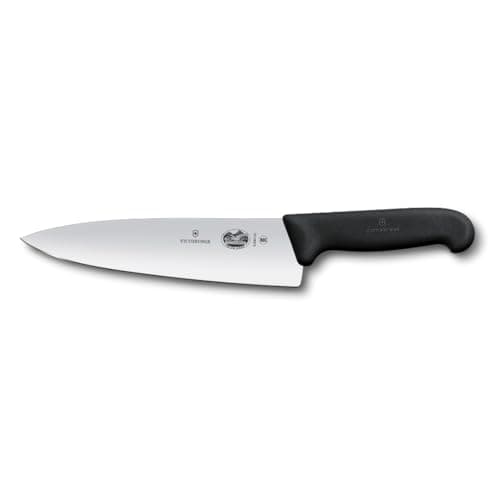
2. Victorinox Fibrox Pro 8" — matches the built-to-be-used case, with the specs published. X50CrMoV15 at a published ~HRC 55–56, ground at ~20° per side, stamped with a full-length tang, ~6.6 oz, Swiss made and NSF-certified. This is the knife this entire site keeps arriving back at for a first good chef's knife: light, tough, easy to sharpen, and documented. The textured Fibrox handle is the best wet grip in its price band, which matters more in practice than a handle that looks better.
Honest cons:it is plainly a tool — nothing about it is handsome, and it will not look like an heirloom on a magnetic strip. Stamped, so there is no bolster and no mass behind the handle. At ~HRC 55–56 and ~20° it is soft and relatively obtuse, so it needs honing weekly and sharpening a few times a year. Victorinox warrants against defects; it does not sharpen your knives for you. Best Victorinox knives ranks the rest of the range.
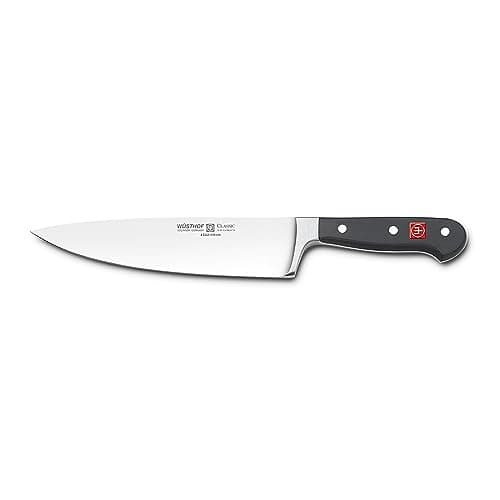
3. Wüsthof Classic 8" — matches the buy-it-forever case, with every number on the table. X50CrMoV15 at a published ~HRC 58, forged from a single billet in Solingen with a full tang and a full bolster, ground to 14° per side, around 9.0 oz. If what you want from Cutco is a knife you buy once and hand on, this is that argument made with published numbers: harder than the stamped picks above, keener out of the box than most German steel, and heavy in a way people either love or dislike immediately.
Honest cons:it is by a wide margin the most expensive knife on this page, so it is an upgrade rather than a like-for-like swap. The full bolster eventually blocks the heel of the edge from a stone after many years of sharpening. At ~9 oz it genuinely tires some hands. And it is made in Germany, so if domestic manufacture is the specific thing you were buying, this does not answer it. Best Wüsthof knives covers the line, and Wüsthof alternatives is the same exercise one tier up.
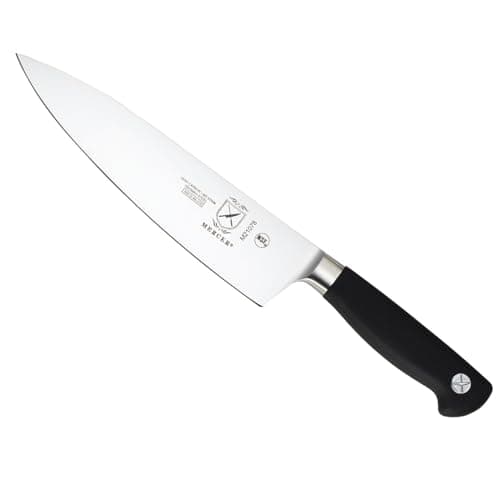
4. Mercer Culinary Genesis 8" — matches the forged, substantial feel for the least money. The budget pick. Forged from a single billet with a full tang and a short bolster, in X50CrMoV15 at ~HRC 56, with a textured Santoprene handle, around 8.5 oz. This is the cheapest knife here and the only cheap one that feels like a serious knife in the hand: the heft and the bolster are the things people usually mean when they say a knife feels well-made, and this delivers both at a stamped-knife price.
Honest cons:the molded Santoprene handle is a commercial-kitchen handle, not tableware, and nobody buys this knife for how it looks. Ground at ~20° per side, so it arrives less keen than a Wüsthof. The same soft-steel edge-retention ceiling applies as to everything else in German stainless. And the bolster, though short, is still a bolster on a stone. Best Mercer knives covers the rest of the range.
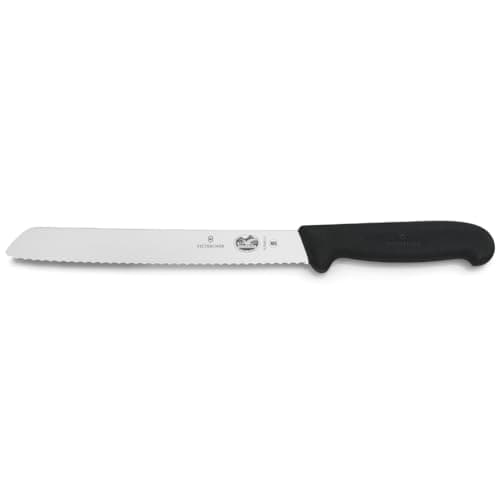
5. Victorinox Fibrox Pro 10.25" serrated — matches the maintenance-free serrated edge. A 10.25 in (26 cm) pointed-serrated blade in high-carbon stainless, conical ground, on the same textured Fibrox handle. If the Cutco blades you actually reach for are the serrated ones — which, for most households, they are — this is the direct replacement: a serrated edge that stays usable for years with no attention at all, long enough to take a big sourdough or a roast in one stroke, and cheap enough that replacing it eventually is not an event.
Honest cons:like any serrated blade it cannot be sharpened at home in any practical way, so when it finally dulls you replace it rather than restore it — and unlike Cutco, nobody will sharpen it for you. Victorinox does not publish a steel grade or an edge angle for this blade, so those cells are thin. At 10.25" it is long for a small kitchen drawer. And it is a bread-and-roast blade, not a general-purpose knife — it does not replace a chef's knife. Best bread knives is the category.
Which alternative fits which reason
- "I want a knife made in America." The Dexter-Russell Sani-Safe. Made in Massachusetts, NSF-certified, and the default blade behind a great many American foodservice counters.
- "I want to know what the steel actually is." The Victorinox Fibrox Pro or the Wüsthof Classic. Both publish alloy, hardness and edge angle, which is the information this site ranks on.
- "I want something I buy once and keep." The Wüsthof Classic 8". Forged in Solingen, ~HRC 58, 14° per side, and it will outlive you if you hone it.
- "I liked the weight and the solid feel, not the price." The Mercer Genesis. Forged, bolstered, full tang, and the cheapest knife on this page.
- "The ones I actually use are the serrated ones." The Victorinox Fibrox Pro 10.25" serrated for bread and roasts.
- "I want someone else to keep my knives sharp forever." Then keep the Cutco. Nothing on this page comes with a sharpening service, and that is a genuine feature if you are never going to own a stone. The alternative is to buy one — best whetstones under $50 costs less than most single knives here and covers every blade you own, and professional knife sharpening is the no-stone version of the same answer.
The spec gap, and why it decides this page
It is worth isolating the one thing that separates how Cutco presents a knife from how everything on this page does.
Cutco publishes the alloy — 440A high-carbon stainless — and the handle material, and lets the guarantee carry the rest of the argument. That is a coherent position: if the company will keep the edge sharp forever, the hardness number matters less to the owner than it does to a reviewer. Most of the picks above take the opposite position: here is the Rockwell figure, here is the grind angle, you maintain it.
Which you prefer is a real choice rather than a right answer. If you want a knife you never think about, a service-backed edge is a legitimate product. If you want to choose between blades on evidence, you need the numbers — and once you have them, the picks above are directly comparable with everything else this site ranks. How to tell if a knife is good quality is the checklist, and Japanese vs German knives is where the hardness axis leads next.
One practical note on 440A specifically: it is a long-established cutlery stainless with good corrosion resistance, and how it performs depends almost entirely on heat treatment, which is the thing nobody publishes. That is not a criticism unique to Cutco — the Dexter pick above has exactly the same gap, and we said so in its cons.
Sharpening, if you switch
Four of the five picks here are straight edges on softer European or American stainless in roughly the HRC 55–58 range. That is the most forgiving category on this site to maintain: they roll rather than chip, a grooved steel rod genuinely works on them, and they come back on any 1000-grit stone in minutes. Hone weekly, sharpen two or three times a year. Sharpening vs honing is the distinction most people get wrong, and how to sharpen a chef knife is the routine itself.
This is the practical difference a switch makes. A Double-D edge goes back to Olean when it needs attention; a straight edge on soft stainless is ten minutes at your own sink, as often as you like, for the cost of a stone you buy once. If that sounds like a chore rather than a feature, the honest conclusion is that Cutco's model suits you and you should keep it.
The verdict
Buy the Dexter-Russell Sani-Safe 8" if American manufacture and hard use are what you were buying. It is made in Massachusetts, NSF-certified, sealed against the things that ruin handles, and priced like the foodservice equipment it is.
Buy the Victorinox Fibrox Pro 8" if you want the best-documented cheap knife in the world and the best wet grip in its price band. Buy the Wüsthof Classic 8" if you want a forged, published, buy-once knife and the budget stretches. Buy the Mercer Genesis 8" if you liked the solid forged feel and want it for the least money. And add the Victorinox Fibrox Pro 10.25" serrated if the blades you actually reach for are the serrated ones.
If the free sharpening is the part you cannot replace, keep the Cutco — nothing here offers it. If you would rather own that step yourself, a stone costs less than any knife on this page and improves every blade in your kitchen at once. Two more pages worth reading next: best chef knives for the money is the value lens on this whole category, and best steak knives under $100 is the table-knife half of the same question, where the straight-edge versus serrated decision comes up all over again.