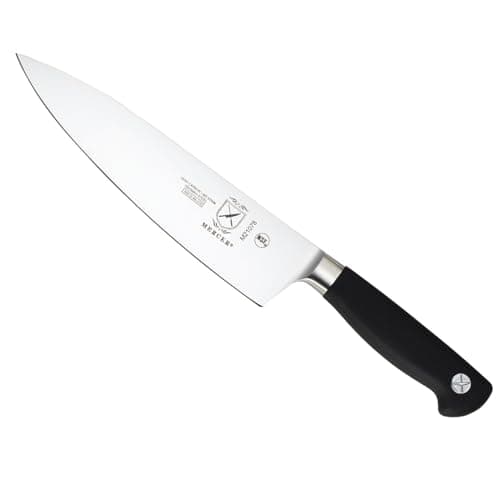
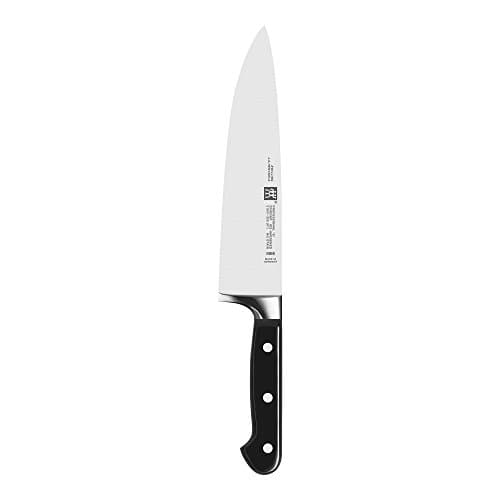
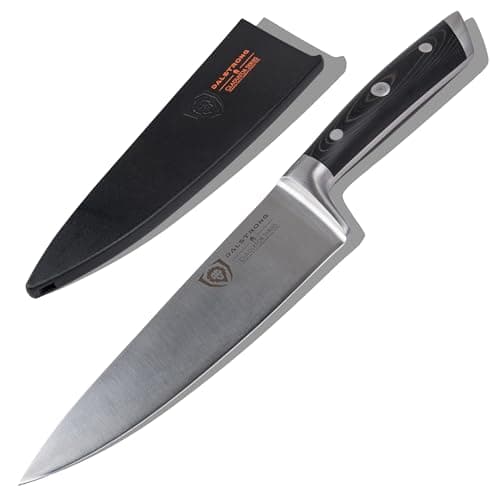
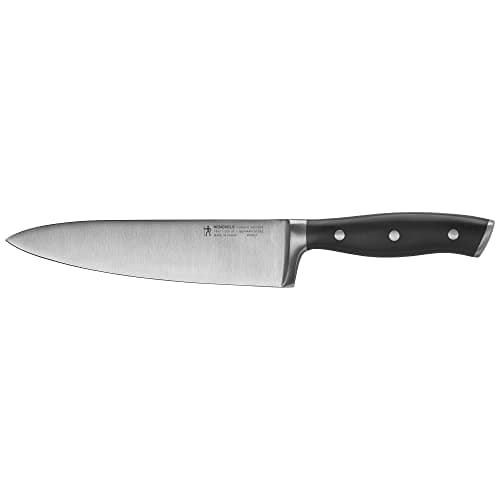
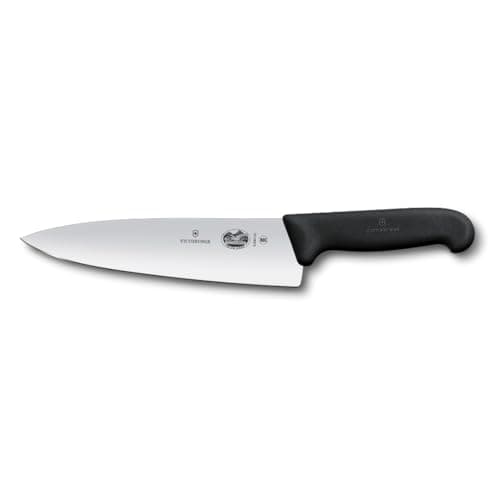
The verdict: the Victorinox Fibrox Pro 8" is the Wüsthof alternative most people should buy. It is for the cook who wants the Wüsthof's toughness and its steel without the weight, the bolster or the price — the same X50CrMoV15 alloy, lighter in the hand, and the easiest knife here to sharpen. The budget pick is the Mercer Culinary Genesis 8": the cheapest forged, full-tang, bolsteredknife here, which is the closest thing to a Wüsthof in construction at a fraction of the cost. Prices render live from the price layer with the "as of" date under the table.
What a Wüsthof Classic actually is
Wüsthof publishes, for the Classic 8" chef's knife: X50CrMoV15 stainless at roughly HRC 58, an edge ground to 14° per side(what Wüsthof calls Precision Edge Technology, replacing the older ~20° grind), forged from a single billet with a full tang and a full bolster, a triple-riveted POM handle, and a weight of about 9.0 oz (255 g). It is made in Solingen, Germany.
That is the archetypal German chef's knife and it earns the reputation: tough enough to shrug off the abuse a home cook actually inflicts, with a handle that is essentially indestructible, and a newer 14° edge that is noticeably keener than the old grind. Our Wüsthof Classic review scores it 7.6, and it ranks on best chef knives and best German chef knives.
The three reasons people look for an alternative come straight off that same specification:
- It is heavy. At ~9 oz it is a real workout over a long prep session, and it is a lot of knife for smaller hands.
- The full bolster complicates sharpening. A bolster that runs all the way to the heel eventually blocks the last inch of edge, so you cannot work the whole blade on a stone without grinding the bolster back.
- The price is high at full retail. Nothing about X50CrMoV15 at HRC 58 is exotic — it is a mainstream German stainless — so the money is going into forging, finishing and the name.
The five alternatives, and what each matches
Victorinox Fibrox Pro 8" — matches the steel, loses the weight and most of the price. The same X50CrMoV15 alloy, published at ~HRC 55–56 and a ~20° edge, stamped with a full-length tang, at ~6.6 oz — about two-thirds the weight. Swiss made and NSF-certified. It is softer than the Wüsthof, which means more frequent honing and the easiest sharpening of anything on this page, and it has no bolster to get in the way. For the cook whose reason for wanting a Wüsthof was "a tough knife that will not let me down," this does that for a fraction of the money. See victorinox vs wusthof.
Mercer Culinary Genesis 8" — matches the forged construction. The budget pick. Forged, full tang, bolstered, in German steel, with a textured Santoprene handle. If what you want from a Wüsthof is the construction— the heft behind the handle, the forged billet, the bolster — this is the cheapest honest way to get it, and it is the cheapest knife on this page. The handle is molded rather than riveted POM, and the finish is plainly a commercial-kitchen finish rather than a showpiece. mercer vs wusthof is the head-to-head.
Zwilling Professional S 8" — matches the idiom and fixes the bolster. The other Solingen house, forged in German steel with a full tang, and with a curvedbolster rather than a full one — so you can sharpen heel to tip without fighting it. This is the direct like-for-like substitute: same city, same tradition, same alloy class, and the single best answer if the full bolster was your objection. wusthof vs zwilling and zwilling vs henckels sort out the family tree, which confuses almost everybody.
Dalstrong Gladiator 8" — matches the forged build, at a lower price and with more presence. Forged high-carbon German steel, full tang, with a thicker spine and a G10 handle. It is the showier object, it costs well under the Wüsthof, and it comes with a sheath. The trade is brand substance: Dalstrong is a marketing-led company rather than a 200-year-old cutler, which matters to some buyers and not to others. dalstrong vs wusthof.
Henckels Forged Accent 8" — matches the forged German build at the lowest price from a Solingen name. Forged, full tang, German steel, from Zwilling's value line. If you want a genuinely forged German knife from a long-established maker and the Wüsthof is simply out of budget, this is the route. Fit-and-finish is a step below the Classic, which is exactly what the price difference represents — henckels vs wusthof.
Which alternative fits which reason
- "It is too heavy." The Victorinox Fibrox Pro, at roughly two-thirds the weight. If you want lighter still, a Japanese knife is the answer — best lightweight chef knives.
- "The full bolster blocks the heel." The Zwilling Professional S, whose curved bolster is specifically designed around that problem. The Victorinox has no bolster at all.
- "I want forged, but cheaper." The Mercer Genesis first, then the Henckels Forged Accent.
- "I want a keener edge." None of these — the Wüsthof's 14° grind is already the keenest German edge here. Go Japanese: ~HRC 60 at 15° or 16°, which is a different performance class and a different maintenance commitment. Start with shun vs wusthof or best gyuto knives.
- "I just want the cheapest knife that is actually good." The Mercer Genesis or the Victorinox, and then spend the difference on a stone.
Sharpening any of these
All five are softer European stainless steels in the HRC 55–58 range, which is the good news: they roll instead of chipping, they tolerate a grooved steel honing rod, and they come back on a stone fast. Hone weekly, sharpen a few times a year — sharpening vs honing is the distinction most owners have backwards, and best honing steels is the rod shortlist.
For actual sharpening, the stones for German knives is the page written for exactly this hardness range, and best sharpening systems is the guided route if freehand is not for you. Note the bolster problem applies to the Wüsthof and the Mercer and not to the Zwilling or the Victorinox.
The verdict
Buy the Victorinox Fibrox Pro 8"if your reason for wanting a Wüsthof was a tough, reliable workhorse: same alloy, two-thirds the weight, a fraction of the price, and the easiest blade here to keep sharp. Buy the Mercer Genesis 8" if you want forged construction on the smallest budget, and the Zwilling Professional S if you want a true like-for-like Solingen knife with a bolster that does not fight the stone. And if what you actually wanted was a keener edge rather than a cheaper knife, the honest answer is a Japanese blade, not a different German one.
If the conclusion you reach is that a Wüsthof is worth it after all, the follow-up question is which one: best Wüsthof knives ranks seven blades from the line on their published specs and explains where the forged Classic range stops being worth the money.