The verdict: the MAC MTH-80 is the Shun alternative to buy. It is for the cook who wants the Shun Classic's thin, hard, acute cutting behaviour without the D-shaped handle or the Damascus premium — published at ~HRC 59–61 and ground near 15°, with a symmetrical Western handle that suits either hand. The budget pick is the Tojiro DP 210 mm: a VG10 core at a published ~HRC 60, clad like the Shun, for roughly half the price. Every figure below comes from the makers' own published specifications, and prices render live from the price layer with an "as of" date under the table.
What a Shun Classic actually is
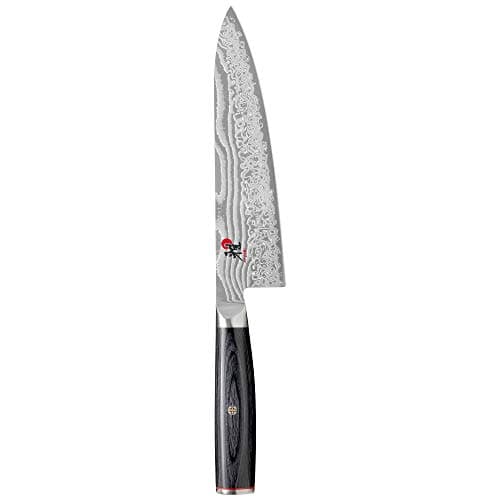
Worth stating accurately before comparing anything to it, because "Shun alternative" usually gets written by people who have not read the spec sheet. Shun publishes, for the Classic 8" chef's knife (DM0706): a VG-MAX cutting core, clad in 68 layers of stainless Damascus (34 per side), a hardness of roughly HRC 60–61, a 16° per side double-bevel edge, a bolsterless build, and a D-shaped PakkaWood handle. It is made in Seki, Japan.
That is a genuinely good knife and it is not a marketing exercise: the Damascus cladding is functional — a soft stainless jacket around a hard core, which is how you get HRC 61 steel into a kitchen knife without it being brittle — and the 16° edge is keener than anything German. Our own Shun Classic review scores it 8.0 and ranks it fourth on best chef knives.
So why look elsewhere? Three reasons, all of which come straight off Shun's own specification rather than from anything we think about the brand:
- The D-shaped handle is built for right-handers. That is a design choice, not a flaw, but it is a real problem if you are left-handed.
- HRC 60–61 at 16° is a demanding edge. Hard, thin steel chips if you treat it like a German knife — bone, frozen food, a glass board, a dishwasher.
- You pay a premium for the finish. The 68-layer cladding takes work, and the price reflects it. If the finish is not what you are buying, there is money on the table.
The four alternatives, and what each matches
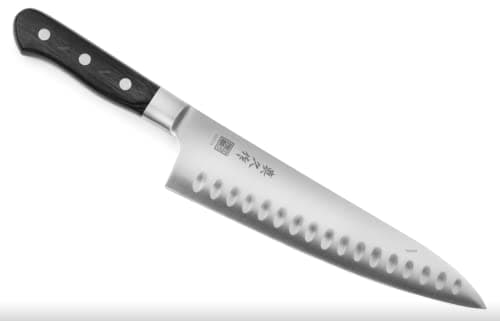
MAC MTH-80 — matches the hardness and the acute grind, loses the Damascus. Published at ~HRC 59–61 and ground near 15° per side — so marginally moreacute than the Shun — with a dimpled hollow edge and a symmetrical Pakkawood Western handle that works in either hand. It is thin where thinness matters and it is our overall number one. The trade is honest: no Damascus pattern, and a plainer object. For the cook whose reason for wanting a Shun was "it cuts beautifully," this is the knife.
MIYABI Kaizen II — matches the Damascus and the hardness, and then some. If what you want is a hard Japanese core in Damascus cladding with a very keen factory edge, Miyabi is the direct equivalent — also made in Seki, also clad, published harder than the Shun and ground finer. It costs about the same, so this is not a saving: it is the alternative for someone who wants the Shun formula from a different maker, or who wants the keenest out-of-box edge we rank. See miyabi vs shun for the head-to-head.
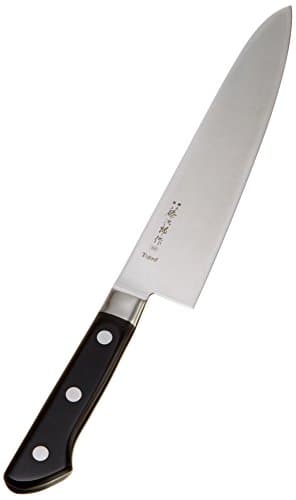
Tojiro DP 210 mm — matches the clad construction and the hardness at roughly half the price. The budget pick. A VG10 cutting core at a published ~HRC 60, clad in soft stainless, ground near 15°. Structurally it is doing exactly what the Shun does — hard core, soft jacket — with the cladding left plain instead of patterned and the handle left utilitarian. If your question was literally "like a Shun but cheaper," this is the answer, and tojiro vs shun is the detailed comparison.
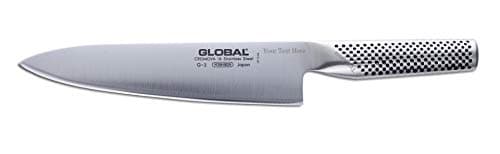
Global G-2 — matches the Japanese origin and solves the handle. A one-piece stainless knife with a dimpled hollow handle, made in Japan, with no wood anywhere and nothing to oil or loosen. It is softer and less acute than the others here, so it is not the pick if you want the keenest edge — it is the pick if you want a Japanese knife that is seamless, light, fully symmetrical and genuinely dishwasher-tolerant. See global vs shun.
Which alternative fits which reason
- "I am left-handed." The MAC MTH-80 or the Global G-2 — both have symmetrical Western handles. The MIYABI Koya, a wa-handled knife with an octagonal grip, is the other good answer: see best chef knives for left-handed cooks.
- "I want the same cut for less." The Tojiro DP. Same clad-hard-core idea, plain finish, roughly half the money.
- "I want the Damascus look." The MIYABI Kaizen II is the straight substitute, at a similar price.
- "I do not want to baby a knife." None of these, honestly. Go German: ~HRC 58 and a 14°–20° edge, which rolls instead of chipping — best German chef knives and Japanese vs German knives.
- "I want a hollow handle I never have to maintain." The Global G-2.
If you keep the Shun, keep it sharp properly
This page is not an argument against buying a Shun — it is a list of knives that match it on a specific strength. If you own one, or buy one anyway, the maintenance is the same across everything on this page: a hard, acute Japanese edge wants a fine ceramic rod for honing and a whetstone for sharpening, not a grooved steel rod and never a pull-through ground for 20°.
Ceramic vs steel honing rod explains why, and the stones for Japanese knives is the shortlist. A 16° edge also needs a sharpener that can hold that angle, which rules out most fixed-angle electrics — best sharpening systems.
The verdict
Buy the MAC MTH-80 if you wanted a Shun for the way it cuts: harder-or-equal steel, a slightly more acute grind, and a handle that does not care which hand you use. Buy the Tojiro DPif you wanted a Shun and the price stopped you — it is the same construction with the decoration removed. Buy the MIYABI Kaizen II if you wanted the Damascus and the keenest possible factory edge, and the Global G-2 if you wanted a Japanese knife with nothing to look after. And if your real objection was that hard Japanese steel needs care, the honest alternative is not on this page: it is a German knife.