Skip to content
Bevel & Bone

HUB 01 · Chef Knives

Best Bread Knives Under $50

Fifty dollars is more than enough for a bread knife, and that is the point: serrations barely re-sharpen, so money spent above this band buys feel rather than better bread.

By Stephen V.Updated How we choose
#ad

We earn a commission when you buy through our Amazon links, at no extra cost to you. It never changes a ranking, and we say so when the cheaper knife is the better buy. How this works.

The verdict: the Mercer Millennia 10" wide wavy edge is the bread knife to buy under $50. It is for anyone who cuts bread — which is to say almost everyone — and it is also the budget pick, because the cheapest knife in this band is genuinely the best one in it. Ten inches of wide wavy serration in high-carbon Japanese stainless clears a big sourdough in one draw, and it costs about what a loaf of good bread and a coffee do. The Millennia 9" offsetis the one to buy instead if your knuckles keep hitting the board. Prices render live from the price layer with the "as of" date printed under the table.

This page ranks only knives that carried a verified live price under $50 at the last price-layer run — and all three of them are Mercer. That is not laziness and it is not a sponsorship: under $50 the serrated-knife market is Mercer's, and the three blades below are genuinely different tools rather than three colours of the same one. The next knife up our main list, the Victorinox Fibrox Pro 10.25", sat just above the ceiling at the last check, so it is named here rather than quietly omitted — it is ranked on best bread knives along with the forged Wüsthof and Shun blades that cost three to ten times as much.

Why $50 is the right ceiling for this category

Serrations do not re-sharpen the way a straight edge does. The points sit proud of the cutting surface and do the damage work; the scallops between them do the cutting, and they are recessed where a stone cannot reach them. There are ways to touch up a serrated edge with a tapered rod, one scallop at a time — how to sharpen a serrated knife is the realistic version — but nobody does it routinely, and the honest expectation for any bread knife is that you use it until it stops biting and then replace it.

That changes the arithmetic completely. On a chef's knife, paying more buys harder steel that holds an edge longer, and you can keep renewing that edge for decades. On a bread knife, paying more buys a forged bolster, a prettier handle and a heavier feel — none of which makes a slice of bread better, and all of which goes in the bin with the knife when the serrations finally round off.

So the useful questions in this band are not about steel at all. They are about length, serration pattern and whether the handle is offset.

The three decisions that actually matter

  • Length. A bread knife should cross the loaf in one stroke, because every change of direction leaves a ridge on the cut face. Ten inches handles a round sourdough; eight inches is fine for sandwich loaves and baguettes and will fight a big boule.
  • Wide wavy versus fine sawtooth. Wide, shallow scallops grip a hard crust and tear the crumb less. Fine, pointed sawtooth patterns bite faster on soft skins — tomatoes, cakes — and crush a soft loaf more. All three picks here are wavy or serrated in the wide family, which is the right default.
  • Offset or straight. An offset handle sits raised above the blade line, so your knuckles clear the board as the knife finishes the cut. On a tall loaf it is irrelevant. On a bagel, a flat focaccia or a sandwich pressed on a board, it is the difference between a clean cut and scraped skin.
  • A verified live offer under the ceiling. Every pick carried a live price below $50 at the last price-layer run. That is also how availability was checked: a live API price means a buyable offer, not a listing we hope still exists.

The three picks

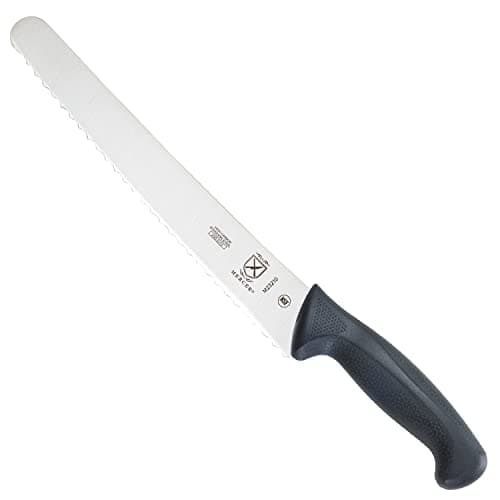
1. Mercer Millennia 10" wide wavy edge — the top pick and the budget pick at once. High-carbon Japanese stainless, stamped in one piece, wide wavy serrations along ten inches of blade, on a textured Santoprene handle with a finger guard. It is the longest blade in the band, the pattern best suited to crusty bread, and it is the cheapest knife on this page. It is also the highest-scoring bread knife on this site at any price, which is a genuinely unusual thing for the cheapest option in a category to be.

Honest cons:it is a working knife from a professional line and it looks like one — moulded handle, no bolster, nothing to admire. Ten inches needs drawer or rack space. And the stamped one-piece build has no heft, which some cooks read as cheap even though it cuts better than heft does.

Don't buy ifyou want an object to hand down. For that, the forged Wüsthof Classic is the knife, and it costs several times this page's ceiling.

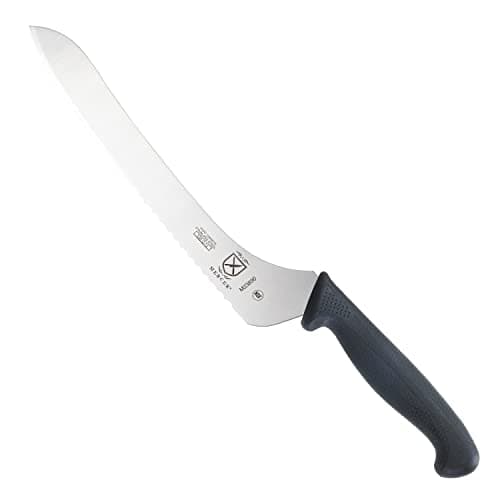
2. Mercer Millennia 9" offset wavy edge — buy this one if your knuckles hit the board. The same steel and the same wavy pattern, nine inches long, with the handle cranked above the blade line. Bagels, flat breads, layer cakes and anything you slice down to a board are where this earns its keep, and it costs essentially what the straight one does.

Honest cons:the offset is slightly awkward on a tall boule, where a straight handle gives a more natural wrist angle. Build is the weakest of the three — a raised stamped handle has more to flex than a straight one. And an inch shorter means one more pass on a large round loaf.

Don't buy ifyou mostly cut tall round loaves on a board. The straight 10" is the better knife for that, for the same money.

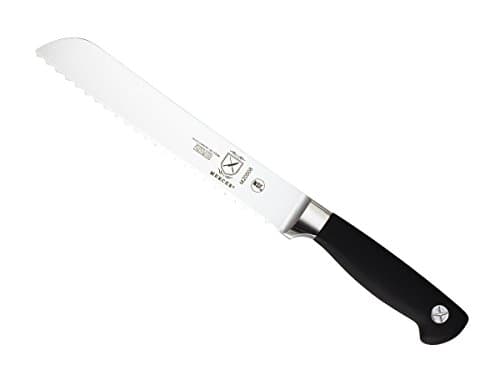
3. Mercer Genesis 8" — the forged option, if feel matters. Genuinely forged from X50CrMoV15 German stainless at about HRC 56, full tang, with a bolster and an ergonomic Santoprene handle. Forging is rare in this band and it is the only pick here that feels like a "real" knife in the hand: heavier, stiffer, better balanced.

Honest cons:it costs roughly twice what the Millennia blades do for a blade two inches shorter, and the extra money buys feel rather than cutting. Eight inches will fight a big sourdough. And serrated German stainless at HRC 56 is no more re-sharpenable than serrated Japanese stainless — forging does not change the disposable logic of the category.

Don't buy if you are buying on function. It is the nicest object on this page and the third-best bread knife on it.

What more money actually buys

Above this band sit the Victorinox Fibrox Pro 10.25", the Wüsthof Classic 9" double-serrated and the Shun Classic 9". The Victorinox is a genuine step up in build for a modest premium and is the one we would reach for if the ceiling here were $75. The other two are forged, beautiful, and bought for reasons that have nothing to do with bread.

If the question behind this page was really whether you need a bread knife at all, do you need a bread knife answers it, and how to slice bread covers the technique that makes a cheap serrated knife look good. If you also want one knife that handles tomatoes and sandwich rolls, a wavy utility knife is the cheaper answer — best utility knives ranks those.

Care: there is not much to do, and that is the point

Hand wash and dry all three. None of them needs honing, none of them wants a stone, and the only real way to shorten their lives is a dishwasher rack knocking the serration points against other steel — can you put knives in the dishwasher has the detail. Store them where the points touch nothing: best knife storage covers the drawer problem, and an edge guard costs a few dollars.

The verdict

Buy the Mercer Millennia 10" wide wavy edge. It is the longest, cheapest and best-suited blade under $50, and the case against it amounts to "it is not pretty."

Buy the Millennia 9" offset instead if you cut bagels, flat breads or sandwiches on a board. Buy the Genesis 8" only if a forged bolster is worth double the money to you, which is a legitimate preference as long as you know that is what you are buying.
The short answer

Quick picks

#ad · Live prices from the Amazon Product API, as of November 24, 2026. Where we have no verified live price we show none — we'd rather leave a gap than print a number that has rotted.

By the numbers

The specs, side by side

Every figure below is the manufacturer's published specification. Where a maker doesn't publish a value, the cell reads "—" rather than a number we made up.

Knife / ToolBladeEdgeSteelConstructionHandle
Mercer Culinary Millennia 10" Wide Wavy Edge Bread Knife10 in (25 cm)Wide wavy serratedHigh-carbon Japanese stainlessStamped, one-pieceTextured Santoprene, finger guard
Mercer Culinary Millennia 9" Offset Wavy Edge Bread Knife9 in (23 cm)Offset wavy serratedHigh-carbon Japanese stainlessStamped, offset (raised) handleTextured Santoprene
Mercer Culinary Genesis 8" Bread Knife8 in (20 cm)SerratedX50CrMoV15 German stainless (~HRC 56)Forged, full tang, bolsterErgonomic Santoprene

In detail

The picks, in full

01
Mercer Culinary Mercer Culinary Millennia 10" Wide Wavy Edge Bread Knife

The best bread knife for most people

Mercer Culinary Millennia 10" Wide Wavy Edge Bread Knife

10 in / 25 cmWavy serratedHigh-carbon Japanese steelStampedSantoprene handle
8.2/10

The honest best bread knife for most kitchens: a long, sharp wavy edge for the price of lunch. Serrations barely resharpen, so spending more buys feel, not better bread.

Slicing
8
Edge quality
8
Handling
8
Build
7
Value
10

Pros

  • Long 10-inch blade clears a full sourdough boule in one or two strokes
  • Wide wavy serrations bite crust cleanly without crushing a soft crumb
  • Costs so little it's effectively disposable — and it out-slices knives many times its price

Cons

  • Stamped blade and molded handle feel utilitarian, not heirloom
  • Serrations can't be honed and are hard to resharpen at home (true of almost every bread knife)

Don't buy this if…

…you want a knife to hand down or a forged feel in the hand. For that, the Wüsthof Classic is the buy; for pure bread-cutting per dollar, nothing here beats this.

$16.15View on Amazon

Price as of November 24, 2026. Prices change — Amazon's is the one that counts.

#ad · we may earn a commission from this link to Mercer Culinary Millennia 10" Wide Wavy Edge Bread Knife

02
Mercer Culinary Mercer Culinary Millennia 9" Offset Wavy Edge Bread Knife

Knuckle clearance and flat slicing

Mercer Culinary Millennia 9" Offset Wavy Edge Bread Knife

9 in / 23 cmOffset wavy serratedHigh-carbon Japanese steelStampedSantoprene handle
7.8/10

The ergonomic pick: a cranked, offset handle lifts your knuckles clear of the board so you can slice a bagel or a low loaf flat without scraping skin.

Slicing
8
Edge quality
8
Handling
9
Build
6
Value
8

Pros

  • Offset handle keeps your hand above the board — ideal for bagels, rolls and flat loaves
  • Same clean-cutting wavy serrations as the standard Millennia, for a little more
  • Comfortable, secure grip at a wallet-friendly price

Cons

  • The offset shape is a niche preference — many bakers prefer a straight handle
  • Serrations don't resharpen at home; stamped build is functional, not fancy

Don't buy this if…

…you mostly cut tall boules on a board — a straight-handled knife is fine there, and cheaper. The offset earns its keep on low, flat and sandwich work.

$16.49View on Amazon

$27.9941% off

Price as of November 24, 2026. Prices change — Amazon's is the one that counts.

#ad · we may earn a commission from this link to Mercer Culinary Millennia 9" Offset Wavy Edge Bread Knife

03
Mercer Culinary Mercer Culinary Genesis 8" Bread Knife

A forged feel on a budget

Mercer Culinary Genesis 8" Bread Knife

8 in / 20 cmSerratedX50CrMoV15ForgedSantoprene handle
7.4/10

A forged German-steel bread knife at a stamped-knife price — the value way to get real heft and a bolster without paying premium money.

Slicing
7
Edge quality
7
Handling
8
Build
8
Value
7

Pros

  • Genuinely forged with a full tang and bolster — heft that punches above its price
  • Grippy Santoprene handle built for a working kitchen
  • Costs a fraction of a premium forged bread knife

Cons

  • 8-inch blade is shorter than ideal for very large boules
  • Serrations don't resharpen at home; edge geometry is coarser than the Wüsthof's

Don't buy this if…

…you cut big round sourdough often — a 9-10-inch blade clears them in fewer strokes. For everyday loaves and sandwiches, this is a lot of forged knife for the money.

$35.49View on Amazon

$37.997% off

Price as of November 24, 2026. Prices change — Amazon's is the one that counts.

#ad · we may earn a commission from this link to Mercer Culinary Genesis 8" Bread Knife

How we picked

We do not run a test kitchen

We compiled each product's published specifications — steel, hardness, edge geometry, weight — normalized them into the matrix above, and scored each one against a published rubric. The scores are judgments from those specs and the value math — they are not measurements we took, because we do not have a test kitchen and we're not going to pretend we do. Units we claim to have tested: 0.

Questions

Frequently asked

What is the best bread knife under $50?

The Mercer Culinary Millennia 10" wide wavy edge. It is the longest blade in the band, the serration pattern best suited to crusty bread, and the cheapest knife on our list — which is also why it is the budget pick. Nothing above $50 cuts bread materially better; it just feels nicer doing it.

Is it worth spending more than $50 on a bread knife?

Only for feel. Serrations cannot be practically re-sharpened at home, so every bread knife is a consumable; above $50 the money goes into forging, bolsters and handle materials rather than into the cut. A forged Solingen bread knife is a lovely object and it will go in the same bin as a $16 Mercer when the points round off.

Should I get an offset bread knife?

Get one if you slice bagels, flat loaves, sandwiches or cakes down to a board. The cranked handle keeps your knuckles clear as the blade finishes the cut. If you mostly cut tall round loaves, a straight handle gives a better wrist angle and is the easier knife.

How long is long enough for a bread knife?

Long enough to cross the loaf in one stroke. Every stroke change leaves a ridge on the cut face, so ten inches is the safe answer for round sourdough, nine is a good compromise, and eight is fine for sandwich loaves and baguettes but will fight a big boule.

Why are all three picks Mercer?

Because that is what the price band contains. Under $50 Mercer owns the serrated category, and the three blades here are genuinely different tools — a long straight wavy, a shorter offset, and a forged one. The next knife up our main bread-knife list, the Victorinox Fibrox Pro 10.25", sat above the ceiling at the last price check, which is why it is named in the body rather than ranked here.

Keep reading

Receipts

Sources

We do not run a test kitchen, and we do not pretend to. Specs are the manufacturer's published figures, attributed as such; where we could not verify something, we say so on the page rather than quietly leaving it out. Read our full method.