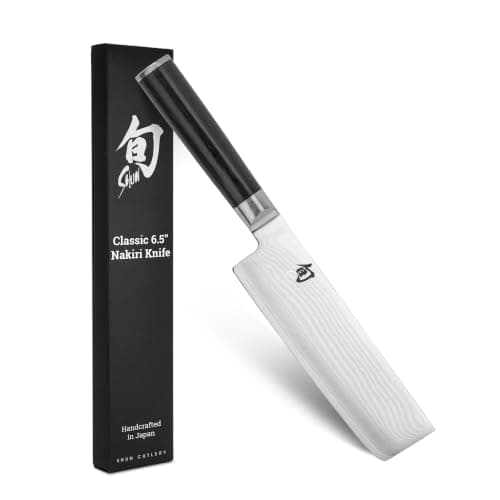
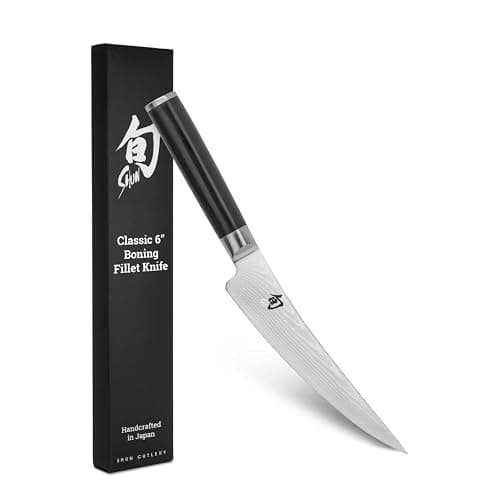
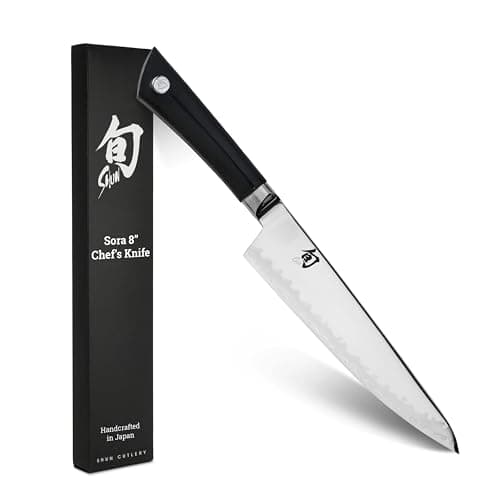
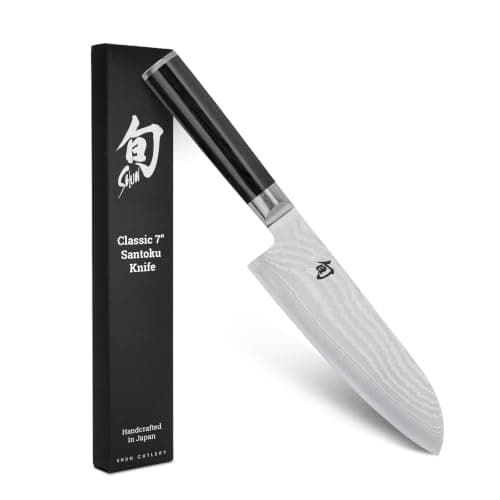
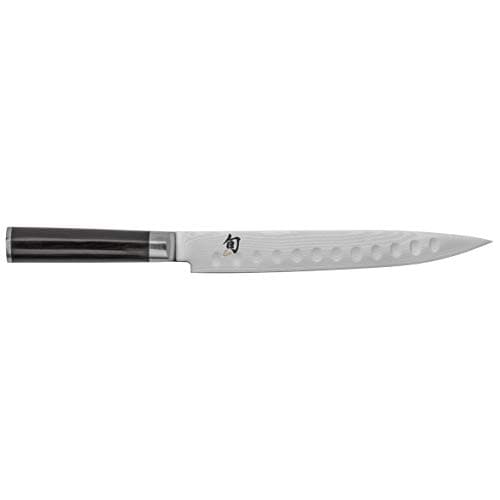
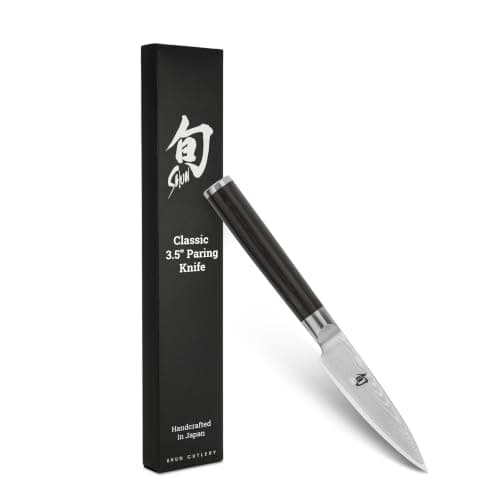
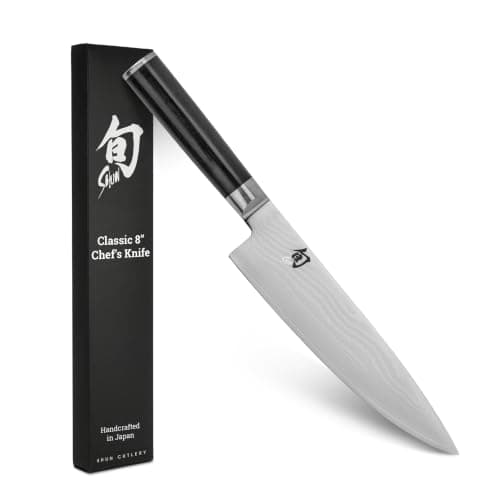
The verdict: if you own no Shun, buy the Classic 8" chef's knife. It is for the cook who wants one Japanese knife to do almost everything and is willing to keep it on a stone — a VG-MAX core at ~HRC 60–61 under 68 layers of Damascus cladding, hand-finished to 16° per side. The budget pick is the Sora 8", the cheapest way into a genuine Shun cutting edge: a VG10 san-mai edge brazed to a cheaper stainless upper, at the same 16°. The highest-scoring Shun blades on our rubric are the Classic nakiri and the Classic boning knife — both win their own categories outright, which the chef's knife does not. Prices render live from the price layer with the "as of" date printed under the table.
One scoping note first. Every figure on this page is published by Shun or its dealers, not estimated by us. Shun states the steel, the hardness band and the edge angle on nearly every blade it sells, which is why a brand page like this one is possible at all. Where a value is absent — the nakiri's weight, for instance — the matrix shows a dash instead of a number borrowed from a sibling knife.
What you are actually buying
Shun is made by KAI in Seki City, Japan, and the Classic line is the one everybody means by "a Shun." The construction is the same across it: a core of VG-MAX stainless, hardened to around HRC 60–61, clad on both sides in 34 layers of softer stainless each — the 68-layer Damascus pattern — then hand-sharpened to a 16° bevel per side, on a D-shaped Pakkawood handle.
Three of those numbers do real work. HRC 60–61 is hard enough to hold an edge through months of home use, where a German knife at ~HRC 56–58 wants honing weekly. 16° per sideis keener than the 20° most Western knives ship at, which is most of why a Shun feels like it falls through an onion. And the cladding is not decoration alone: soft outer layers make a hard core less brittle overall, and they give the blade its pattern.
The same three numbers are also the reasons to walk away. Hard steel at a thin, acute angle chips where soft steel rolls, so a Shun punishes prying, bone contact and the dishwasher. And the D-shaped handle is contoured for a right hand — best chef knives for left-handed cooks is the honest page for the other ten percent of cooks.
Classic or Sora: the only line decision that matters
The Classic is the Damascus-clad line described above. The Sorais Shun's entry line, and it is more interesting than entry lines usually are: the cutting edge is a real VG10 san-mai composite at the same ~HRC 60–61 and the same 16°, brazed to a 420J stainless upper, on a polymer handle.
So a Sora cuts very nearly like a Classic and does not feel remotely like one. The join between the edge and the upper is visible, the handle is molded rather than Pakkawood, and the knife is lighter and plainer in the hand. If your money is going into the cutting, buy the Sora and spend the difference on a stone. If the object matters — and with Shun it usually does, because this is the brand people buy with their eyes — the Classic is the line you actually want. Our Shun Sora 8" review goes through that trade in detail.
The criteria, in the order they mattered
- Does the blade win its own category on this site? A page that ranks seven knives from one maker is only useful if it says which of them are genuinely class-leading and which are merely the Shun version of something cheaper. Two here win outright.
- Published hardness and edge angle. Shun states both on most blades, so every pick below carries a real figure rather than the words "Japanese steel."
- Is the premium doing work in this category? Hard steel and an acute edge pay off most on long, thin slicing cuts and least on light in-hand tasks. That is why the paring knife ranks last here and the nakiri near the top — same steel, very different value.
- A verified live offer. Every pick carried a live price at the last price-layer run, which is also how availability was checked: a live API price means a buyable offer, not a listing we hope still exists.
Where the money is well spent, and where it is not
The two Shun blades that win their categories on this site are the Classic nakiri and the Classic boning and fillet knife. Both are jobs where a hard, keen, thin edge is the whole point: a nakiri exists to drop straight through vegetables without wedging, and a curved gokujo boning blade is trying to follow a bone closely enough that a degree of edge angle genuinely shows.
The weakest value is at the small end. A paring knife spends its life doing light work in your hand, where premium steel contributes least — and Shun charges premium money for it anyway. The same is true of the Classic bread knife and the Classic utility knife: both are lovely, neither out-cuts a knife costing a fraction as much, and neither is ranked here for that reason. Buy those two in Shun only if you are assembling a matching block.
Care: what a 16-degree edge asks of you
A Shun is not high-maintenance, but it is specific. Hand wash and dry it, keep it off ceramic and glass boards, and never put it in a dishwasher or a drawer full of other steel — best knife storage covers the drawer problem.
For sharpening, the number to respect is 16°. A pull-through sharpener set to a Western 20° will grind a wider bevel onto a Shun every time you use it, undoing the one thing you paid for — knife sharpening angle explains why matching it matters more than which stone you buy. In practice that means a whetstone: best sharpening stones for Japanese knives is the shortlist, and how to use a whetstone is the method. A hard VG-MAX core also prefers a ceramic rod to a steel one between sharpenings — ceramic vs steel honing rod is the explanation.
The verdict
Buy the Classic 8" chef's knifeif you want one Shun and you cook with a knife most days. It is the most versatile blade in the line and the one whose published 16° edge you will notice daily.
Buy the Sora 8" if you want the cutting without the price, and accept that it looks and feels like what it costs. Buy the Classic nakiri or the Classic boning knifeif you already own a chef's knife you like — those two are where Shun's specification beats everything else we rank, rather than merely matching it in prettier clothes.
And if the honest conclusion is that the premium is not for you, Shun alternatives ranks five knives matched to what Shun is actually good at, at lower prices.