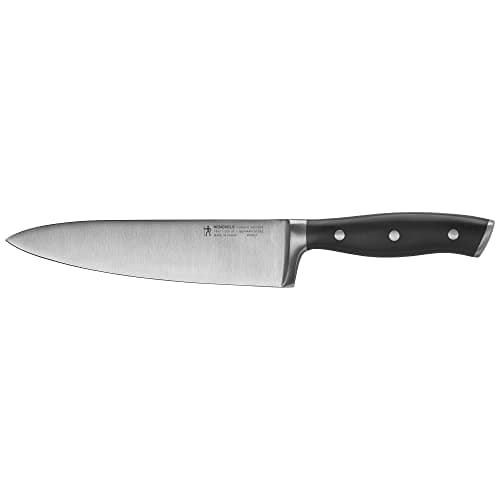
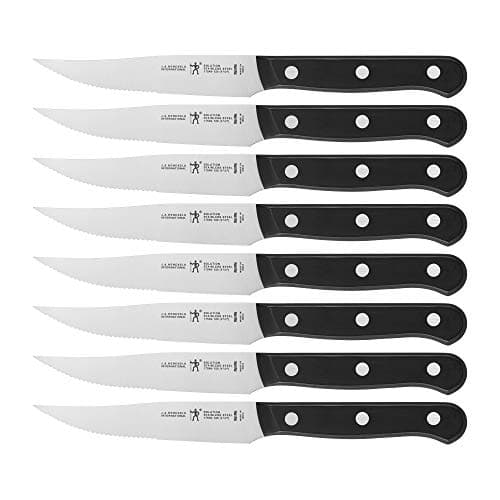
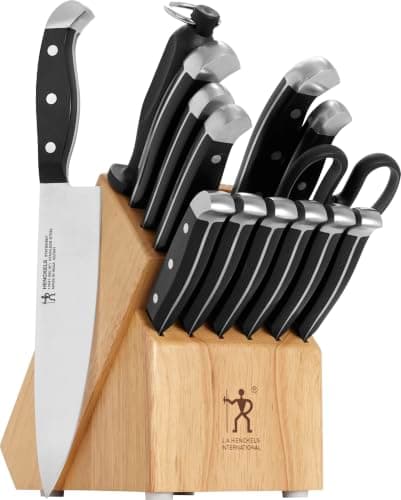
The verdict: if you own no Henckels, buy the Forged Accent 8" chef's knife. It is for the cook who wants a forged, full-tang, full-bolster German knife and is not willing to pay Solingen money for one — German stainless at ~HRC 57, ground to about 15° per side, at roughly a quarter of what a Wüsthof Classic costs. The budget pick is the Solution 8-piece steak knife set, the cheapest Henckels item on this page and the only way we know to set eight places for the price of four decent knives. The highest-scoring Henckels product on our rubric is the Statement 15-piece block set, on range and storage rather than on blade quality. Prices render live from the price layer with the "as of" date printed under the table.
Two honesty notes before the list. First, the Statement row in the spec matrix carries two dashes: a fifteen-piece set has no single blade length, and Henckels publishes no Rockwell figure for the line. Second, Henckels publishes hardness and edge angle far less consistently than Wüsthof does, so several cells below are thin. We would rather show you a gap than a number we invented.
Henckels and Zwilling are the same company. That is the point.
The single most useful thing to know before buying is the logo. The twin-figure mark is Zwilling, the premium line, made largely in Solingen. The single-figure mark is Henckels, the value line of the same group — which is why the two brands run separate websites and separate price ladders.
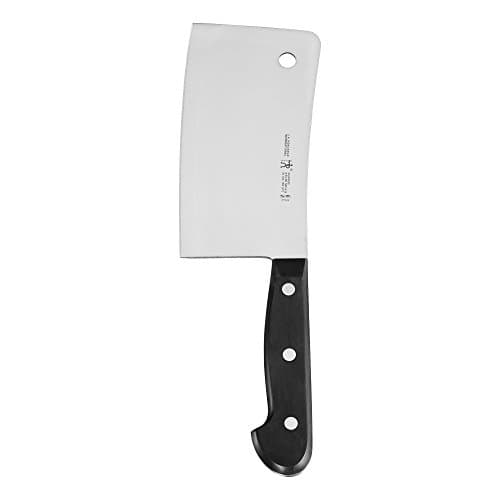
That relationship is the whole argument for the brand. Henckels is not an imitation of a German knife; it is the same company's cheaper one, using the same geometry language, with manufacturing moved out of Solingen and the finish simplified. Our Classic cleaver, for example, is marked as made in Spain rather than Germany. Nothing dishonest about that — but if "German knife" to you means "made in Germany," read the listing before you buy, on this brand more than most.
Forged or stamped: the only line decision that matters
Classic and Forged Accent are forged. Hot-worked from a single billet, full tang, bolster, seamless blade-to-handle transition. They are heavier, stiffer and better balanced, and they feel like what people mean when they say "a proper German knife."
Statement and Solution are stamped. Cut from rolled sheet, then ground and handled. Lighter, cheaper, and — this matters — not worse at cutting. A stamped blade loses heft and bolster, not sharpness. What you give up is feel and longevity in the handle join, which is precisely what a budget set should be giving up.
So the forged picks are the ones to buy as individual knives, and the stamped picks are the ones to buy as sets. That is also the honest answer to the question behind most Henckels searches, which is whether the cheap block set is a mistake: best knife sets under $200 ranks it against the alternatives, and forged vs stamped knives is the mechanism.
The criteria, in the order they mattered
- Forged or stamped, stated plainly. Henckels sells both at overlapping prices, and the listings do not always make it obvious. Every row in the matrix says which.
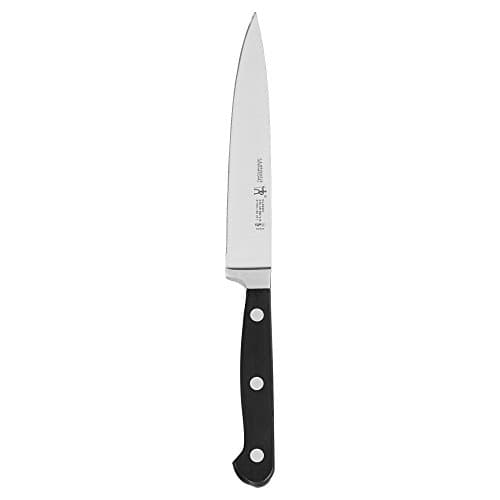
- Published hardness, where it exists. The Classic utility knife carries ~HRC 55–58 and the Forged Accent ~HRC 57. The cleaver, the steak set and the block set carry nothing, and we did not transfer a sibling product's figure into them.
- Price per useful piece, not per piece. A fifteen-piece set that includes eight steak knives and a pair of shears is a five-knife set with accessories. Judge it that way.
- A verified live offer. All five picks carried a live price at the last price-layer run, which is also how availability was checked.
Where Henckels beats the alternatives, and where it does not
It wins on forged construction per dollar. The Forged Accent is a genuinely forged, triple-riveted, full-bolster blade at a price where most of the competition is stamped. The only thing we rank that does the same job for similar money is the Mercer Genesis, which has a short bolster instead of a full one — easier to sharpen heel-to-tip, which is a real advantage if you own a stone. Henckels vs Mercer settles that pairing.
It loses on edge retention and documentation. At ~HRC 57 you are honing weekly, which is the German bargain and fine if you know it. But Wüsthof publishes a 14° PEtec grind and a hardness figure for nearly everything it sells, and Henckels does not — so if spec literacy is how you shop, the brand is harder to buy with confidence. Henckels vs Wüsthof and Zwilling vs Henckels are the two comparisons worth reading before you commit.
Care: soft steel, weekly honing
German stainless at ~HRC 55–58 dulls by rolling rather than chipping, which is good news: a honing rod straightens it back in seconds and you only need a stone every few months. How to hone a knife is the two-minute version, and best honing steels ranks the rods.
When honing stops working, a 1000-grit stone at the factory angle is the fix — best sharpening stones for German knives is the shortlist for exactly this steel. Soft steel is also the easiest steel to learn on, which makes a cheap forged Henckels a better first sharpening subject than a hard Japanese blade.
The verdict
Buy the Forged Accent 8" if you want one Henckels knife and you want it forged. Buy the Classic 6" utility knifeif you already have a chef's knife and keep reaching past it for something smaller — it is the best-documented blade on this page.
Buy the Statement 15-piece set if you are filling an empty kitchen and want the block, the shears and the steak knives in one purchase, with eyes open that the blades are stamped. Buy the Solution 8-piece steak set if your table seats eight. And buy the Classic 6" meat cleaveronly if you genuinely break down bone-in meat — most people searching for a cleaver want the tall, thin Chinese blade instead, which best Chinese cleavers covers.