The verdict: the Victorinox Fibrox Pro 7" granton santoku is the santoku to buy under $100. It is Swiss-made X50CrMoV15 at ~HRC 55–56, stamped with a full tang, granton-fluted on both faces, NSF certified, and razor-sharp out of the box. The budget pick is the Mercer Millennia, which costs a fraction of it and is the cheapest santoku this site ranks. The one in between, the forged Mercer Genesis, is for cooks who want a bolster and real heft. Prices render live from the price layer with the "as of" date printed under the table.
Only three santokus in our registry carried a verified live price under $100 at the last price-layer run, and all three are on this page. That is the honest shape of this band: the santokus people have heard of — the MAC MSK-65, the Shun Classic, the Global G-48, the Wüsthof Classic — all sit above the ceiling, most of them well above it. If you want one of those, best santoku knives is the unrestricted list, and best Japanese knives under $200 is the band where the Japanese-made santokus start.
What a santoku is, and what the shape is for
A santoku is a chef-class knife with three differences you can see: it is shorter (about 165 mm to 180 mm rather than 200 mm), it is taller at the heel, and its edge is much flatter with the tip dropped down to meet it. Those three things add up to one cutting style. A flat edge meets the board along its whole length, so a straight push-cut leaves nothing hinged at the far end of the slice — no half-cut onion ring holding on by a thread.
The trade is rocking. A French or German chef's knife has a pronounced belly specifically so you can rock through herbs and garlic without lifting the tip. Try that with a santoku and the flat edge slaps the board. If you learned to cook rocking a chef's knife, a santoku will feel wrong for a week, and then it will feel faster — chef knife vs santoku is the full comparison, and what is a santoku knife covers the name and its history.
The height is the under-rated part. A tall blade gives you knuckle clearance and a wide face to scoop with, which is why a santoku is the knife many home cooks reach for ninety percent of the time once they own one.
What $100 does and does not buy in a santoku
It does not buy hard steel. This is the single most important thing to understand before you spend. All three picks here are in the HRC 53–56range on their makers' own figures. The thin, hard ~HRC 59–61 Japanese blades that give a santoku its reputation start above this ceiling. Softer steel means you hone more often and sharpen more often — and, in exchange, the edge rolls instead of chipping and comes back in minutes on a cheap stone. Knife hardness explained is the mechanism.
It does buy the right geometry. All three are genuinely flat-profiled, properly tall santokus rather than short chef's knives with a Japanese name, and two of the three carry a granton edge — the row of oval scallops ground into the blade face that breaks the suction between wet food and steel. On a santoku that feature earns its keep, because the work is mostly wet vegetables sliced thin. What is a granton edge explains why it helps here more than on a chef's knife.
It does buy commercial-kitchen build. All three are NSF-certified professional-line knives with moulded, textured handles designed to be gripped wet and washed hot. None of them is beautiful. Every one of them is replaceable without pain, which is a real feature in a knife you will use daily for years.
The criteria, in the order they mattered
- Published steel and hardness. Maker-stated figures only. Victorinox publishes X50CrMoV15 and no official weight for this model; Mercer publishes HRC 53–54 and a 15° blade angle for the Millennia and HRC 56 for the Genesis. Where a maker publishes nothing, the matrix shows a dash.
- Out-of-box edge. In this band you will be sharpening sooner than you would with hard steel, so how keen the knife arrives matters more than usual. The Victorinox wins this outright.
- Granton edge. Two of three have one. On a vegetable-focused blade it is close to a requirement rather than a nicety.
- Forged or stamped, argued honestly. Forging buys heft and a bolster, not cutting performance — forged vs stamped knives is the long version. The stamped pick still ranks first here.
- A verified live offer under the ceiling. Each pick carried a live price below $100 at the last price-layer run, which is also how availability was checked.
The three picks
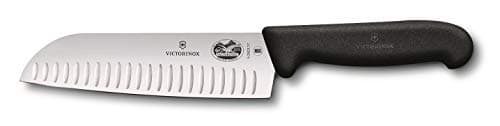
1. Victorinox Fibrox Pro 7" granton santoku — the one to buy. Swiss-made X50CrMoV15 stainless at ~HRC 55–56, stamped with a full tang, granton fluting on both faces, double-bevel, NSF certified, on the textured Fibrox handle that is the reason this family of knives lives in professional kitchens. It arrives keener than anything else in the band, it is light and nimble, and it takes a screaming edge on a stone in minutes. If you have read our chef knives under $100 page, this is the same argument in a santoku profile.
Honest cons: soft-ish steel, so you hone weekly and sharpen every month or two under real use. Victorinox publishes no weight figure for this model, so that cell is a dash. And the Fibrox handle is a tool-handle: hard-wearing, grippy, completely without charm.
Don't buy if you want a knife that holds its edge for months. That is what the harder Japanese santokus above the ceiling are for, and they want a whetstone in exchange.
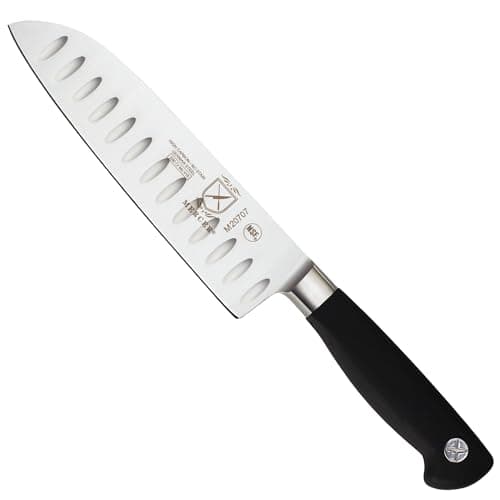
2. Mercer Genesis 7" santoku — the forged option. Genuinely forged X50CrMoV15 at ~HRC 56 with a full tang, a bolster, a granton edge and a Santoprene handle. This is the pick if what you missed in the Victorinox was weight and a bolster to pinch-grip against — it feels like a German knife and costs less than a nice dinner. It is also the santoku that matches the Mercer Genesis chef's knife if you are building a set from one line, which best Mercer knives lays out.
Honest cons: the heft cuts both ways. It is less nimble than the Victorinox and noticeably thicker behind the edge, which is the opposite of what most people want from a santoku. The factory edge is good rather than keen. And Mercer publishes no weight for it either.
Don't buy if the thin, light, keen feel is what drew you to a santoku in the first place. Forging does not deliver that; a thin grind does, and this blade is not thin.
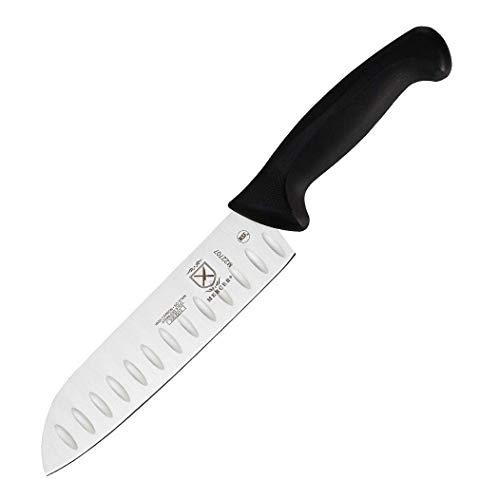
3. Mercer Millennia 7" granton santoku — the budget pick, and it is not a compromise. High-carbon Japanese steel at a published HRC 53–54 with a stated 15° blade angle, granton grooves on both faces, stamped, NSF certified, on a raised textured Santoprene and polypropylene handle. It costs less than a decent cutting board. Culinary schools put Millennia knives on their supply lists, which is the honest endorsement: not that it is a fine knife, but that it is a real one at the lowest price anybody serious will stand behind.
Honest cons:HRC 53–54 is the softest steel on this page and it is Mercer's own figure, so the edge rolls sooner than anything else here and needs honing often. No bolster, no heft, no published weight, and fit and finish that match the price exactly.
Don't buy if you can stretch to the Victorinox. A few dollars more buys harder steel, a keener factory edge and better finishing. Buy the Millennia when every dollar counts, or when you want a santoku you will not mind lending out.
What sits just above the ceiling, and whether it is worth it
The honest answer is that the santoku category rewards spending more than most knife categories do, because the whole appeal of the shape — thin, light, keen, falls through a carrot — is bought with hardness and grind rather than with steel alloy names. Above $100 you reach the MAC Professional MSK-65at a published ~HRC 59–61 with a near-15° per side grind, which is this site's best santoku overall and is reviewed in full on our MAC MSK-65 review. Above that sit the Damascus Shun Classic and the one-piece Global G-48.
What that extra money buys is weeks between sharpenings instead of days, and a thinner blade that wedges less in a dense sweet potato. What it costs you, besides money, is forgiveness: hard steel chips when a soft edge would simply roll. If you are not going to own a stone, the Victorinox at the top of this page is genuinely the better purchase, and that is not a consolation prize.
If vegetables are the whole reason you are here, consider the other Japanese vegetable shape instead: best nakiri knives under $100 covers a band where a genuinely hard Japanese blade does clear $100, and santoku vs nakiri is the decision between the two shapes.
Keeping a soft-steel santoku sharp
Every knife on this page is easy to sharpen, and all of them need it more often than a hard Japanese blade does. That is the deal you have made, and it is a good one if you accept the small routine that comes with it.
Hone before a big prep session — how to hone a knife is the two-minute version — and put the blade on a stone when honing stops bringing it back. A 1000/6000 combination stone is the whole kit for this band; best whetstones under $50 has options that cost less than the knife, and how to sharpen a santoku knife covers the one wrinkle the shape adds: the flat edge needs a slightly different sweep than a curved chef's knife, because there is no belly to roll through.
One warning specific to granton edges: do not grind so far up the blade that you cut into the scallops. You will not reach them with normal sharpening for years, but an aggressive electric sharpener can get there in one session.
The verdict
Buy the Victorinox Fibrox Pro 7" granton santoku. It arrives the sharpest, it is the easiest to bring back, it is NSF certified for professional use, and it costs roughly a third of the cheapest Japanese santoku worth owning.
Buy the Mercer Genesis if a bolster and real heft matter to you, and the Mercer Millenniaif the budget is genuinely tight or you need several knives at once. And if you find yourself wanting the thin, hard, keen version of this shape, save up rather than trading sideways — the jump above $100 is one of the few places in cutlery where the money buys something you can feel on every cut.