The verdict: the Mercer BPX 11" granton edge slicer is the carving knife to buy under $100. It is for anyone carving a roast, a bird or a brisket at home, and it is also the budget pick— the cheapest knife on this page is the best one on it. Eleven inches of ice-hardened German stainless at HRC 57–58, with a published 15° per side grind and a granton edge, for roughly what a roasting pan costs. The Wüsthof Gourmet 2-piece setis the one to buy instead if you need the fork as well. Prices render live from the price layer with the "as of" date printed under the table.
This page ranks only knives that carried a verified live price under $100 at the last price-layer run. The forged Wüsthof Classic 9" hollow edge and the Shun Classic 9" hollow ground slicer are both better objects and both sit well above the ceiling, so they are ranked on best carving knives rather than here. Neither produces a materially better cut face than the knife at the top of this page, which is the single most useful thing to know before spending more.
The two specs that decide a carving knife
Length first. A carving knife is trying to cross the whole cut in one draw, because every change of direction leaves a step on the face of the slice. Ten inches handles a chicken, a loin or a small leg. Eleven covers almost everything a home kitchen roasts. Twelve is for packer brisket, a whole bone-in ham and a twenty-pound turkey — and it is genuinely more knife than most boards can take.
Then the edge face. A granton edge — the row of oval scallops ground into the flat of the blade — exists to break the suction between wet meat and steel. On a long thin slicer that stiction is the main thing fighting you: it drags the slice, bunches the fibres and leaves a ragged face. Three of the four picks here are granton or hollow ground, and on this category it is close to a requirement rather than a nicety.
Everything else is secondary. Hardness matters less here than on a chef's knife, because a carver meets no bone and no board edge if you use it properly, so even soft stainless keeps a usable edge for a season of roasts. A bolster is irrelevant. Weight is a preference.
The criteria, in the order they mattered
- Published grind angle, where there is one. Mercer states 15° per side on both of its picks, which is unusually keen for a Western knife and the main reason the BPX leads. Victorinox publishes neither an angle nor a steel grade for its slicer, and Wüsthof publishes no hardness for the Gourmet line — the matrix shows dashes rather than borrowed figures.
- Length against the cuts you actually carve. The ranking rewards the length that suits most home roasts, not the longest blade available.
- Granton or hollow edge. Three of four have one. The exception is the Wüsthof Gourmet knife, which is a plain edge — a real functional gap, and the reason it ranks last despite being the only Solingen-made pick here.
- A verified live offer under the ceiling. Every pick carried a live price below $100 at the last price-layer run, which is also how availability was checked.
The four picks
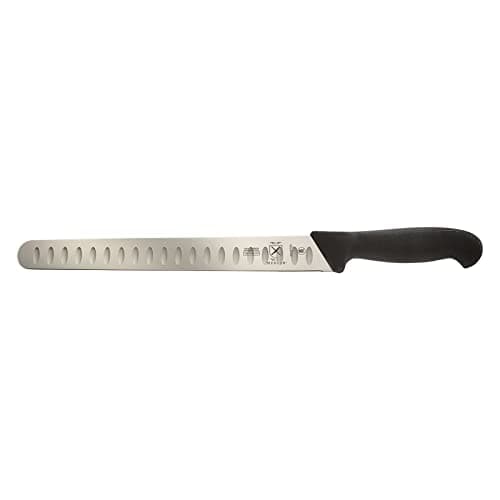
1. Mercer BPX 11" granton edge slicer — the top pick and the budget pick at once. Eleven inches, granton edge, published 15° per side, ice-hardened high-carbon German stainless at HRC 57–58, taper-ground, NSF certified, on a textured glass-reinforced nylon handle. On paper it out-specifies knives at five times the price, and the only thing it gives up is looking like a nice knife.
Honest cons:it is professional-line equipment and it looks it — moulded handle, no bolster, nothing to put on a rack. Eleven inches needs storage. And a stamped blade has no heft, which matters to some cooks even though it does not affect the cut.
Don't buy ifthe knife is a present or will live on display. The Wüsthof set is the object; this is the tool.
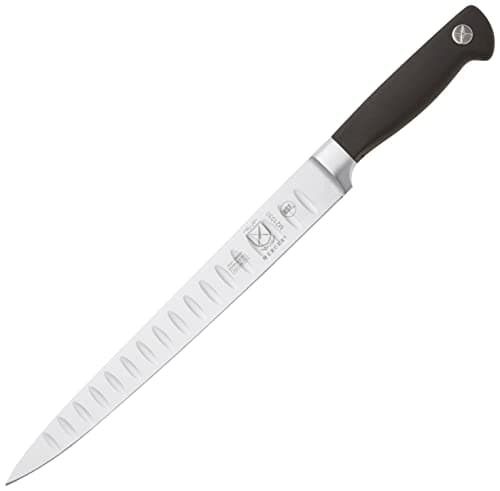
2. Mercer Genesis 10" granton edge carving knife — the forged option. Genuinely forged with a full tang and a bolster, granton edge, the same published 15° per side, at HRC 56 ±1. This is the pick if you want a carver that feels like a real knife in the hand and you mostly carve chicken, pork loin and small joints.
Honest cons: it costs about twice the BPX for an inch less blade, and the extra money buys forging rather than cutting. Ten inches means extra passes on a big brisket, and extra passes mean a rougher face.
Don't buy if your biggest cut is a whole turkey or a packer brisket. Buy length instead of forging.
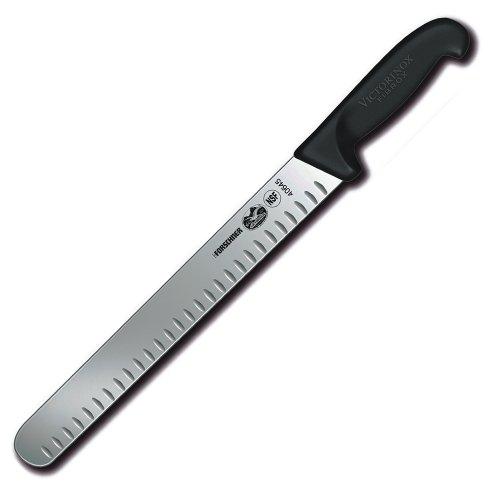
3. Victorinox Fibrox Pro 12" granton edge slicer — buy length if you carve big. Nearly twelve inches with a rounded tip, granton edge, Swiss made, NSF, and about six ounces — genuinely light for the size, which is why it lives on catering benches and carving stations. If you do brisket, whole hams or very large birds, this is the one draw that crosses them.
Honest cons: Victorinox publishes neither the steel grade, the hardness nor the bevel angle for this knife, so three cells in the matrix are deliberately empty. Twelve inches is unwieldy on a standard home board, and it costs several times the BPX for less published specification and two more inches.
Don't buy if you carve a chicken and a Sunday roast. It is more knife than the job needs and it handles like it.
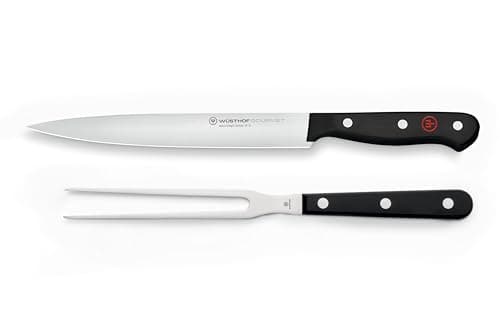
4. Wüsthof Gourmet 2-piece carving set — the only pick with the fork. An 8" stamped plain-edge blade in X50CrMoV15 with a 6" fork, laser-cut, full tang, triple-riveted, made in Solingen. If you do not own a carving fork, or this is a first carving kit rather than a blade for a working cook, it is the obvious answer: two tools, one purchase, a real German name on both.
Honest cons:bought for the knife alone it is poor value — eight inches, plain edge, no hollow grind, no published hardness, for more than twice what the 11" granton BPX costs. Eight inches is short for a roast. And a plain edge on a long thin blade means more stiction and a slightly worse cut face.
Don't buy if you already own a carving fork or a decent pair of tongs. Then you are paying a premium for the box.
Technique does more than the knife
Carving badly with a good knife looks worse than carving well with a cheap one. Rest the meat before you touch it, find the direction of the grain and cut across it, let the blade's length do the work in one long draw rather than sawing, and keep the knife shallow rather than pressing down. How to carve a turkey is the step-by-step for the hardest version of the job, and carving knife vs slicing knife settles the naming confusion — the two terms are used almost interchangeably by makers, and the differences that matter are length and edge face, not the word on the box.
One more thing worth knowing before you buy: a carving knife is not a boning knife and will not get near a joint. Best boning knives is the other half of breaking down a bird, and best brisket knives is the barbecue-specific version of this page.
Care: the easiest knife in the drawer to keep sharp
A carver should never meet bone or a hard board, so it dulls more slowly than anything else you own. Hone it before a big cook and put it on a 1000-grit stone once or twice a year — how to sharpen a chef knife is the same method, and the long thin blade is actually easier to keep at a consistent angle than a short one.
Store it where the edge touches nothing. An eleven- or twelve-inch blade does not fit most blocks, so a magnetic strip or an edge guard in a drawer is usually the answer — best knife storage covers both.
The verdict
Buy the Mercer BPX 11". It is the longest sensibly sized blade in the band, the only pick with both a granton edge and a published 15° grind, and the cheapest knife on the page.
Buy the Victorinox 12" if you genuinely carve brisket and whole hams, the Mercer Genesis 10" if a forged bolster is worth double the money to you, and the Wüsthof Gourmet setif you need the fork or the knife is a present. All four will carve a Thanksgiving bird properly, which is more than can be said for the chef's knife most people reach for instead.