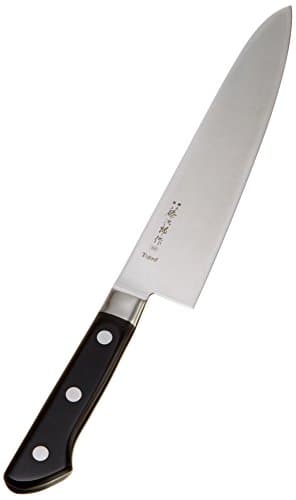
The verdict: the Tojiro DP Gyuto 210 mm is the MAC alternative to buy. It is for the cook who wanted exactly what a MAC offers — a thin, hard Japanese blade with a keen grind and no decoration — at well under half the money: a VG-10 core at a published ~HRC 60 clad in soft stainless, ground near 15° per side, bolsterless, made in Japan. The budget pick is the Victorinox Fibrox Pro 8", a different philosophy entirely but the cheapest knife here that a professional will stand behind. If you want the MAC's geometry in a knife that looks like an heirloom, the Shun Classic 8" and the Miyabi Koya 8"are the two to look at. Prices render live from the price layer with the "as of" date printed under the table.
One thing to say plainly first: there is nothing wrong with a MAC, and the MTH-80 is the knife this site ranks first in the whole chef-knife category. It carried a live price at the last price-layer run, so it is buyable. This page exists because "MAC knife alternative" is a query people type for real reasons — price, looks, what their local store stocks, a handle preference — and because the knives below get you most of what a MAC does, some of them for far less. Best MAC knives is the page to read if you have not ruled the brand out.
What a MAC actually is
MAC's reputation rests on a narrow, deliberate set of published specs. The MTH-80 Professionalis a 200 mm chef's knife in high-carbon molybdenum-vanadium stainless at ~HRC 59–61, ground to about 15° per side, with a row of dimples along the edge and a riveted Pakkawood handle, made in Seki, Japan. The Chef Series HB-85 is the same steel and grind in a lighter, plainer package at under five ounces. Our MTH-80 review and our HB-85 review have the full spec sheets.
Two of those numbers are the whole argument. Hardness in the high 50s to low 60s lets a maker grind thin without the edge folding, and a 15° per sideedge on a blade that is genuinely thin behind it is what people mean when they say a MAC "disappears" through an onion. There is no Damascus, no hammered finish and no bolster sculpting on most of the range. You are paying for geometry.
What MAC does not publish is context. The hardness is given as a range rather than a measured figure, parts of the Japanese Series carry no stated edge angle at all, and there is nothing about the heat treatment. Where a maker states nothing we mark the cell with a dash rather than borrowing a figure from a review, and the same discipline applies to every alternative below.
Why people look for an alternative
- Price. Far and away the main reason. A MTH-80 now sits in the upper half of the sub-$200 band, and a Tojiro DP matches its published hardness and grind for well under half of it.
- Looks. MAC builds tools. If the knife is a gift, or lives on a magnetic strip in a kitchen people see, a Damascus Shun or a Miyabi is a materially nicer object for similar money.
- Where you shop. MAC's distribution is narrower than Shun's or Wüsthof's. Plenty of cooks want to hold a knife before buying it and cannot find one locally.
- The chipping worry. A thin edge at ~HRC 59–61 chips rather than rolls if it meets bone or a frozen edge. That is true of every hard Japanese knife here, including most of the alternatives — the genuine escape from it is softer steel, which is what the Victorinox below offers.
- Sharpening commitment. A MAC wants a whetstone. If you will only ever use a pull-through, the honest alternative is not another hard Japanese knife; it is a cheap soft one you can re-profile without regret.
How we matched the alternatives
Each pick matches the MAC on at least one of its stated strengths — published hardness near HRC 60, an edge ground near 15° per side, or a genuinely thin blade — or undercuts it decisively on price. They are ranked by our overall score, which weights value alongside cutting.
- Tojiro DP Gyuto 210 mm — matches the steel for half the money. A VG-10 core at a published ~HRC 60 clad in soft stainless, ground near 15°, with 10 mm more blade than the MTH-80.
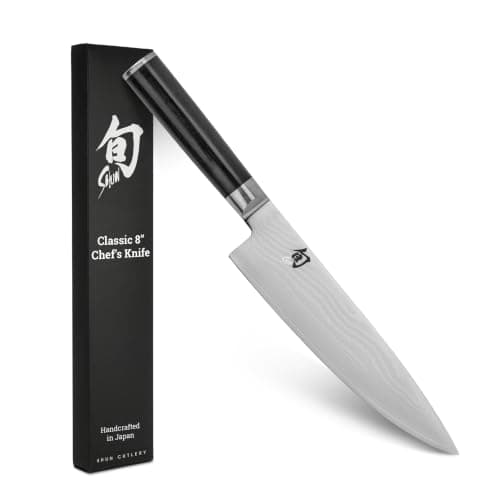
- Shun Classic 8" — matches the hardness and beats it on looks. VG-MAX core at ~HRC 60–61 under 68-layer Damascus cladding, 16° per side, D-shaped Pakkawood handle, handcrafted in Seki.
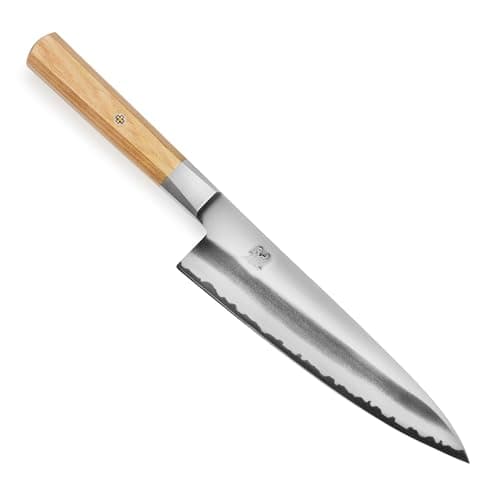
- Miyabi Koya 8" — the other Seki-made showpiece, with a hand-finished edge and a traditional handle shape rather than a Western riveted one.
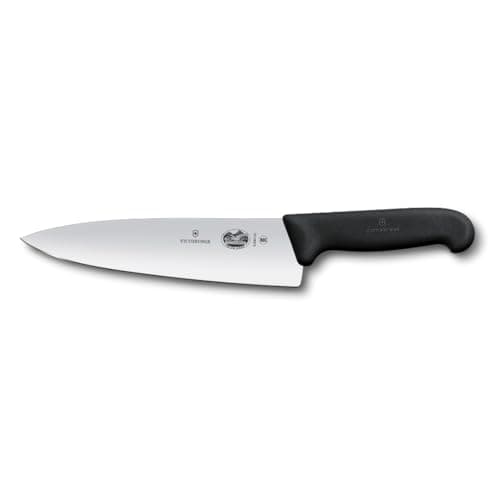
- Victorinox Fibrox Pro 8" — the opposite trade, deliberately. X50CrMoV15 at ~HRC 55–56, stamped, NSF certified, about 6.6 oz, and a fraction of the price. Softer steel dulls sooner and will not chip.
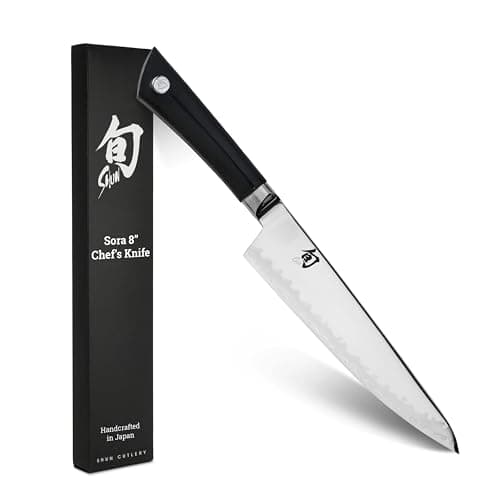
- Shun Sora 8" — the cheapest way to a VG10 cutting edge. A VG10 san-mai edge brazed to a cheaper stainless upper at ~HRC 60–61, ground to 16°, on a polymer handle.
The five picks, with the honest objection to each
1. Tojiro DP Gyuto 210 mm — the one to buy. On the two specs that make a MAC a MAC, this is a draw: ~HRC 60 against ~HRC 59–61, and a published grind near 15° per side on both. The DP is clad rather than monosteel, which makes it slightly more forgiving of a knock, and it is 10 mm longer, which is free reach on a big board. Tojiro vs MAC is the head-to-head.
Honest cons:the savings come out of finish. The handle is purely functional, the spine and choil are left square from the factory, and at a published ~7.4 oz it is almost an ounce heavier than the MAC. It is also a plainer object than a MAC, which is saying something.
Don't buy if the knife is a present. Buy the Shun.
2. Shun Classic 8" — if you want the geometry and the object. A VG-MAX core at ~HRC 60–61 with Damascus cladding and a 16° per side edge: harder on paper than the MAC, a degree or so less keen at the factory, and incomparably better looking. Usually priced within a few dollars of a MTH-80. MAC vs Shun settles the pairing properly.
Honest cons:you pay a visible premium for the cladding pattern, the D-shaped handle favors right-handers, and the thin tip is the part people chip most often. A Shun is also no easier to sharpen than a MAC — same commitment, prettier blade.
Don't buy if cutting per dollar is what you are optimizing. The Tojiro matches its hardness for less than half.
3. Miyabi Koya 8" — the traditional-handled Seki option. A hard Japanese blade with a hand-finished edge and a handle shape closer to a Japanese wa-handle than a Western riveted one, made in Seki under Zwilling. If what you wanted was a Japanese knife that feels Japanese in the hand, this is the pick on this page. Our Koya review has the detail, and MAC vs Miyabi compares the two brands directly.
Honest cons: the handle shape that is the whole appeal is also the reason some cooks bounce off it, and it is right-hand biased. It costs about as much as the MAC it replaces, so this is a sideways move on price, not a saving.
Don't buy if you grip a knife with your whole fist rather than a pinch grip. A Western handle with a bolster suits that better.
4. Victorinox Fibrox Pro 8" — the budget pick, and the honest answer for some readers. X50CrMoV15 at ~HRC 55–56, stamped with a full tang, NSF certified, about 6.6 oz, on a textured handle that grips wet. This does not match a MAC on steel and does not pretend to. What it does is cut well, cost a fraction of the price, survive abuse that would chip a hard edge, and come back to screaming sharp on a cheap stone in minutes. Victorinox vs MAC is the full comparison.
Honest cons: you will hone it weekly and sharpen it monthly under real use. The stamped blade has no heft and no bolster. Nothing about it is beautiful, and Victorinox publishes no weight for some models in the line.
Don't buy if edge retention is the thing you were shopping for. Soft steel is the trade being made here, and it is the trade that makes it cheap and easy to maintain.
5. Shun Sora 8" — a VG10 edge at the lowest price here. Shun's composite-blade line brazes a VG10 san-mai cutting edge at ~HRC 60–61 to a cheaper stainless upper, ground to 16°, on a polymer handle. The part that does the cutting is premium steel; the part that does not is priced accordingly.
Honest cons: the visible weld line between the two steels divides opinion, the handle is plain polymer rather than Pakkawood, and the composite construction means a hard sharpening life eventually takes you past the VG10 section. It is also the lowest-scoring pick here on our rubric.
Don't buy if you plan to keep this knife for twenty years and sharpen it hard. A monosteel or fully clad blade ages better.
If you wanted the MAC santoku rather than the chef's knife
The MAC Professional MSK-65 is this site's best santoku overall, and the alternatives question is different in that shape, because almost nothing hard and thin clears $100 in a santoku. Best santoku knives under $100 is the band below it, and the honest summary there is that you are choosing a softer Swiss or American professional blade rather than a cheaper Japanese one. The full category, MAC included, is on best santoku knives.
And if the MAC you were looking at was the Japanese Series vegetable cleaver, the equivalent decision lives on best nakiri knives, where a Shun Classic nakiri and a Mercer Genesis sit either side of the MAC on price.
What we did not rank, and why
The Miyabi Kaizen II is the keenest factory edge we have specs for in this price range, but at the last price-layer run it cost more than the MTH-80 it would be replacing, so it is not an alternative in the sense people mean. It is ranked on best Japanese knives under $200 instead.
German forged knives — a Wüsthof Classic or a Zwilling Pro — are not on this page because they are the opposite purchase: softer steel, a thicker grind, more weight, more forgiveness. MAC vs Wüsthof is that comparison, and Japanese vs German knives is the general version. If the answer you want is "heavier and tougher", start there rather than here.
The Global G-2 would be a natural comparison — another light, thin, Japanese-made blade — but it showed no buyable offer at the last price-layer run, so we do not rank it. Global knives alternatives covers that situation.
Whatever you buy instead, budget for the stone
Four of the five picks here are hard Japanese steel, and the running cost is the same as a MAC's: a whetstone every few months, a gentle hand, and no pull-through sharpeners. Best sharpening stones for Japanese knives is the kit, and knife sharpening angle explains why putting a 20° shoulder on a 15° edge throws away what you paid for.
If reading that makes you want to opt out, that is useful information and not a failure. Buy the Victorinox, buy a cheap combination stone, and accept honing weekly — easiest knives to sharpen is written for exactly that reader.
The verdict
Buy the Tojiro DP 210 mm. It is the closest thing on the market to a MAC's published specs at a materially lower price, and the money it saves pays for the stone you will need either way.
Buy the Shun Classic or the Miyabi Koya if the knife needs to look like a knife worth owning, the Shun Sora if you want VG10 at the lowest price here, and the Victorinox Fibrox Proif what you have actually decided is that you do not want to maintain a hard Japanese edge at all. And if none of those arguments move you, the MAC is still the knife we rank first — there is no shame in buying the original.