Skip to content
Bevel & Bone

HUB 02 · Sharpening

Best Work Sharp Sharpeners

Work Sharp makes three very different machines and only one of them is really a kitchen tool. Ranked on published angles, abrasives and how much metal each one removes.

By Stephen V.Updated How we choose
#ad

We earn a commission when you buy through our Amazon links, at no extra cost to you. It never changes a ranking, and we say so when the cheaper knife is the better buy. How this works.

The verdict: the Work Sharp Precision Adjust is the Work Sharp to buy. It is for the cook who wants repeatable, genuinely sharp edges without learning to freehand on a stone — a clamped, guided rod that click-sets anywhere from 15° to 30°, with coarse and fine diamond plates plus a ceramic rod. It is the only machine in the range that can match a Japanese knife's 15° bevel instead of overriding it. The budget pick is the Culinary E2, the cheapest of the three and the gentlest: flexible abrasive discs and a 90-second timer make it the hardest Work Sharp to ruin a knife with. The Mk.2 is a workshop toolthat happens to sharpen kitchen knives, and it is ranked last here for that reason rather than because it works badly. Prices render live from the price layer with the "as of" date printed under the table.

A scoping note first. These three machines are not three price tiers of one product. One is a manual guided jig, one is a gentle electric with flexible discs, and one is a two-speed abrasive belt grinder. They remove wildly different amounts of metal and they grind different angles, so the right choice depends entirely on what is in your drawer.

The one spec that decides this: the angle it grinds

Every powered or guided sharpener imposes its own geometry on your knife. If that geometry does not match the edge the knife was built with, the machine slowly re-profiles the blade — and on a knife you paid for because of its grind, that is expensive damage dressed up as maintenance.

The numbers here are unambiguous: the Precision Adjust covers 15° to 30° in roughly one-degree steps. The Culinary E2 is a fixed 20° guide, and the Mk.2 switches between 20° and 25°. So if you own Japanese knives ground near 15° — a Shun, a MAC, a Tojiro, a Global — only one of these three can maintain them honestly. The other two will widen that bevel a little further every time you use them. Knife sharpening angle is the full explanation of why that matters more than which abrasive the machine uses.

If your drawer is all German and Western stainless at 20° — Wüsthof, Henckels, Victorinox, Mercer — then a fixed 20° machine is not a compromise at all, and the E2 becomes a genuinely good buy.

The criteria, in the order they mattered

  • Angle range, published. The single most important figure, for the reason above.
  • How much metal it removes. A knife has a finite number of sharpenings in it. A flexible disc at a 90-second timer removes very little; a coarse P80 belt removes a great deal. Both are correct for different jobs.
  • Can you repair an edge with it? The E2 refines and maintains; it will not rescue a chipped blade. The Precision Adjust will, slowly. The Mk.2 will, quickly, and will take the blade's life with it if you are careless.
  • Published serrated capability. Work Sharp states it for the Mk.2 and does not for the E2, so our matrix carries it for one and leaves the other blank rather than assuming.
  • A verified live offer. All three picks carried a live price at the last price-layer run, which is also how availability was checked.

The three machines, and the kitchen each one suits

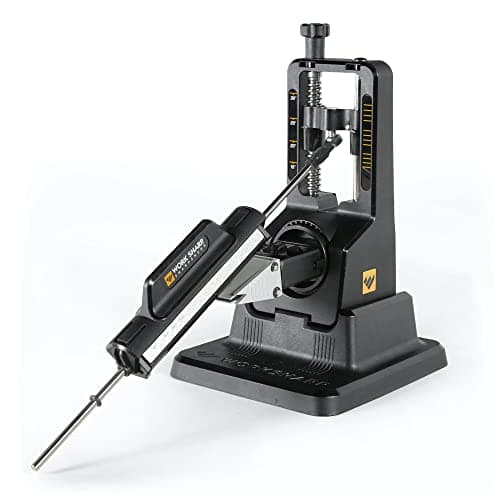
1. Precision Adjust — the one to buy, for almost everyone. A clamp holds the blade, a rod holds the angle, and you draw the abrasive along the edge. Because the angle is mechanical rather than muscular, your tenth stroke is the same as your first — which is the whole difficulty of freehand sharpening, solved with a jig. Coarse diamond for repair, fine diamond for the working edge, ceramic to finish.

Honest cons:it is slower than any electric, because you clamp the knife and work both sides by hand. The clamp can struggle with very tall blades and very short ones. And a jig teaches you nothing transferable — a whetstone is a skill that works on any knife anywhere, and guided vs freehand sharpening is the honest comparison before you buy any jig at all.

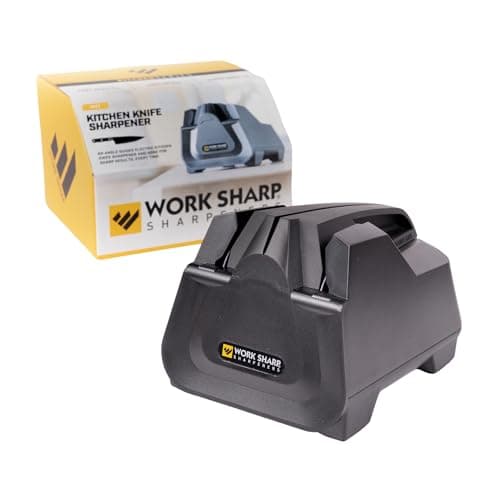
2. Culinary E2 — the budget pick, and the gentlest machine here. Flexible abrasive discs put a slightly convex edge on the blade and cut far less aggressively than a rigid diamond wheel. A timer stops the machine at 90 seconds, which removes the single most common way people destroy a knife on a powered sharpener: leaning on it for another go. A ceramic honing slot handles touch-ups, so one small box covers both jobs, and it is the only machine here that genuinely fits in a drawer.

Honest cons:the 20° guide is fixed, so it cannot maintain a Japanese knife and will slowly widen one that already has a 15° edge. The discs are consumables — reversible and replaceable, but you will buy more. And Work Sharp publishes no serrated capability for it, so treat serrated blades as out of scope.

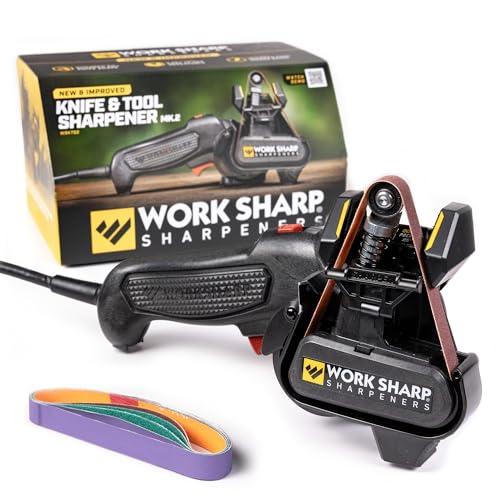
3. Knife & Tool Sharpener Mk.2 — a belt grinder for the house. Three belt grits, from P80 for genuine damage through a 6000 finishing belt, two motor speeds, and leather-lined guides that flick between 20° and 25°. It will rescue an edge no kitchen electric will touch, and it sharpens scissors, axes and garden tools too.

Honest cons:a moving belt removes metal fast — by a distance the most aggressive machine here. There is no 15° setting, so it has no answer for a Japanese kitchen edge. Belts are consumables, it is noisy, it throws grit, and it asks more of the user than an insert-and-press electric. The low speed exists specifically so kitchen knives are not fed to a tool-speed belt, and you should use it.

Where a Work Sharp sits against the alternatives

Against a whetstone, a guided jig trades skill for repeatability. A stone is cheaper, teaches a transferable skill, puts a better edge on a knife in trained hands, and takes a few evenings to learn — best sharpening stones for beginners is where to start if that appeals, and best whetstones under $50 is how little it costs.

Against a kitchen electriclike the Chef'sChoice machines, the Precision Adjust trades speed for control: a Chef'sChoice 1520 will sharpen a knife in a couple of minutes with no setup, and it decides the angle for you from two options. Best Chef'sChoice sharpeners ranks that side, and electric vs manual knife sharpener is the decision laid out properly.

Against a pull-through, anything here wins. A two-slot pull-through sets a fixed, usually coarse angle and tears metal away without any control at all — pull-through vs whetstone makes the case.

The verdict

Buy the Precision Adjustunless you have a specific reason not to. It is the only machine Work Sharp makes that can maintain a 15° Japanese edge, it repairs as well as refines, and it removes the least metal per sharpening of any guided system we rank.

Buy the Culinary E2if your knives are all Western 20° blades and you want the job done in ninety seconds with no setup and almost no risk. Buy the Mk.2only if kitchen knives are one of a dozen things you need sharp — and if they are, it is a genuinely excellent machine that happens to live in a garage.

If you are still deciding between a machine and a stone, best knife sharpeners under $100 is the cross-brand version of this page, and our Precision Adjust review is the long form on the winner.
The short answer

Quick picks

#ad · Live prices from the Amazon Product API, as of November 24, 2026. Where we have no verified live price we show none — we'd rather leave a gap than print a number that has rotted.

By the numbers

The specs, side by side

Every figure below is the manufacturer's published specification. Where a maker doesn't publish a value, the cell reads "—" rather than a number we made up.

Knife / ToolMechanismAngleAbrasivesStages
Work Sharp Precision Adjust Knife SharpenerManual guided rod, clamped blade15°–30° (click-set)Coarse + fine diamond, ceramic rod3 abrasives (coarse + fine diamond, ceramic rod)
Work Sharp Culinary E2 Electric Kitchen Knife SharpenerFlexible abrasive disc20° (fixed guide)Flexible abrasive discs + ceramic hone2 (sharpen + hone)
Work Sharp Knife & Tool Sharpener Mk.2Abrasive belt20° or 25° (switchable)P80 / P220 / 6000 grit belts3 belt grits

In detail

The picks, in full

01
Work Sharp Work Sharp Precision Adjust Knife Sharpener

Guided results without a stone

Work Sharp Precision Adjust Knife Sharpener

Guided rod15–30° setCoarse+fineManualClamp
8.4/10

The best answer for someone who wants repeatable, sharp results without learning to freehand on a stone.

Results
9
Ease of use
8
Angle consistency
9
Versatility
8
Value
8

Pros

  • The angle is locked in, so you get a consistent bevel without the freehand learning curve
  • Diamond plates plus a ceramic rod cover repair through finishing
  • Genuinely sharp, repeatable edges — the closest thing to foolproof here

Cons

  • Clamping and stroking each side is slower than a quick pull-through
  • The clamp can struggle with very tall or very short blades

Don't buy this if…

…you want to learn to sharpen freehand on a stone — the skill that works on any knife anywhere. A guided jig is a fine destination, but a King stone is the better teacher.

$69.95View on Amazon

Price as of November 24, 2026. Prices change — Amazon's is the one that counts.

#ad · we may earn a commission from this link to Work Sharp Precision Adjust Knife Sharpener

02
Work Sharp Work Sharp Culinary E2 Electric Kitchen Knife Sharpener

Removing the least metal

Work Sharp Culinary E2 Electric Kitchen Knife Sharpener

Electric20° guideFlexible discCeramic hone90s timer
7.4/10

The gentlest electric here. Flexible abrasive discs and a 90-second timer make it hard to over-grind a knife — which is the failure mode of the whole category.

Results
7
Ease of use
9
Angle consistency
8
Versatility
5
Value
8

Pros

  • Flexible discs put a convex edge on the blade and cut far less aggressively than a diamond wheel — the least destructive electric here
  • A timer stops the machine at 90 seconds, which removes the single biggest way people ruin a knife on a powered sharpener
  • Built-in ceramic honing slot handles the between-sharpenings touch-up, so one small box covers both jobs
  • The smallest and quietest machine on this list — it genuinely fits in a kitchen drawer

Cons

  • 20° guide only: it cannot put a 15° edge on a Japanese knife, and it will slowly widen one that already has it
  • Discs are a consumable — they are replaceable and reversible, but you will buy more
  • Work Sharp does not publish a serrated capability for it, so treat serrated blades as out of scope

Don't buy this if…

…you own Japanese knives ground near 15°. The fixed 20° guide will re-profile them wider every time you use it — buy the 1520 or learn a stone instead.

$59.95View on Amazon

Price as of November 24, 2026. Prices change — Amazon's is the one that counts.

#ad · we may earn a commission from this link to Work Sharp Culinary E2 Electric Kitchen Knife Sharpener

03
Work Sharp Work Sharp Knife & Tool Sharpener Mk.2

Sharpening more than kitchen knives

Work Sharp Knife & Tool Sharpener Mk.2

Electric belt20° / 25°3 belt grits2-speed3 lb
7.4/10

A belt grinder for the house, not a kitchen appliance. Superb if the chef's knife is one of a dozen things you need sharp; overkill and over-aggressive if it isn't.

Results
7
Ease of use
7
Angle consistency
7
Versatility
8
Value
8

Pros

  • Three belt grits, from P80 for real damage through a 6000 finishing belt — it can rescue an edge no kitchen electric will touch
  • Two motor speeds: the low speed exists specifically so kitchen knives are not fed to a tool-speed belt
  • Leather-lined angle guides flick between 20° and 25° without scratching the blade finish
  • Sharpens scissors, axes and garden tools too, which no other machine here pretends to do

Cons

  • A moving belt removes metal fast — the most aggressive machine on this list by a distance
  • 20° and 25° only, so it has no setting for a Japanese kitchen edge
  • Belts are consumables and the coarse ones go quickly if you use them for repair work
  • Noisy, throws grit, and asks more of the user than any 'insert knife, press button' electric

Don't buy this if…

…the only things you sharpen are kitchen knives. This is a workshop tool that happens to do kitchen knives — a 20° kitchen electric does that job with a fraction of the metal loss.

$89.95View on Amazon

Price as of November 24, 2026. Prices change — Amazon's is the one that counts.

#ad · we may earn a commission from this link to Work Sharp Knife & Tool Sharpener Mk.2

How we picked

We do not run a test kitchen

We compiled each product's published specifications — steel, hardness, edge geometry, weight — normalized them into the matrix above, and scored each one against a published rubric. The scores are judgments from those specs and the value math — they are not measurements we took, because we do not have a test kitchen and we're not going to pretend we do. Units we claim to have tested: 0.

Questions

Frequently asked

What is the best Work Sharp knife sharpener?

The Precision Adjust. It is the only Work Sharp that click-sets an angle across the whole 15°–30° range, which means it is the only one that can maintain a Japanese knife without widening its bevel. It also repairs a damaged edge, which the Culinary E2 cannot, and removes far less metal than the belt-driven Mk.2.

Is the Work Sharp Culinary E2 good for Japanese knives?

No. Its guide is a fixed 20°, and a Shun, MAC, Tojiro or Global is ground near 15°. Every pass on the E2 would widen that bevel a little more. For Japanese knives use the Precision Adjust, a Chef'sChoice machine with a 15° stage, or a whetstone.

Will a Work Sharp ruin my knives?

The Mk.2 can, if you use the high speed and a coarse belt on a kitchen knife — a moving abrasive belt removes metal very quickly. The Culinary E2 is the opposite: flexible discs and a 90-second timer make it one of the gentlest powered sharpeners made. The Precision Adjust removes only what you draw across the edge yourself.

Can a Work Sharp sharpen serrated knives?

Work Sharp publishes a serrated capability for the Mk.2 and does not for the Culinary E2, which is why our matrix carries it for one and leaves the other blank. For a serrated bread knife, the honest answer is usually a tapered rod worked scallop by scallop — see how to sharpen a serrated knife.

Work Sharp Precision Adjust or a whetstone?

The jig if you want consistent results this week; the stone if you want a skill. A guided system makes your tenth stroke identical to your first, which is the hard part of sharpening. A whetstone is cheaper, works on any knife including ones a clamp cannot hold, and puts a better edge on a blade once you can use it.

Keep reading

Receipts

Sources

We do not run a test kitchen, and we do not pretend to. Specs are the manufacturer's published figures, attributed as such; where we could not verify something, we say so on the page rather than quietly leaving it out. Read our full method.