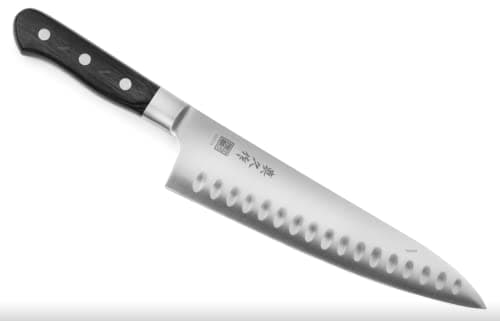
The verdict: the MAC MTH-80 is the Japanese knife to buy under $200. It is a 200 mm Seki-made gyuto in high-carbon molybdenum-vanadium steel at a published ~HRC 59–61, ground near 15° per side, with dimples cut into the blade face and a riveted Pakkawood handle — and it is the knife this site ranks first in the chef-knife category outright, not just inside this band. The budget pick is the Tojiro DP 210 mm gyuto: a VG-10 core at ~HRC 60 clad in soft stainless, for less than half what the MAC costs. Prices render live from the price layer with the "as of" date printed under the table.
Every knife on this page carried a verified live price under $200 at the last price-layer run, and every one of them is made in Japan. That second filter matters more than it sounds. A great many knives sold as "Japanese-style" are German steel with a thinner grind and a Japanese word on the box — a santoku stamped in Solingen is a fine knife and not what someone searching this phrase is asking for. The six below are made by Japanese makers in Japan: MAC and Tojiro in Seki, Shun and Miyabi also in Seki, under the Kai and Zwilling groups respectively.
What $200 actually buys in Japanese steel
Hardness, first. Under about $60 you are mostly buying softer stainless in the ~HRC 55–56 class — easy to sharpen, quick to dull. The band on this page starts where makers publish a Rockwell figure in the HRC 59–61 range, and that difference is the single most useful thing your money does here. A harder edge holds its apex through weeks of prep rather than days, which is why a cook who sharpens on a stone will pay for it and a cook who owns only a pull-through sharpener often should not. See knife hardness explained for what the number does and does not promise.
Then the grind. Hardness is permission to grind thin. A blade at HRC 60 can carry a ~15° or ~16° per side edge without rolling it on the first onion; soft steel at the same angle folds. Every pick here publishes an edge in that range, or a clad construction that gets it there, and the result is the sensation people mean when they say a Japanese knife "falls through" food — it is geometry, not magic. Why are Japanese knives so sharp takes that apart properly.
Then construction. At this price you get one of three builds: a monosteel blade ground thin (MAC), a hard core clad in softer stainless for toughness and corrosion resistance (Tojiro DP, Shun, Miyabi), or Damascus cladding over that core, which is the same engineering with a pattern on it. Cladding is genuinely useful — it puts tough, forgiving steel around a brittle core — but a Damascus face is cosmetic, and you should know which half of the price you are paying for. Damascus steel knives explained is the longer version of that argument.
Finally the handle. Japanese makers split between a Western riveted handle and a D-shaped handle that is slightly asymmetric and suits right-handers best. Four of the picks here are Western-handled, two are D-shaped. If you are left-handed, read that spec before you buy — best chef knives for left-handed cooks covers which blades are symmetric.
The criteria, in the order they mattered
- Published hardness and steel. A maker's stated Rockwell figure and alloy, never an estimate. Where a maker states nothing — the Shun nakiri's weight, for instance — the matrix shows a dash rather than a borrowed number.
- Edge angle or clad geometry. Roughly 10° to 16° per side is this band's working range. A knife that needed a 20° shoulder to survive would not belong here.
- Made in Japan. Not Japanese-styled. Every pick is made by a Japanese maker in Japan.
- A verified live offer under the ceiling. Each pick carried a live price below $200 at the last price-layer run, which is also how availability was checked — a live API price means a buyable offer, not just a listing.
- One blade shape per job. Four of the six are chef-class blades, because that is what most readers want. One santoku and one nakiri are included, because at this price the vegetable-specialist blades are where Japanese geometry shows off hardest.
The six picks
1. MAC MTH-80 Professional 200 mm — the one to buy. A thin, hard, dimpled blade in high-carbon molybdenum-vanadium at a published ~HRC 59–61, ground near 15° per side, on a riveted Pakkawood handle, made in Seki. It is the knife cooks keep quietly recommending to each other, and its reputation is earned on the two specs above: it is thinner behind the edge than any German knife at the price, and hard enough to stay that way. Our full MAC MTH-80 review goes deeper.
Honest cons: MAC states its hardness as a range rather than a measured figure, and publishes little about the heat treatment that produces it. The hollow-edge dimples are not as effective as people hope at stopping potato clinging to the blade. And the handle is plain to look at next to a Damascus Shun at the same money.
Don't buy if you sharpen with a pull-through or you cut through bone and squash rind carelessly. Thin, hard steel chips rather than rolls, and a chip is a repair job on a stone, not a two-minute fix.
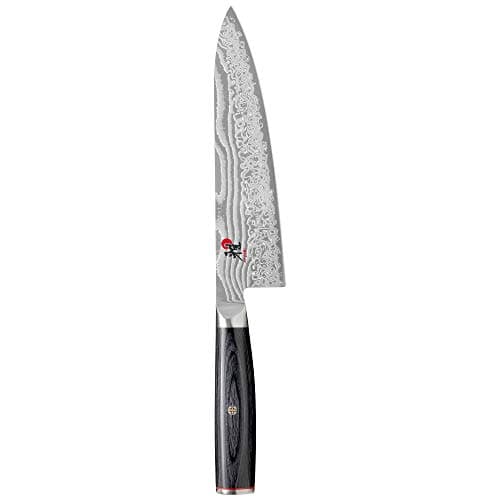
2. Miyabi Kaizen II 8" — the keenest published edge in the band. Forged FC61 fine-carbide stainless at a published ~HRC 60, with a hand-honed three-step Honbazuke edge in the ~9.5° to ~12° per side range and a symmetric Micarta handle that works in either hand, made in Seki. On published specs it has the thinnest factory geometry on this page by a wide margin, and it is the pick if you want the object as well as the edge. The full Miyabi Kaizen II review has the spec sheet.
Honest cons:the thinnest factory edge here is also the most fragile, and re-creating a sub-12° bevel at home takes a stone and patience you may not have. At a published ~7.9 oz it is the heaviest knife on this page, which is not what most people expect from a Japanese blade. And it sits at the very top of the band, so a price move puts it out of it.
Don't buy if this is your only knife and nobody else in the house will be careful with it. Buy the MAC, or buy a Victorinox and a stone and spend the difference on groceries.
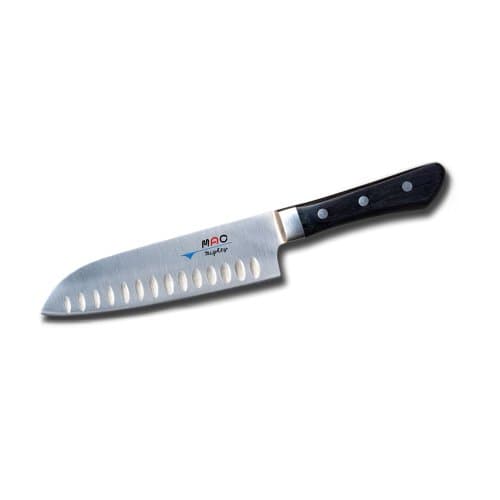
3. MAC Professional MSK-65 santoku — the best santoku in the band. The 165 mm santoku sibling of the MTH-80: the same high-carbon molybdenum-vanadium steel at ~HRC 59–61, the same near-15° grind, the same dimpled face, on a Pakkawood handle. A santoku is shorter and taller than a gyuto with a flatter profile, which suits cooks who push-cut vegetables rather than rock-chop. Best santoku knives is the full category, and chef knife vs santoku settles which shape fits your hands.
Honest cons:165 mm is genuinely short for a big cabbage or a watermelon, and the flat profile punishes a rocking stroke. It costs most of what the longer MTH-80 does. And the same chipping caveat applies to the same steel.
Don't buy ifyou only want one knife. A 200 mm gyuto covers more of the kitchen; a santoku is the second knife most people should own, not the first.
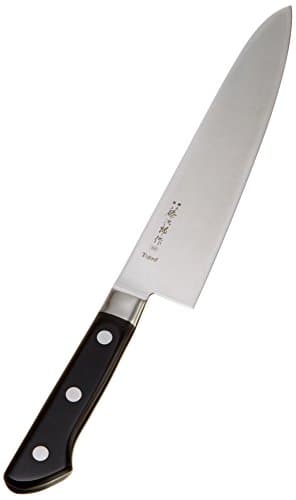
4. Tojiro DP Gyuto 210 mm — the budget pick, and the value champion of this band. A VG-10 core at a published ~HRC 60 clad in soft stainless, ground near 15° per side, bolsterless with a riveted composite handle, made in Japan. It costs less than half the MAC and gives up almost nothing that shows up on a board: the steel is as hard, the grind is as thin, and the extra 10 mm of blade is free reach. Our Tojiro DP gyuto review explains where the money was saved.
Honest cons:the money was saved on finish. The handle is functional rather than nice, the spine and choil are left square from the factory, and the fit is a tier below the MAC. At a published ~7.4 oz it is also almost an ounce heavier than the MAC, so it feels less lively in the hand.
Don't buy if the knife is a gift or will live on display. Nothing about a DP is handsome; it is the best cutting per dollar on this page and it looks exactly like that.
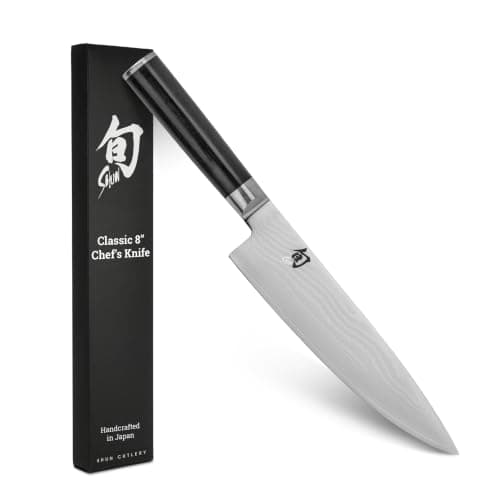
5. Shun Classic 8" — the Damascus one people actually want. A VG-MAX core at a published ~HRC 60–61 under 68-layer Damascus cladding, a 16° per side edge, and a D-shaped Pakkawood handle, handcrafted in Seki. It is the most recognizable Japanese knife sold in the United States, and the reason is that it is genuinely good as well as genuinely pretty. The full Shun Classic review covers the line.
Honest cons:you pay a visible premium for the cladding pattern, and the D-shaped handle again favors right-handers. The thin tip is the most commonly chipped part of any knife we write about. And Shun's stated 16° edge is keener than German, less keen than the Miyabi's Honbazuke bevel — past that point you are paying for looks, not geometry.
Don't buy if you want maximum cutting per dollar. The Tojiro matches it on published hardness for less than half the money, and the difference is finish rather than performance.
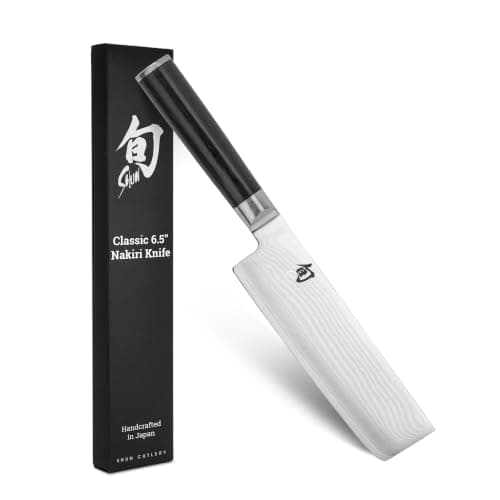
6. Shun Classic 6.5" Nakiri — the vegetable blade, if you have a gyuto already. The same VG-MAX core and Damascus cladding at ~HRC 60–61 with a 16° per side edge, in a straight-edged, tall, flat-profiled nakiri. On a board full of vegetables it is the most satisfying knife here: the flat edge meets the board along its whole length, so nothing is left hinged at the end of a cut. Best nakiri knives is the full list, and is a nakiri worth it is the honest answer to the obvious question.
Honest cons: it is a specialist. No tip worth the name, so no mincing a shallot in the air and no working around a joint. It is the most expensive knife on this page per job it can do, and the hardest to justify as a first purchase.
Don't buy ifyou do not already own a chef's knife. Buy the MAC or the Tojiro first; a nakiri is the knife you add when you have noticed how much of your cooking is vegetables.
What we left out, and why
The Shun Sora and the MAC HB-85 both clear the band comfortably and are both good knives — the Sora pairs a VG10 cutting edge brazed to a cheaper stainless upper, and the HB-85 is the lightest chef-class blade in our registry. They score below the six above on our rubric, so they are argued on best Japanese chef knives rather than ranked here.
The Global G-2 is the famous one-piece stainless Japanese chef's knife, and it showed no buyable offer at the last price-layer run, so it is not ranked. That is a snapshot of one retailer rather than a judgement on the knife; Global knives alternatives is the page for that situation.
German knives are absent on purpose. A Wüsthof Classic or a Zwilling Pro at this money is a different proposition — softer steel, a thicker grind, more forgiving of abuse, heavier in the hand. Japanese vs German knives is that comparison, and it is a genuine fork in the road rather than a ranking.
And if $200 is more than you want to spend, the sibling band is best Japanese chef knives under $100. The honest summary of the difference: under $100 you are choosing between hard steel and good finish, and in this band you can have both.
The running cost nobody mentions
A hard Japanese edge is cheap to keep and expensive to neglect. It will not respond well to a pull-through sharpener, it does not want a coarse steel rod dragged across it at 20°, and it will chip if it meets bone. What it wants is a whetstone every few months and a gentle touch — the best sharpening stones for Japanese knives is the kit, and how to sharpen a chef knife is the method. Budget for a 1000/6000 combination stone on top of whatever you spend here; it is the difference between a knife that stays this good and one that is a blunt showpiece by spring.
Two habits protect the edge more than anything else: a wooden or composite board rather than glass or stone, and storage where the blade touches nothing. Wood vs plastic cutting board settles the first and best knife storage the second. Neither is optional at this price.
Two neighboring decisions, if this band is not quite the question you came with: best santoku knives under $100 is what happens to this list when the ceiling halves — the Japanese-made santokus drop out entirely — and MAC knives alternatives is the page for readers who have decided our top pick is not for them.
The verdict
Buy the MAC MTH-80. It is the thinnest, hardest, most useful single knife in the band, and the one most likely to be the last chef's knife you buy.
Buy the Tojiro DPif you would rather keep the difference — it matches the MAC on published steel and grind and gives up only finish. Buy the Miyabi Kaizen II if you want the keenest published factory edge here and will maintain it. Buy the Shun Classic if the knife is a present or lives where people see it. And buy the MAC santoku or the Shun nakiri as second knives, once a gyuto has told you what shape your hands actually want.