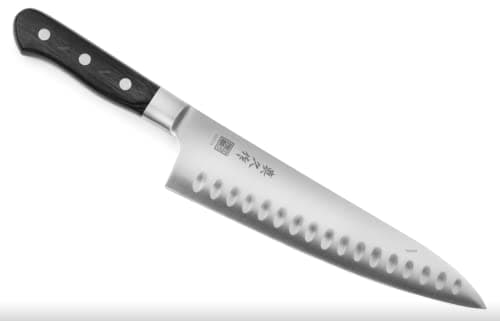
The verdict: the Mac MTH-80 Professional is the Mac to buy. It is for the cook who has decided their next chef's knife should cut better rather than look better — a thin molybdenum-vanadium blade at ~HRC 59–61, ground to about 15° per side, with dimples along the edge and nothing decorative anywhere on it. The budget pick is the Chef Series HB-85, the cheapest way into Mac's steel and geometry: the same hard, thin Japanese blade in a plainer, lighter package at under five ounces. Prices render live from the price layer with the "as of" date printed under the table.
A note on why this page exists. Mac is the brand cooks arrive at second — after they have owned a German knife and decided it is thicker than it needs to be. Our own Search Console data shows people reaching this site on MTH-80 queries specifically, which is a reasonable sign that the model name does more work than the brand name. So this page ranks the range rather than one knife.
What a Mac actually is
Mac has been making knives in Seki City, Japan since the 1960s, and the whole catalogue is built on one idea: make the blade thin, make the steel hard enough to survive being thin, and spend nothing on anything else.
The steel is a high-carbon molybdenum-vanadium stainless, hardened to around HRC 59–61on the Professional line. That is Japanese-hard — three to five points above a German knife — and it is what lets Mac grind the edge to about 15° per side and leave the blade stock at two to two and a half millimetres without the edge folding over the first time it meets a carrot.
Thinness is the thing you actually feel. A thick blade has to shove food apart as it travels; a thin one parts it. That is why a Mac feels quicker than a knife of the same sharpness in thicker stock, and it is also why a Mac is not the knife to pry with, hit a bone with, or put through a dishwasher. Hard, thin steel chips where soft, thick steel rolls.
The three lines, and which one you want
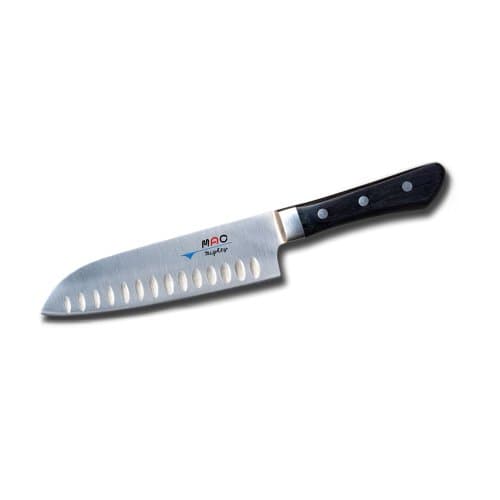
- Professional (MTH, MSK). The flagship. Hardest steel, thinnest grind, dimpled "hollow" edges to reduce stiction, Pakkawood handles with a bolster. This is the line worth paying for.
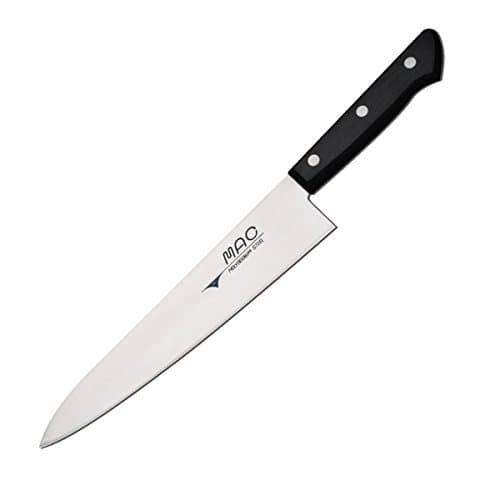
- Chef Series (HB). The entry line, and unusually honest about it: the same family of steel at a published ~HRC 60, two millimetres thick, no dimples, lighter, plainer. Gives up finish rather than cutting.
- Japanese Series (JU). Traditional Japanese shapes — the vegetable cleaver here is the one that matters. Note that Mac publishes almost nothing about it: no hardness, no bevel angle. Our matrix shows dashes rather than figures borrowed from the Professional line.
The criteria, in the order they mattered
- Published hardness and edge angle. Two of the four picks carry both; one carries hardness only; one carries neither, and loses points for it. A spec Mac will not state is a spec we will not invent.
- Blade thickness at the spine. The single number that separates Mac from everyone else at the price, and the reason the HB-85 is a genuine bargain rather than a decontented disappointment.
- Weight, because thin and light is the whole proposition. The HB-85 is under five ounces. A forged German 8" is closer to nine. If you have ever finished a long prep session with a sore wrist, that difference is the product.
- A verified live offer. All four picks carried a live price at the last price-layer run, which is also how availability was checked.
Mac versus the knives people compare it to
Against Shun, the trade is finish for food release: Shun gives you Damascus cladding and a Pakkawood D-handle at a similar hardness; Mac gives you dimples, a thinner grind and a plainer object. Mac vs Shun settles that one properly, and best Shun knives ranks the other side of it.
Against a German forged knife, the trade is toughness for speed. A Wüsthof or Zwilling at ~HRC 57–58 will survive treatment that would chip a Mac, and it will need honing far more often to stay sharp. Mac vs Wüsthof has the detail. Against Tojiro, the trade is hardness for money — a Tojiro DP is a VG10 core at ~HRC 60 for meaningfully less, in a thicker blade with a cruder finish.
Care: what thin steel asks of you
Hand wash, dry immediately, and keep a Mac away from bone, frozen food and ceramic boards. Store it where the edge touches nothing — best knife storage covers that, and can you put knives in the dishwasher explains why the answer is no twice over for this brand.
For sharpening, respect the 15°. A whetstone is the right answer — best sharpening stones for Japanese knives is the shortlist, and knife sharpening angle explains why a 20° pull-through slowly destroys the geometry you bought. Mac sells a well-regarded ceramic honing rod for the same reason Shun does: a hard edge responds better to ceramic than to a steel rod.
And if the brand itself is the sticking point — price, looks, or what your local store stocks — MAC knives alternatives matches five knives to the specs MAC is known for, starting with one that holds the same published hardness and grind for under half the money.
The verdict
Buy the MTH-80 if you want the knife a lot of cooks quietly consider the best all-rounder made, and you will look after it. Buy the MSK-65 Professional santoku instead if your cutting is mostly vegetables and you prefer a shorter blade with a flatter profile.
Buy the HB-85if the Professional price is more than you want to spend: it is the same idea for less money, and the lightest chef's knife on this site. Buy the JU-65 vegetable cleaveronly as a second knife, with eyes open about the missing spec sheet — best nakiri knives is where it is ranked against documented rivals.