Skip to content
Bevel & Bone

HUB 02 · Sharpening

Best Chef'sChoice Sharpeners

Chef'sChoice built the electric sharpener that is actually good, then built two more. The difference between them is the angle they grind and how much steel they take - here is which is which.

By Stephen V.Updated How we choose
#ad

We earn a commission when you buy through our Amazon links, at no extra cost to you. It never changes a ranking, and we say so when the cheaper knife is the better buy. How this works.

The verdict: the Chef'sChoice 1520 AngleSelect is the Chef'sChoice to buy. It is for the household with a mixed drawer — some German knives at 20°, some Japanese ones near 15° — because it is the only machine here with separate stages for both, so you are not forced to re-grind every knife you own to one angle. One hundred percent diamond abrasives, three stages, and a published serrated capability. The budget pick is the 312 Diamond UltraHone, the cheapest of the three and the only one with no coarse grinding stage at all — it maintains a 20° edge rather than eating one. The Trizor XVsits between them: a fixed 15° machine that converts a 20° German knife to a keener edge, fast. Prices render live from the price layer with the "as of" date printed under the table.

One warning that applies to all three, and to every electric sharpener ever made. A motorised wheel removes more metal than any manual method. That is the trade you are making: speed and repeatability in exchange for the length of your knives' lives. Are electric knife sharpeners bad is our honest answer to the question, and the short version is that they are bad for expensive knives and perfectly sensible for a busy household of tough Western ones.

The one spec that decides this: 15 degrees or 20

A powered sharpener imposes its own geometry. Whatever angle its guides hold, that is the angle your knife ends up with — which means choosing the machine is really choosing the edge your whole drawer will carry from now on.

  • 1520 AngleSelect: 15° or 20°, selectable. Separate stages for each. The right answer for a mixed drawer, and the only one of the three that does not force a decision on you.
  • Trizor XV: a fixed 15° per side. It will convert a 20° German edge to 15° the first few times you use it, which makes the knife cut noticeably better and leaves slightly less steel behind the edge. That conversion is a one-way trip.
  • 312 UltraHone: 20° class, fixed. No angle to choose and nothing to get wrong, as long as everything you own is a Western 20° blade.

So the honest first question is not "which machine is best" but "what is in my drawer." All German and Western? The 312 or the Trizor. Mixed? The 1520. All Japanese? Think hard about a whetstone instead — knife sharpening angle explains why, and best sharpening stones for Japanese knives is the alternative.

The criteria, in the order they mattered

  • Published angle, and whether you can choose it. The figure that decides everything else.
  • How much metal the machine removes. A coarse grinding stage rescues a ruined edge and shortens the knife's life. A machine with no coarse stage does the opposite. Both are correct answers to different questions.
  • Number of stages, and what the last one does. A stropping or polishing stage is what separates a machine edge that feels refined from one that feels toothy.
  • Published serrated capability. Chef'sChoice states it for all three, which most of the category does not — it is a genuine point in the brand's favour and it is in the matrix.
  • A verified live offer. All three picks carried a live price at the last price-layer run, which is also how availability was checked.

The three machines

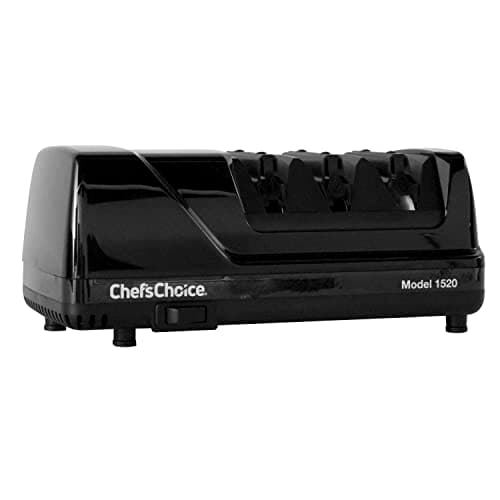
1. 1520 AngleSelect — the one to buy if your knives disagree with each other. Motorised diamond discs, three stages, 100% diamond abrasives plus stropping disks, and separate 15° and 20° sharpening stages. Chef'sChoice publishes a three-year limited warranty on it. If you own a Wüsthof and a Shun and want one machine for both, this is the only honest pick in the range.

Honest cons:it is the most expensive machine here, and it is still a metal-removing motor. Selectable angles only help if you know which of your knives is which — get it wrong and you re-profile a knife by accident. At around four pounds it is a counter appliance, not a drawer tool.

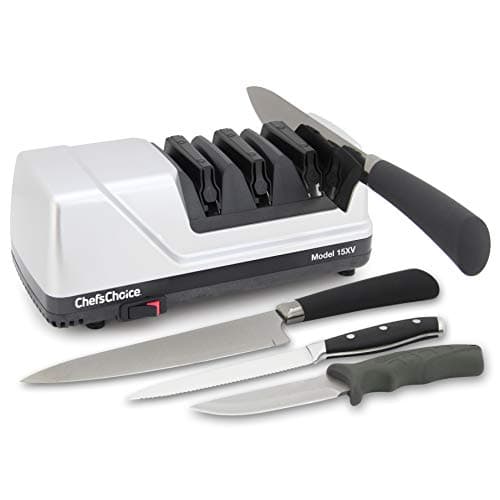
2. Trizor XV — the fast one, and the one that converts an edge. A fixed 15° per side with diamond stages and a stropping stage. Dull to sharp in a couple of minutes with no skill required, and on a soft German knife the 20°-to-15° conversion genuinely improves how it cuts. This is the machine that earned the brand its reputation.

Honest cons: the conversion is permanent, and it takes real metal to do it. It is wrong for hard, thin Japanese knives and for single-bevel blades, where fixed Western geometry can ruin the edge. Bulky and noisy.

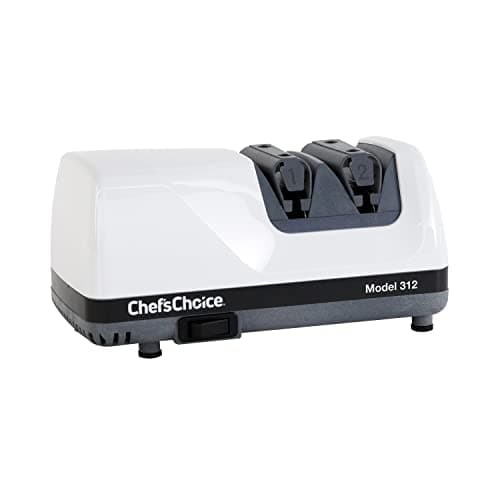
3. 312 Diamond UltraHone — the budget pick, and the gentlest. Two stages, both fine: stage one sets the bevel, stage two ultra-hones it. There is no coarse wheel, which means there is no way to over-grind with it. Conical diamond disks apply the pressure for you rather than letting you lean on the blade, and it handles straight-edge and serrated 20° knives plus small sporting knives.

Honest cons:with no coarse stage it is slow to rescue a badly dull or chipped edge — that is the deliberate trade. 20° class only, so it has no answer for a Japanese knife. And it is priced above the cheapest machines in the wider category for one fewer stage than the top picks here.

What to use instead, and when

If you own fewer than five knives and two of them are good, a whetstone is the better purchase at a fraction of the price: it removes a fraction of the metal, puts a better edge on the blade, and works on anything. Best sharpening stones for beginners is where to start and whetstone vs electric sharpener is the decision in full.

If you want repeatability without a motor, a guided jig is the middle road — best Work Sharp sharpeners ranks that brand, and its Precision Adjust covers 15° to 30° while removing only what you draw across the edge yourself.

And if your knives are merely dull rather than blunt, you may not need any of this. A honing rod straightens a rolled edge in thirty seconds and removes no metal at all — sharpening vs honing is the difference, and most people reaching for a sharpener should have reached for a rod.

Care: what these machines ask of you

Follow the stage order the maker prints on the machine, use light pressure and let the motor set the pace — leaning on the blade is how people turn a sharpening into a re-grind. Pull the knife through at a steady walking speed rather than scrubbing it back and forth, and finish on the stropping or honing stage every time.

Between sharpenings, hone. An electric sharpener used twice a year and a rod used weekly will keep a Western kitchen knife in better shape than an electric used monthly — best honing steels ranks the rods, and how often should you sharpen a knife is the schedule.

The verdict

Buy the 1520 AngleSelect if your drawer holds both Japanese and Western knives. It is the only machine in the range that respects both, and the angle choice is worth the premium precisely because the alternative is re-grinding knives you paid for.

Buy the Trizor XVif everything you own is a soft Western blade and you want it converted to a keener 15° edge, quickly. Buy the 312 UltraHone if your knives are Western, already in reasonable shape, and you want the machine that takes the least steel. And if you own three knives and a whetstone would do, buy the whetstone.

Two related pages: best electric knife sharpeners is the cross-brand version of this list, and our 1520 AngleSelect review is the long form on the winner.
The short answer

Quick picks

#ad · Live prices from the Amazon Product API, as of November 24, 2026. Where we have no verified live price we show none — we'd rather leave a gap than print a number that has rotted.

By the numbers

The specs, side by side

Every figure below is the manufacturer's published specification. Where a maker doesn't publish a value, the cell reads "—" rather than a number we made up.

Knife / ToolMechanismAngleAbrasivesStagesSerrated
Chef'sChoice 1520 AngleSelect Electric Knife SharpenerMotorized diamond disc15° or 20° (selectable)100% diamond + stropping disks3Yes
Chef'sChoice 15 Trizor XV Electric SharpenerMotorized diamond disc15° per side (fixed)Diamond stages + stropping stage3Yes
Chef'sChoice 312 Diamond UltraHone Knife SharpenerMotorized diamond disc20° class (fixed)100% diamond — fine, then micron2Yes

In detail

The picks, in full

01
Chef'sChoice Chef'sChoice 1520 AngleSelect Electric Knife Sharpener

A drawer of mixed 15° and 20° knives

Chef'sChoice 1520 AngleSelect Electric Knife Sharpener

Electric15° or 20°100% diamond3-stageSerrated OK
7.8/10

The one electric that lets a 20° knife stay 20° and takes a Japanese-style blade to 15°. That choice is the whole reason it leads.

Results
8
Ease of use
9
Angle consistency
8
Versatility
8
Value
6

Pros

  • Separate 15° and 20° sharpening stages, so you are not forced to re-grind every knife in the house to one angle
  • 100% diamond abrasives plus a dedicated stropping/polishing stage — a genuinely refined finish for a machine
  • Chef'sChoice publishes a serrated-knife capability, which most electrics here do not
  • Three-year limited warranty from the maker

Cons

  • The most expensive machine on this list, and it is still a metal-removing motor
  • Selectable angles only help if you actually know which of your knives is which — get it wrong and you re-profile a knife by accident
  • Bulky on a counter and heavy enough (about 4 lb) that it is not a drawer tool

Don't buy this if…

…your knives are all soft German 20° blades. You are paying a premium for an angle choice you will never use — the cheaper two-stage machines below do that one job for half the money.

$187.99View on Amazon

Price as of November 24, 2026. Prices change — Amazon's is the one that counts.

#ad · we may earn a commission from this link to Chef'sChoice 1520 AngleSelect Electric Knife Sharpener

02
Chef'sChoice Chef'sChoice 15 Trizor XV Electric Sharpener

Fast, hands-off sharpening

Chef'sChoice 15 Trizor XV Electric Sharpener

Electric15° edgeDiamondPowered3-stage
7.4/10

The electric sharpener that's actually good. It converts a 20° German edge to a keener 15° and does it fast.

Results
8
Ease of use
10
Angle consistency
8
Versatility
5
Value
6

Pros

  • Genuinely fast and repeatable — dull to sharp in a couple of minutes with no skill needed
  • Re-profiles softer German knives to a keener 15° edge that then cuts better
  • The three-stage system includes a stropping/polishing stage for a refined finish

Cons

  • Motorized diamond wheels remove more metal than any manual method — it shortens a knife's life
  • Not for hard, thin Japanese knives or single-bevel blades; the fixed geometry can ruin them
  • Bulky, noisy, and the priciest option here

Don't buy this if…

…you own nice Japanese knives or you sharpen infrequently. Electric wheels eat metal; on a $150 gyuto that's expensive damage. This is for a busy household of tough Western knives.

$128.99View on Amazon

$165.9922% off

Price as of November 24, 2026. Prices change — Amazon's is the one that counts.

#ad · we may earn a commission from this link to Chef'sChoice 15 Trizor XV Electric Sharpener

03
Chef'sChoice Chef'sChoice 312 Diamond UltraHone Knife Sharpener

Maintaining a 20° edge, not re-grinding it

Chef'sChoice 312 Diamond UltraHone Knife Sharpener

Electric20° class100% diamond2-stageSerrated OK
6.6/10

A two-stage machine with no coarse grinding stage at all — so it maintains a 20° edge instead of eating one. The right electric for a knife that is dull, not damaged.

Results
6
Ease of use
9
Angle consistency
8
Versatility
5
Value
5

Pros

  • Both stages are fine abrasives — stage one sets the first bevel, stage two ultra-hones the second — so there is no coarse wheel to over-grind with
  • Conical diamond disks are designed to apply the sharpening pressure for you rather than letting you lean on the blade
  • Handles straight-edge and serrated 20° knives, and small sporting and pocket knives too
  • Compact and simple: two slots, no angle to choose, nothing to get wrong

Cons

  • With no coarse stage it is slow to rescue a badly dull or chipped edge — that is the trade, and it is deliberate
  • 20° class only; it has no answer for a Japanese knife
  • Priced well above the cheapest machines here for one fewer stage than the top picks

Don't buy this if…

…your knives are already blunt or chipped. This machine refines an edge; it does not rebuild one. Repair the edge on a coarse stone first, or buy a machine with a grinding stage.

$75.96View on Amazon

$99.9924% off

Price as of November 24, 2026. Prices change — Amazon's is the one that counts.

#ad · we may earn a commission from this link to Chef'sChoice 312 Diamond UltraHone Knife Sharpener

How we picked

We do not run a test kitchen

We compiled each product's published specifications — steel, hardness, edge geometry, weight — normalized them into the matrix above, and scored each one against a published rubric. The scores are judgments from those specs and the value math — they are not measurements we took, because we do not have a test kitchen and we're not going to pretend we do. Units we claim to have tested: 0.

Questions

Frequently asked

What is the best Chef'sChoice knife sharpener?

The 1520 AngleSelect. It is the only machine in the range with separate 15° and 20° sharpening stages, so it can maintain both Japanese and Western knives without re-profiling either. It uses 100% diamond abrasives, has three stages including a stropping stage, and Chef'sChoice publishes a serrated capability for it.

Chef'sChoice Trizor XV or 1520?

The Trizor XV if every knife you own is a Western 20° blade and you want them all converted to a keener 15° edge. The 1520 if your drawer is mixed, because it keeps 20° knives at 20° and sharpens Japanese blades at 15°. The Trizor's conversion is permanent, which is the thing to decide before you buy rather than after.

Does a Chef'sChoice sharpener ruin knives?

It shortens their lives. Motorised diamond wheels remove more metal than a stone or a rod, so a knife sharpened on an electric every month will be visibly narrower in a few years. That is an acceptable trade on a $40 German knife in a busy kitchen and an expensive one on a $200 gyuto. The 312 UltraHone is the gentlest of the three because it has no coarse stage at all.

Can a Chef'sChoice sharpen serrated knives?

Chef'sChoice publishes a serrated capability for all three machines here, which is more than most of the category does. Expect it to maintain a serrated edge rather than rebuild one; for a badly dull bread knife, a tapered rod worked scallop by scallop is still the honest method — see how to sharpen a serrated knife.

Is an electric sharpener worth it at all?

It depends on how many knives you own and how much you care about them. For a household with a drawer of ordinary Western knives that nobody is going to maintain, a two-minute electric used twice a year is far better than the alternative, which is cutting with blunt knives. For two or three good knives, a whetstone costs less, removes less metal and produces a better edge.

Keep reading

Receipts

Sources

We do not run a test kitchen, and we do not pretend to. Specs are the manufacturer's published figures, attributed as such; where we could not verify something, we say so on the page rather than quietly leaving it out. Read our full method.